Best Gravel Vacuums & Siphons for Easy Aquarium Water Changes
A gravel vacuum can make aquarium maintenance noticeably easier—or turn a small water change into a race against an overflowing bucket. The difference is often less about suction power and more about matching the tool to your tank, substrate, and drain setup.
Our short recommendation: Choose the Fluval GravelVAC if you want adjustable flow and easy priming with a bucket. For a tiny aquarium, the Aqueon Mini is more manageable. If carrying buckets is your biggest frustration, the Python No Spill Clean and Fill is worth considering—as long as your faucet and water-preparation routine are compatible.
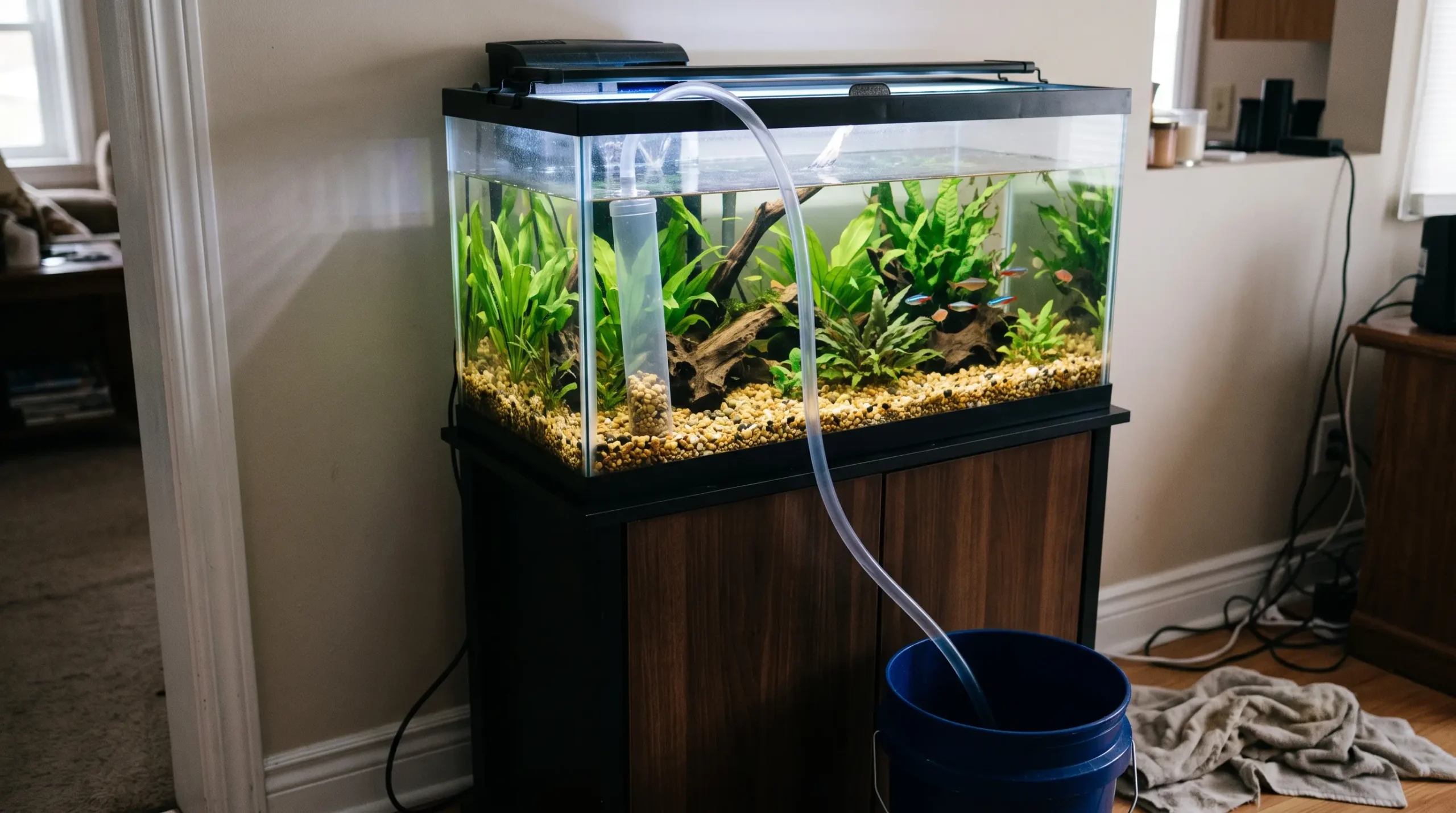
This research-based buying guide compares five aquarium gravel vacuums and siphons available in 2026. We evaluated manufacturer specifications, tank fit, priming, flow control, drainage, maintenance, safety considerations, and practical value. We have not physically tested these products, and prices or availability may vary by retailer.
Best Aquarium Gravel Vacuums: Quick Comparison
| Product | Best For | Water Removal | Main Trade-Off |
|---|---|---|---|
| Aqueon Siphon Vacuum Mini 5″ | Nano aquariums | Gravity siphon to bucket | Small tube makes large jobs slower |
| Tetra Water Cleaner | Basic, economical maintenance | Manual siphon to bucket | Fewer dedicated flow-control features |
| Fluval GravelVAC S/M | Easy starting and adjustable suction | Bulb-primed siphon to bucket | More parts than a basic siphon |
| Python No Spill Clean and Fill 25 ft | Bucket-free water changes | Faucet-connected drain and refill | Needs suitable faucet and water preparation |
| hygger HG955 Electric Cleaner | Powered water transfer and deeper tanks | Electric pump and outlet hose | Power, assembly, and stronger flow |
These are recommendations for different setups, not a claim that one model outperforms every other in laboratory testing. A simple siphon may be a better purchase than an expensive powered system if you maintain one small aquarium.
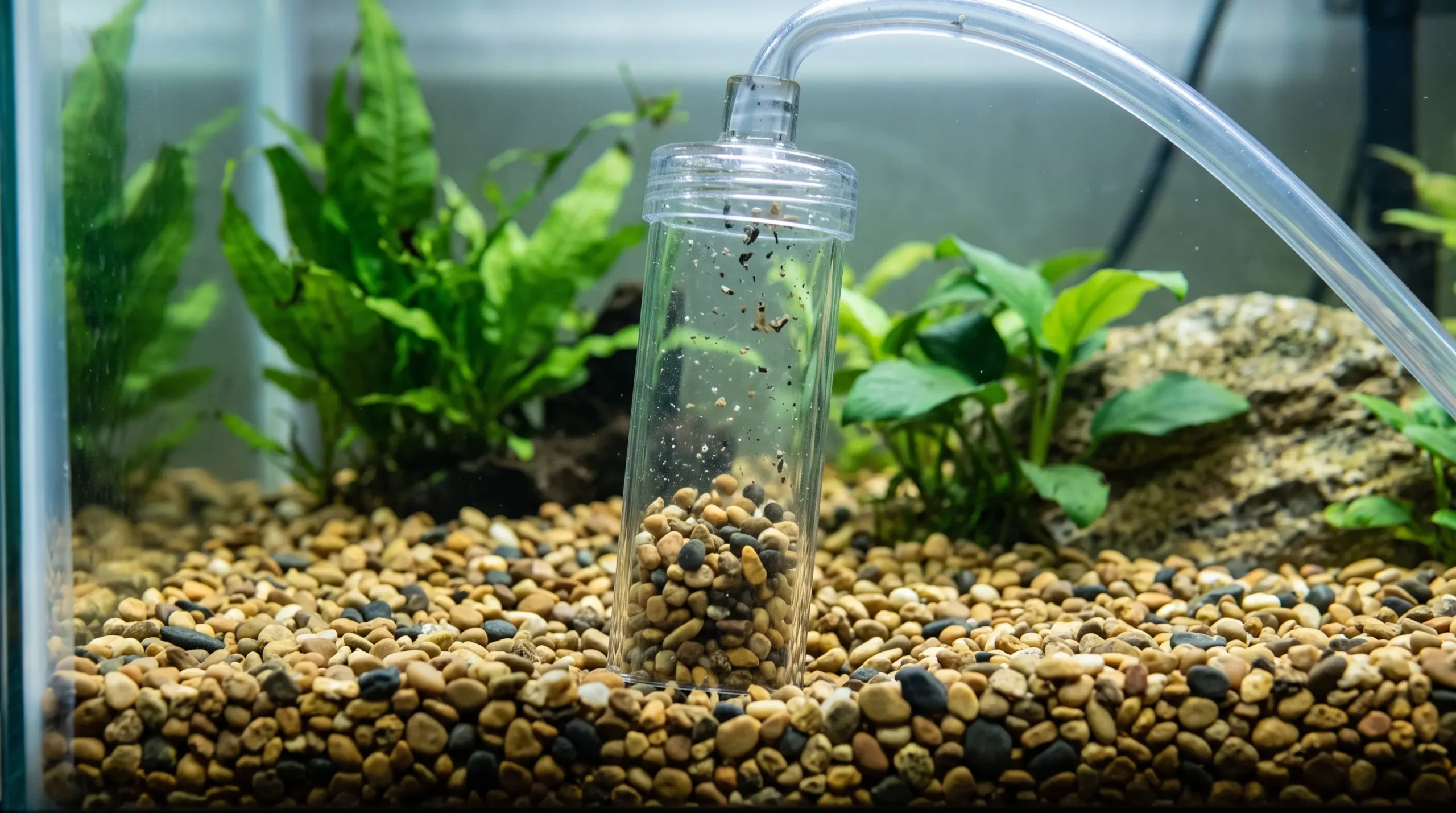
Our 5 Gravel Vacuum Picks for 2026
1. Aqueon Siphon Vacuum Mini 5″ — Best for Nano Tanks
Best for: Small desktop aquariums, especially approximately 1–5 gallons.
Skip it if: You maintain a large or deep aquarium and want to remove water quickly.
The Aqueon Mini uses a short, five-inch intake tube and a six-foot flexible hose. Aqueon’s up-and-down priming method starts the siphon without needing a separate electric pump.
Its biggest advantage is physical size. In a small aquarium, a large vacuum tube can occupy too much working space and remove water faster than you can clean carefully. The Mini provides a more manageable tool for limited areas.
Pros
- Compact intake tube suits tight spaces.
- No electricity or faucet connection required.
- Six-foot hose and bucket clip included.
- Simple construction with relatively few parts.
Cons
- Slow for large gravel beds.
- Short intake requires closer hand positioning in deeper tanks.
- Still requires a collection bucket below the aquarium.
- No dedicated adjustable-flow valve is listed for the Mini configuration.
Safety and value: The smaller intake can make careful positioning easier, but it is not automatically safe for tiny shrimp or fry. Watch the opening, protect vulnerable livestock, and control suction manually. For a small tank, paying for a larger powered cleaner may offer little practical benefit.
Alternative: The Fluval EasyVac Mini is worth comparing if access around plants and decorations matters more than choosing the simplest low-cost option.
Check the official Aqueon specifications.
2. Tetra Water Cleaner — Best Basic-Value Siphon
Best for: Aquarium owners who want a straightforward siphon for routine gravel cleaning without buying a more complicated system.
Skip it if: An integrated flow regulator, electric pumping, or direct-to-sink drainage is essential.
Tetra markets its Water Cleaner for aquariums from 2 to 55 gallons and highlights a shorter intake that can work in aquariums of 10 gallons or less. Its bucket clip helps secure the outlet during maintenance.
That broad compatibility claim does not mean it is equally convenient in every tank. Tank depth, substrate layout, and the amount of water you intend to remove still determine whether the tube is comfortable to use.
Pros
- Simple manual siphon design.
- Short intake is useful in smaller aquariums.
- Bucket clip helps manage the outlet hose.
- A practical entry-level option without powered components.
Cons
- Does not eliminate bucket handling.
- Less specialized flow adjustment than the Fluval GravelVAC.
- May not offer the reach or convenience preferred for deep tanks.
Safety and value: This is a sensible purchase when you mainly need a tube that removes debris and water without extra accessories. Compare the actual retail price with similarly sized Aqueon or Fluval models; an inexpensive basic siphon loses its value advantage if a better-controlled model costs only slightly more.
Alternative: Choose the Aqueon Mini for a particularly compact tank or the Fluval GravelVAC if easy priming and adjustable flow are higher priorities.
Check the official Tetra Water Cleaner details.
3. Fluval GravelVAC Multi-Substrate Cleaner S/M — Best for Flow Control
Best for: Aquarists who want easy priming and more precise flow control, especially around planted layouts or mixed substrates.
Skip it if: You only want the cheapest possible siphon or cannot easily place a bucket below the aquarium.
The Fluval GravelVAC stands apart from simpler siphons because it includes an Easy Start priming bulb and a thumb-operated flow regulator. The S/M model is offered for setups requiring reach up to approximately 20 inches, while the M/L version offers a longer configuration for deeper tanks.
The flow regulator is especially useful when moving from open gravel into a tighter area near plants or decorations. Instead of depending entirely on pinching flexible tubing, you can adjust suction using the built-in control.
The included gravel guard and extension tube provide further flexibility. Fluval lists the product for sand, gravel, and rock, but effective cleaning still depends on choosing suitable suction and technique for the substrate.
Pros
- Priming bulb simplifies starting.
- Thumb-operated flow control offers more adjustment.
- Gravel guard helps reduce clogging.
- Extension tube improves reach.
- Available in different sizes.
Cons
- More components to assemble and rinse.
- Requires a bucket or appropriate drainage container.
- Still needs careful operation around delicate livestock.
Safety and value: This is one of the more convincing upgrades over a basic siphon because the added features address real frustrations: starting the flow and slowing it when necessary. However, it does not make deep vacuuming automatically safe for planted aquasoil or sensitive animals.
Alternative: The Tetra Water Cleaner or a standard Aqueon siphon may be sufficient if you rarely need adjustable suction.
Check the official Fluval GravelVAC specifications.
4. Python No Spill Clean and Fill 25 ft — Best Bucket-Free Water Changer
Best for: Medium-to-large freshwater aquariums located within practical reach of a compatible sink faucet.
Skip it if: Your faucet cannot accept the required connection, your sink is too far away, or your replacement-water routine requires separate preparation.
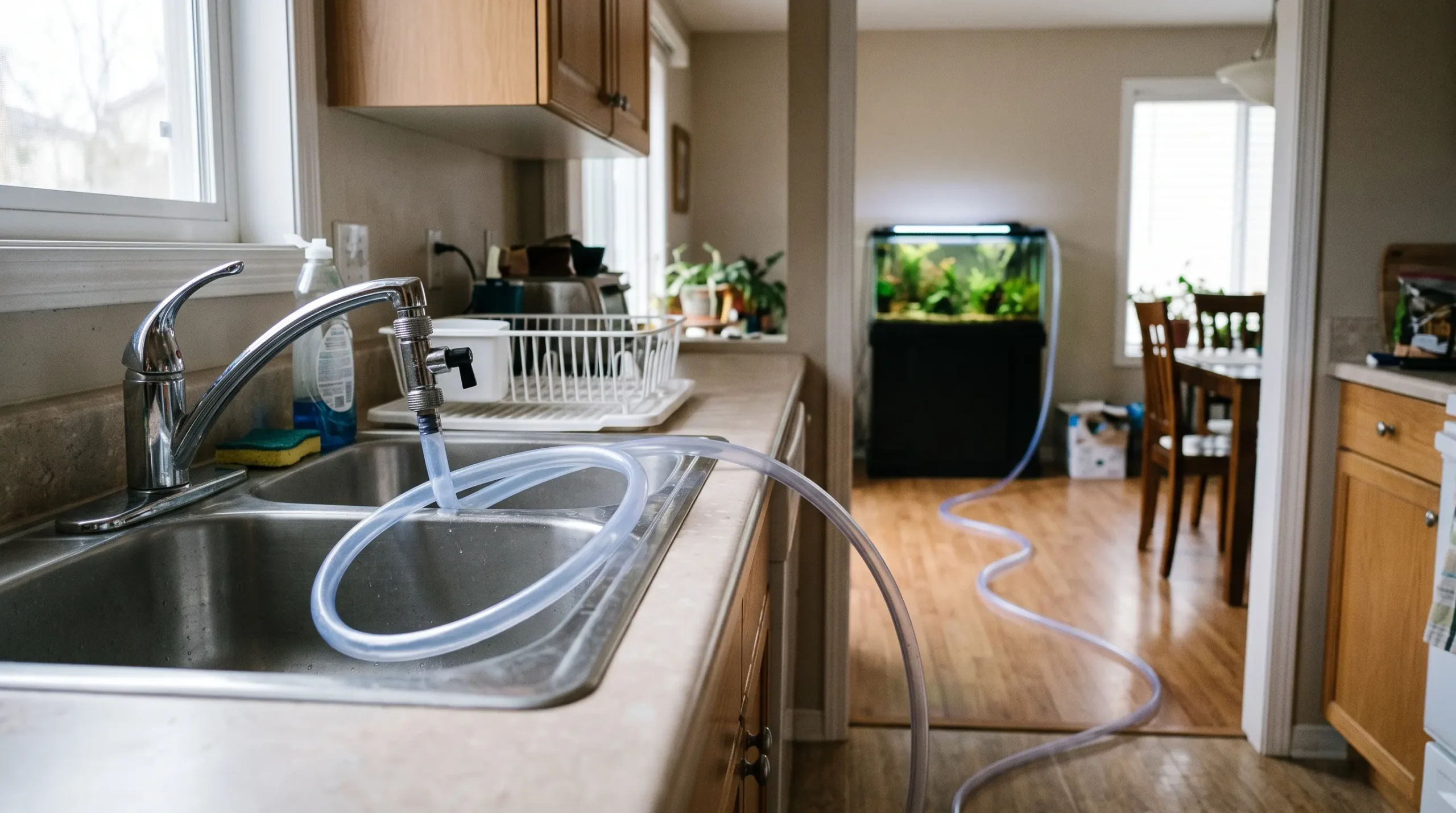
Python’s No Spill Clean and Fill is more than a basic gravel siphon. The system connects to a faucet to assist with draining aquarium water, while its hose and intake tube allow gravel cleaning. The same system can then be configured to refill the aquarium.
The practical benefit is reduced bucket lifting. If you maintain a large aquarium, repeated trips between the tank and the sink can make the water change more demanding than vacuuming the substrate itself.
However, the faucet connection is a genuine purchase requirement, not a minor detail. Python’s documentation identifies different faucet-thread arrangements and notes that additional adapters may be needed for some taps.
Pros
- Drain and refill functions in one system.
- Can eliminate routine bucket carrying.
- Long hose is useful when the aquarium is away from the sink.
- Replacement connections and fittings are available from the manufacturer.
Cons
- Faucet compatibility must be verified.
- Longer hoses require more storage and careful routing.
- Faucet-assisted drainage can consume additional tap water.
- Higher purchase cost than a basic bucket siphon.
- Direct refilling requires a carefully planned water-conditioning routine.
Safety and value: Do not treat faucet-connected refilling as permission to introduce untreated tap water. Chlorine, chloramine, temperature differences, and species-specific requirements still matter. Know how to condition replacement water appropriately before choosing a direct-refill system.
For aquarists with compatible plumbing and larger water changes, reduced lifting may justify the extra expense. For one small aquarium, the long hose and faucet connection may be unnecessary complexity.
Alternative: The Aqueon Aquarium Water Changer offers a similar faucet-connected drain-and-refill approach in 25-foot and 50-foot configurations.
View the Python manufacturer’s website or review its faucet compatibility and setup FAQ.
5. hygger HG955 Electric Aquarium Gravel Cleaner — Best Powered Option
Best for: Aquarium owners who need powered water movement, adjustable reach, or equipment capable of multiple cleaning tasks.
Skip it if: You keep a small aquarium, prefer minimal equipment, or do not want to manage electrical connections near water.
The hygger HG955 is a multifunction electric cleaner. The 15W AC configuration has a manufacturer-rated maximum flow of approximately 360 gallons per hour, while the product family also includes a different 20W configuration. These are published equipment specifications, not independently measured water-change speeds.
The HG955 uses extension sections for different tank depths and can perform gravel cleaning, water removal, and other cleaning functions with suitable attachments.
The important distinction is that the pump moves water rather than relying solely on gravity. This may help in setups where a conventional siphon arrangement is inconvenient.
Pros
- Powered water movement reduces reliance on gravity.
- Adjustable-length cleaning assembly.
- Multiple cleaning and water-transfer functions.
- Useful for deeper setups where a short manual tube is awkward.
Cons
- More assembly and maintenance than a manual siphon.
- Strong flow may be excessive for small or delicate setups.
- Requires a suitable power source and careful cable management.
- Accessories and filter components need cleaning.
- Powered suction does not automatically protect fry, shrimp, or loose substrate.
Safety and value: Follow the manual for which components must be submerged and which electrical connections must remain dry. Secure the outlet hose and never leave the system operating unattended. A powered cleaner is worth considering only if its additional functions solve a specific maintenance problem.
Alternative: The Fluval GravelVAC provides controllable siphoning without an electric motor. If bucket-free refilling is the main goal, compare a faucet-connected system instead.
Check the official hygger HG955 product information.

How to Choose the Right Gravel Vacuum
Instead of buying the model with the longest feature list, compare these practical factors.
1. Tank size and working space
A small tank benefits from a narrow intake tube that leaves enough room to work around plants and decorations. Larger or deeper tanks may require a longer tube or hose so you can clean comfortably without stretching or disturbing the aquarium.
2. Flow control and delicate livestock
Strong suction is not automatically better. A model with adjustable flow can be useful when you need to clean near plants or loose substrate.
If your aquarium contains shrimp, fry, or other small animals, inspect the intake design and use suitable protection where necessary. Never assume a standard gravel guard is fine enough to exclude tiny livestock.
3. Where the dirty water goes
This is often the deciding factor:
- Bucket siphon: Simple, inexpensive, and practical for smaller water changes.
- Faucet-connected system: Reduces bucket carrying but needs compatible plumbing.
- Electric pump: Moves water using a motor but needs an appropriate outlet route and safe electrical setup.
If the hose cannot reach a suitable collection point—or you cannot safely manage the bucket—the advertised features become less important.
4. Maintenance and replacement parts
Basic siphons usually have fewer components to clean. Powered cleaners have additional parts, while faucet systems depend on adapters, valves, and hose connections.
Check whether replacement parts are available before buying a complex system. An inexpensive cleaner can become poor value if a small broken connector makes the entire unit unusable.
5. Realistic value for money
For one small aquarium, a basic manual siphon is often the most economical choice. Adjustable-flow models justify additional expense when you need their control features. Faucet-connected or powered systems make more sense when they reduce a specific recurring inconvenience.
Because retailer prices and stock change, compare current offers for the exact model and size rather than relying on a fixed price quoted in a buying guide.
Gravel, Sand, and Planted Tanks: Does the Cleaner Matter?
Yes. Tube width and water flow can change how easily you remove debris without disturbing the substrate.
For ordinary gravel: Most appropriately sized siphons can separate lighter debris from heavier gravel.
For fine sand: Gentle, adjustable suction makes it easier to remove surface debris without sending excessive sand into the tube.
For planted or aquasoil layouts: More control and a smaller working area may be valuable. Avoid assuming the substrate can tolerate the same deep-cleaning approach as inert gravel.
For the actual technique, how deep to clean, and how to avoid disturbing your aquarium’s biological balance, read our guide to vacuuming aquarium gravel safely. This buying guide focuses on selecting equipment rather than repeating those instructions.
Three Buying Mistakes Worth Avoiding
- Choosing by tank capacity alone: A cleaner advertised for a broad aquarium-size range may still have the wrong tube length, flow, or working footprint for your setup.
- Buying a faucet system before checking compatibility: Thread type, faucet access, sink distance, and water preparation are essential purchase considerations.
- Confusing debris cleaning with water replacement: Some powered products can recirculate filtered aquarium water. That function does not replace an actual partial water change when one is needed.
To plan the water-change frequency itself, rather than the equipment purchase, see our aquarium water-change frequency guide.
Frequently Asked Buying Questions
Is an electric aquarium gravel vacuum better than a siphon?
Not automatically. Electric models can help move water where gravity siphons are inconvenient, but they add cost, equipment maintenance, and electrical precautions. Manual siphons remain practical for many home aquariums.
Is a small gravel vacuum better for a 10-gallon tank?
Often, yes, if space and water-removal speed are concerns. However, tube dimensions, bucket placement, and substrate layout matter more than an advertised tank-size label alone.
Can a gravel vacuum work in a saltwater aquarium?
Some models, including the Fluval GravelVAC, are marketed for freshwater and saltwater use. Check the specific product’s compatibility and clean equipment appropriately. Avoid cross-contaminating tanks with shared maintenance tools.
Do faucet-connected water changers require water conditioner?
Yes, when replacement water contains chlorine or chloramine. A direct-refill connection does not make untreated tap water aquarium-safe. Follow your conditioner directions and the needs of your livestock.
Final Buying Recommendation
If you have a small aquarium and want simple, low-cost maintenance, start by comparing the Aqueon Mini and Tetra Water Cleaner. Neither requires a motor or faucet connection.
If you want more precise suction control with a bucket, the Fluval GravelVAC offers the clearest practical upgrade.
For a larger aquarium where carrying buckets is the main obstacle, consider the Python No Spill Clean and Fill after confirming faucet compatibility. Choose the hygger HG955 when powered water transfer or deeper reach is a genuine requirement.
The right gravel vacuum is the one you can use safely, comfortably, and consistently—not necessarily the most expensive or powerful model.
Sources & Editorial References
Research-based product comparison. Product features were reviewed using manufacturer documentation. No hands-on product testing was conducted for this article. Prices and availability may change.