Green Water Aquarium: Suspended Algae Causes & How to Clear It
You glance at your aquarium and the water suddenly looks like pea soup. The glass may be clean, but the fish are barely visible. What changed?
Green water usually comes from microscopic algae multiplying in the water itself. Excess light, available nutrients, and recent changes can trigger a bloom. Start by checking your fish and water quality, then reduce the conditions encouraging algae and choose a targeted clearing method if necessary.
A mild bloom is often more of a visibility problem than an immediate danger. Dense blooms deserve closer attention because oxygen levels can fluctuate, particularly overnight and when algae die off.
What Is Green Water in an Aquarium?
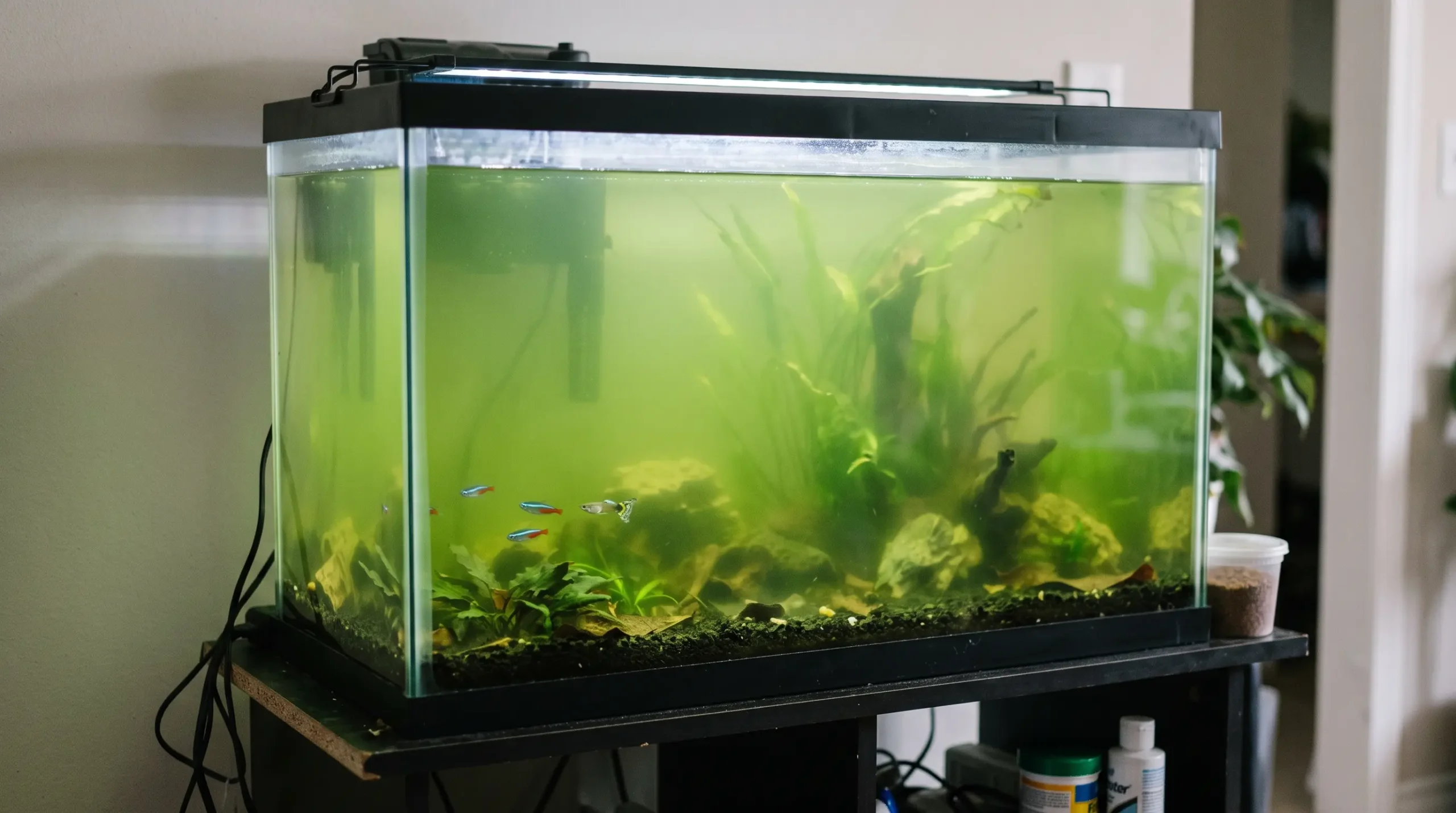
Green water is an overgrowth of free-floating microscopic algae, often called phytoplankton. Unlike algae attached to glass or decorations, these organisms remain suspended in the water, turning it faintly green or so opaque you cannot see the back of the tank.
The key distinction is whether the water itself is green. Scraping the glass will not remove a bloom floating throughout the aquarium.
How to Tell Green Water From Other Aquarium Cloudiness
Check what you are actually seeing before changing equipment or adding treatments.
| What You See | Likely Explanation | What to Check |
|---|---|---|
| Uniform green haze in the water | Suspended algae bloom | Light, nutrients, and recent changes |
| Milky-white or gray cloudiness | Possible bacterial bloom or fine debris | Tank age, waste, filtration, and tests |
| Brown dusty coating on surfaces | Often diatoms | Whether the film wipes off |
| Green spots or film on glass | Attached algae | Whether the water itself remains clear |
| Blue-green slimy sheets | Possible cyanobacteria | Growth texture and location |
A small sample in a clean clear glass, viewed against white paper, may reveal a green tint that is harder to distinguish through aquarium glass. This is a useful clue, not a laboratory identification.
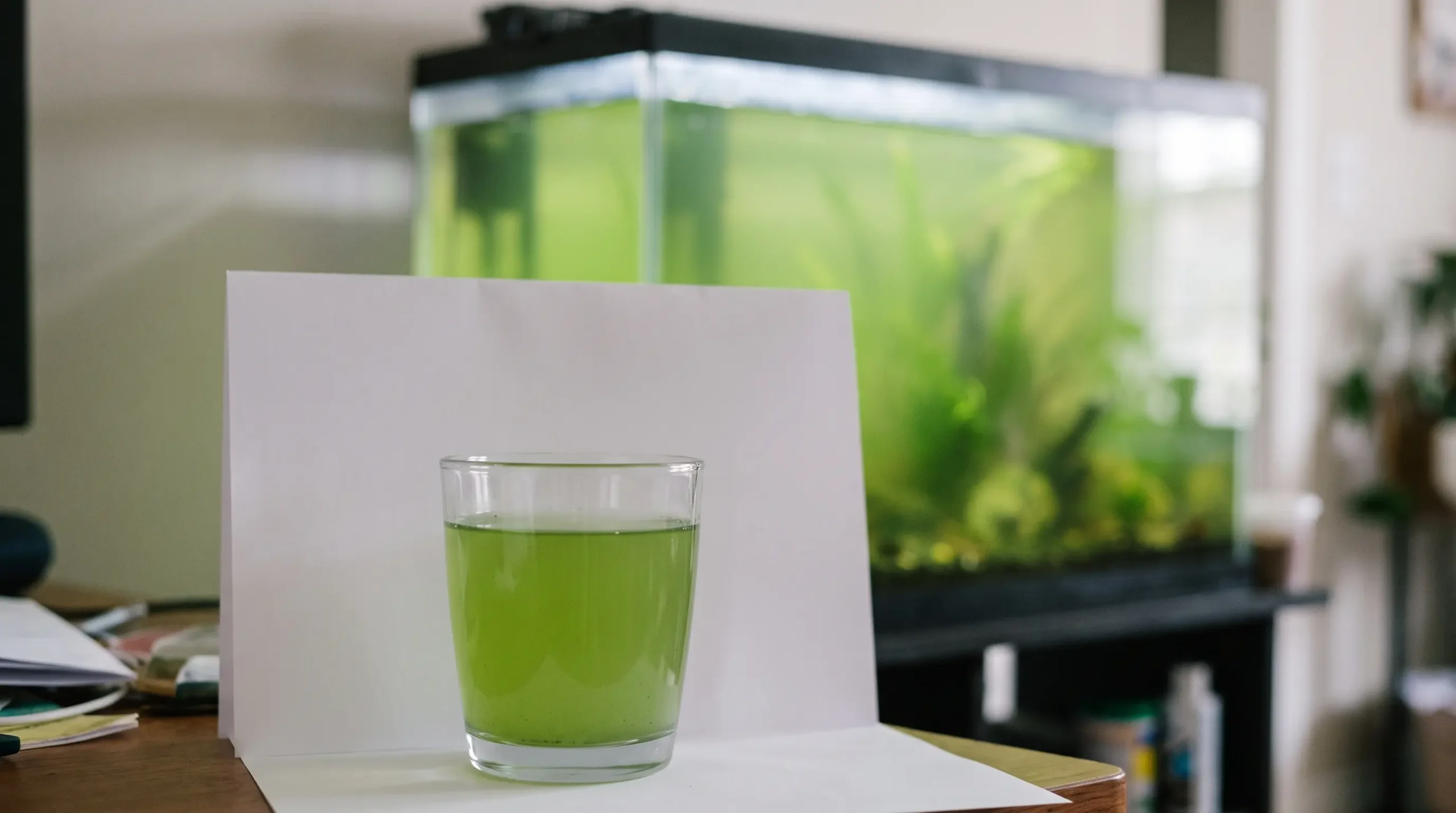
For other conditions, see our guides to milky white aquarium water and bacterial blooms and brown diatom algae in new aquariums.
Why Does Aquarium Water Turn Green?
A bloom becomes more likely when light and nutrients are available in conditions that favor rapid algae growth.
1. Excessive Light or Direct Sunlight
Direct sunlight, a brighter new aquarium LED, or long lighting periods can support a bloom. Think about what changed just before the water turned green: did the tank move near a window or did the lighting schedule get longer?
2. Available Nutrients and Organic Waste
Overfeeding, fish waste, decaying plants, source water, and excess fertilizer can supply nutrients. Nitrate and phosphate may contribute, but one test result does not tell the whole story. Rapidly growing algae can consume nutrients as they become available, and ammonia from a disrupted tank may also be involved.
Do not aim for zero nutrients simply to fight algae. Live plants need appropriate nutrients too. Focus on waste control and consistent, suitable fertilization.
3. A New or Recently Disturbed Aquarium
New tanks and established tanks undergoing changes in stocking, feeding, filtration, substrate, or fertilizer may experience blooms. Green water does not show that the nitrogen cycle is complete; test ammonia and nitrite independently.
How to Clear Green Aquarium Water Safely
Don’t dismantle the tank. Check livestock safety first, correct avoidable causes, and assess whether the bloom needs direct treatment.
Step 1: Check Fish, Filtration, and Water Quality
Confirm that filtration and surface movement are working, observe breathing and swimming, and test ammonia and nitrite—particularly in new or recently disturbed aquariums. Review nitrate and phosphate where useful, along with temperature and recent maintenance.
Concerning ammonia or nitrite requires an appropriate water-quality response, not patience while waiting for the water to clear. Our comparison of aquarium liquid test kits and strips can help with choosing test equipment.
Fish gasping, breathing rapidly, becoming lethargic, or losing normal swimming behavior need prompt attention. Improve aeration or surface agitation as appropriate, check water quality, and investigate the cause rather than assuming algae are the only issue. See our fish gasping at the surface emergency guide.
Step 2: Correct the Lighting Conditions
Block direct sunlight with a shade or curtain. If artificial lighting runs unnecessarily long, use a timer and adjust the schedule to the plants and aquarium inhabitants. An unplanted tank generally needs less illumination than a densely planted one.
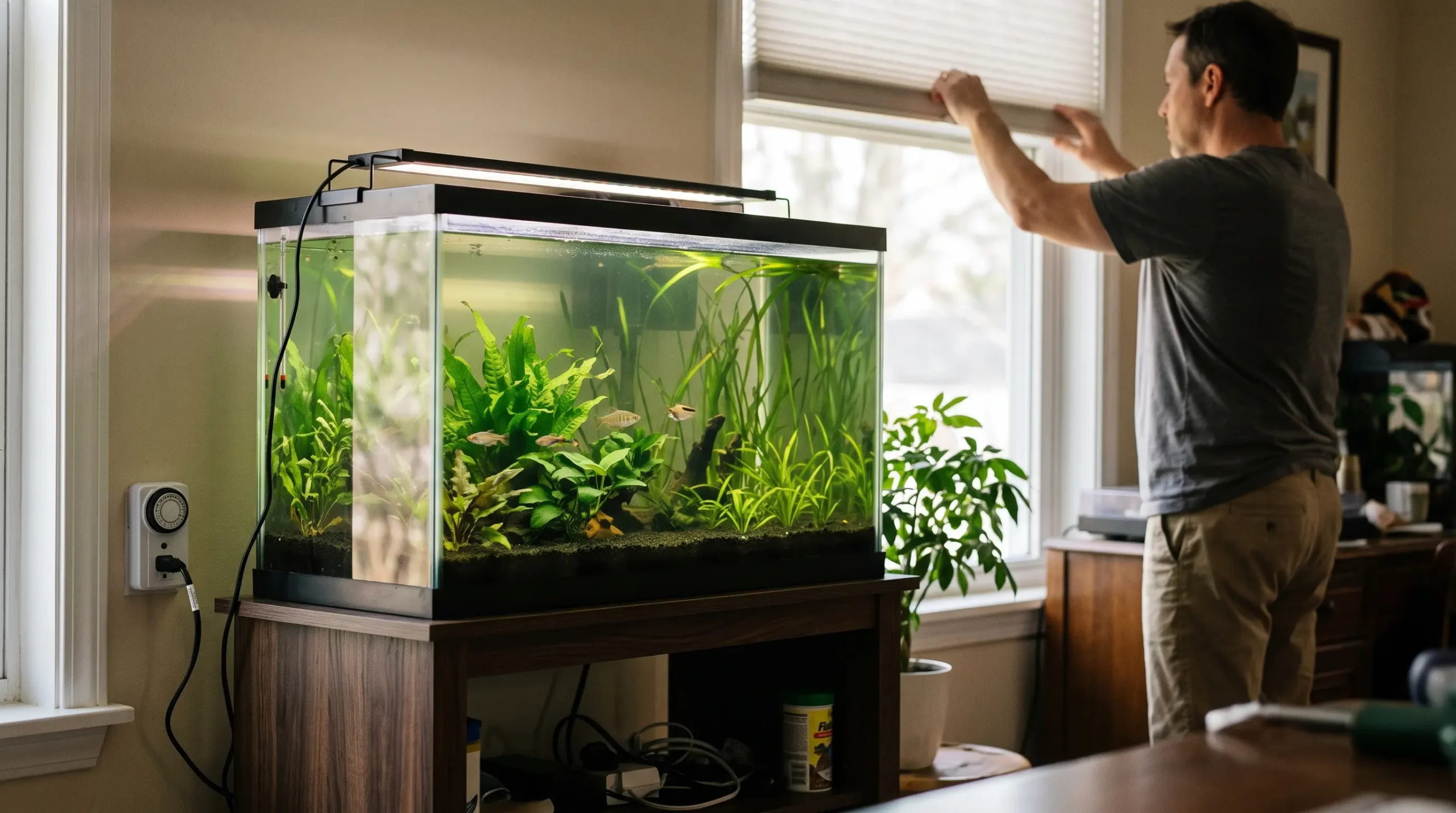
Reducing excess light can discourage regrowth, but may not clear an already dense bloom by itself. For photoperiod decisions, see our aquarium lighting guide covering PAR, spectrum, and photoperiod.
Step 3: Reduce Excess Waste Without Overcleaning
Remove uneaten food and visibly decaying plant matter, correct overfeeding, and maintain appropriate partial water changes. Avoid replacing all mature filter media or aggressively cleaning the entire substrate: these surfaces support important biological filtration.
Repeated very large water changes solely to improve appearance may have only temporary effects if light and nutrient inputs remain unchanged. Necessary water changes for unsafe test results still take priority. Our aquarium water-change guide explains how to choose a suitable routine.
Which Treatment Actually Clears Suspended Algae?
Correcting the cause limits future blooms; clearing the existing suspended algae may require a separate method.
| Method | Main Benefit | Important Limitation |
|---|---|---|
| Light and nutrient adjustments | Address the conditions behind regrowth | May clear a dense bloom slowly |
| Enclosed UV clarifier | Targets algae passing through the device | Does not correct the original trigger |
| Temporary blackout | Restricts photosynthesis | Can stress plants and complicate oxygen management |
| Specialized fine filtration | Removes very small suspended particles | Ordinary pads may not trap algae cells |
| Chemical algaecide | Some products suppress algae | Livestock compatibility and die-off concerns |
Option 1: Use an Aquarium UV Clarifier
For stubborn green water, an appropriately sized enclosed aquarium UV clarifier is a targeted option. Water flows through a sealed chamber, where UV exposure damages suspended algae and limits their ability to reproduce. Clarity may improve over several days, depending on the bloom, flow, and unit.

A clarifier does not replace biological filtration or correct excess nutrients and light. It mainly treats organisms passing through the chamber; most nitrifying bacteria live attached to aquarium surfaces and filter media.
Choose an aquarium-rated unit, verify tank-volume and flow requirements, install it exactly as directed, and keep the UV lamp enclosed. Never look into an exposed operating UV lamp. Some medications also require UV to be switched off during treatment. Monitor fish and water tests as the bloom clears.
Fluval’s UV clarifier guidance explains how flow rate and contact time affect performance.
Option 2: Consider a Temporary Blackout Carefully
Short-term light deprivation can reduce suspended algae, but it also deprives plants of light. Large algae die-offs may increase oxygen demand and affect ammonia or nitrite. A blackout therefore is not the automatic first choice, especially when fish are already distressed.
If using one, maintain filtration and aeration, keep normal air exchange open, check fish and water quality, and stop if problems develop. Do not seal ventilation or cover electrical equipment in an unsafe way. Consider the needs of plants and sensitive livestock.
Option 3: Use Specialized Fine Filtration
Standard sponge and filter pads often cannot capture microscopic free-floating algae. Equipment designed for very fine water polishing, including appropriate diatom filtration, may physically remove them but needs setup and maintenance. Keep your established biological filter in place.
What Should You Avoid When Clearing Green Water?
- Repeated huge water changes just for clarity: The bloom may return unless its causes are addressed. Do change water when livestock safety or test results require it.
- Replacing all filter media: This can destabilize the biofilter without fixing the algae.
- Using algaecides first: Some formulations are unsuitable for particular fish or invertebrates, and mass algae die-off can worsen oxygen and water chemistry.
- Adding algae-eating fish: Typical grazers target surface growth, not microscopic algae suspended in water, and additional livestock increases waste.
- Changing everything at once: Multiple simultaneous adjustments make the cause and response harder to judge.
For any aquarium chemical, check the exact label and its compatibility with shrimp, snails, fish, and plants.
Can Green Water Harm Aquarium Fish?
A mild phytoplankton bloom often does not directly harm otherwise healthy fish. The greater danger with heavy green water is an unstable environment.
Algae release oxygen through photosynthesis when illuminated, but algae, fish, and other organisms consume oxygen through respiration around the clock. Overnight oxygen may fall. A large algae die-off can further increase microbial oxygen demand and sometimes affect ammonia or nitrite. Very dense blooms can also shade live plants.
Watch fish, aeration, and water tests—not just water color. Our aquarium surface agitation and gas exchange guide explains how to support oxygen transfer.
How to Prevent Green Water From Coming Back
Once the bloom clears, keep the conditions that favored it under control:
- Limit direct sun and keep artificial lighting on a consistent, suitable timer.
- Feed appropriate amounts and promptly remove accumulating waste.
- Maintain routine partial water changes and preserve established biological filtration.
- Dose plant fertilizers according to the aquarium’s needs, rather than guessing or aiming for zero nutrients.
- Support healthy plant growth without expecting plants alone to prevent every bloom.
- Review recent stocking, feeding, lighting, or equipment changes if the water becomes green again.
If blooms recur, consider whether source water adds substantial nutrients. Do not switch to untreated distilled or reverse-osmosis water without accounting for your livestock’s mineral and water-chemistry needs.
How Do You Know Your Treatment Is Working?
As suspended algae decline, you should gradually see farther into the tank. But improved visibility alone is not the full measure of success.
Confirm fish are swimming and breathing normally, filtration and aeration work, and ammonia and nitrite remain at appropriate levels. If the water turns green again soon afterward, revisit light and nutrient inputs rather than relying on repeated clearing treatments.
Bottom line: Green water is usually a suspended algae bloom, not dirt on the glass. Keep fish safe, reduce excess light and waste, and use an enclosed UV clarifier or another suitable treatment if the existing bloom persists. Lasting clarity comes from stability, not a panic cleanout.
Sources & Editorial Standards
This guide draws on aquarium-care resources, equipment guidance, and aquatic-science references covering suspended algae, lighting, filtration, and dissolved oxygen:
- Aqueon — Green Water: Causes and Cures
- Aqueon — Prevention and Control of Nuisance Algae
- Aquarium Co-Op — How to Get Rid of Green Water
- Aquarium Co-Op — What Are UV Sterilizers Used For?
- Fluval — UVC In-Line Clarifier: Technical FAQ
- University of Florida IFAS Extension — Dissolved Oxygen for Fish Production
Editorial note: This guide covers common suspended green-algae blooms in freshwater aquariums, not every type of discoloration. Treatments should reflect tank size, filtration, live plants, species, and water conditions. If fish show distress or tests suggest oxygen or water-quality problems, address those immediately and seek knowledgeable aquatic veterinary advice as needed.