Pet-Safe Pest Control for Cats: A Practical IPM Guide
You spot an ant trail beside the cat bowl. Or a cockroach disappears beneath the refrigerator just as you turn on the kitchen light. The spray under the sink suddenly looks like the fastest solution.
But cats complicate pest control in an easy-to-miss way. They walk across treated surfaces, squeeze behind furniture, brush against edges, investigate objects with their paws, and then groom those paws and their coat.
So the useful question isn’t only, “Could my cat eat this pesticide?” It’s also, “Could this treatment reach my cat indirectly?”
Quick Answer: Safer pest control in a home with cats starts with Integrated Pest Management (IPM): identify the pest, remove food and unwanted moisture, reduce hiding places, block entry points, and monitor activity. If a pesticide is necessary, use a registered product labeled for that pest and location, follow all pet-exclusion and re-entry instructions, and prevent your cat from reaching the treatment, bait, residue, or contaminated items.
Start With IPM, Not the Spray Can
Integrated Pest Management is not another term for “natural pest control.” It is a decision-making process that asks why the pest is present and what will actually interrupt the problem before escalating treatment.
IPM combines pest identification, monitoring, sanitation, exclusion, physical controls, and—when necessary—carefully selected pesticides.
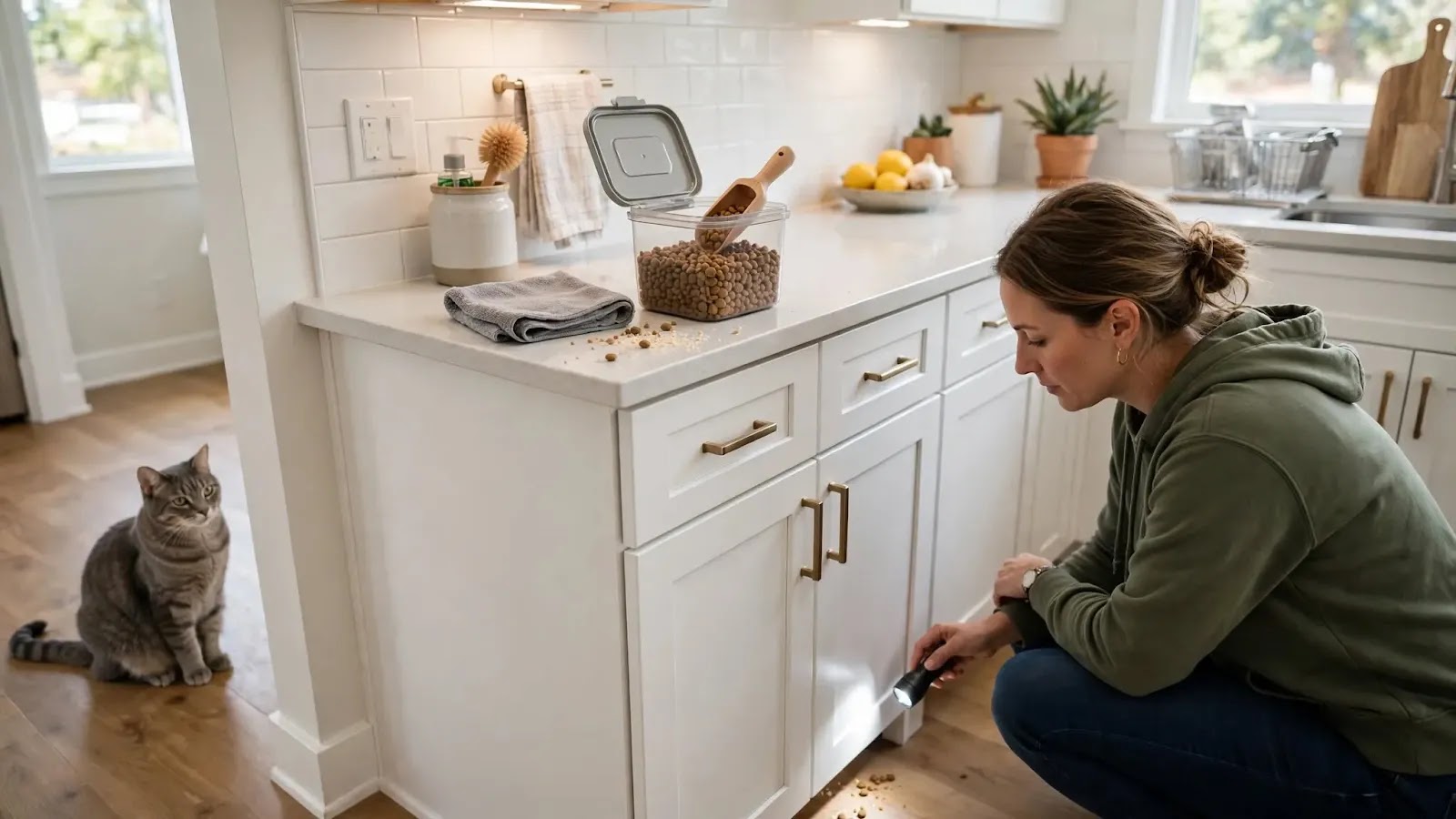
In a cat household, that may mean sealing dry food, cleaning food debris under appliances, repairing a plumbing leak, closing a gap around a pipe, or removing clutter before applying anything.
Sometimes pesticide treatment is still appropriate. The goal is to make it a targeted decision rather than the automatic first step.
Use the Paw-to-Tongue Test
Direct ingestion is only one possible exposure route. A cat can walk across a treated surface, collect residue on the paws or coat, and later swallow some of that material during normal grooming.
The Paw-to-Tongue Test: Before treating an area, mentally trace the route from that surface to your cat’s paws or fur—and then to the tongue. If your cat can walk through it, brush against it, lick it, chew it, or transfer it onto a resting surface, ask whether another label-approved placement or control method would reduce exposure.
This does not mean every dried pesticide residue is automatically dangerous. Risk depends on the active ingredient, formulation, concentration, amount, route of exposure, and label directions. The test simply makes normal feline grooming part of the plan before treatment begins.
Step 1: Identify the Pest Before Treating It
“Small bug in the kitchen” is not enough information to choose a pesticide.
Ants, cockroaches, pantry insects, fleas, flies, rodents, and harmless incidental insects require different strategies. Using the wrong product can add exposure without solving the actual problem.
Look at where activity occurs, whether there are trails, droppings, egg cases, damaged food packages, moisture, pet-food spills, or visible entry points.
If identification is uncertain, photograph the pest or safely collect a specimen when practical. A local extension service or licensed pest professional can often help.
Step 2: Remove What the Pest Is Using
- Control food: Store dry cat food securely, clean spilled kibble, remove leftover wet food appropriately, seal pantry items, and manage trash.
- Fix unwanted moisture: Repair leaks and remove persistent standing water around sinks, appliances, and other problem areas.
- Reduce hiding places: Limit excess cardboard, paper bags, clutter, and forgotten packaging.
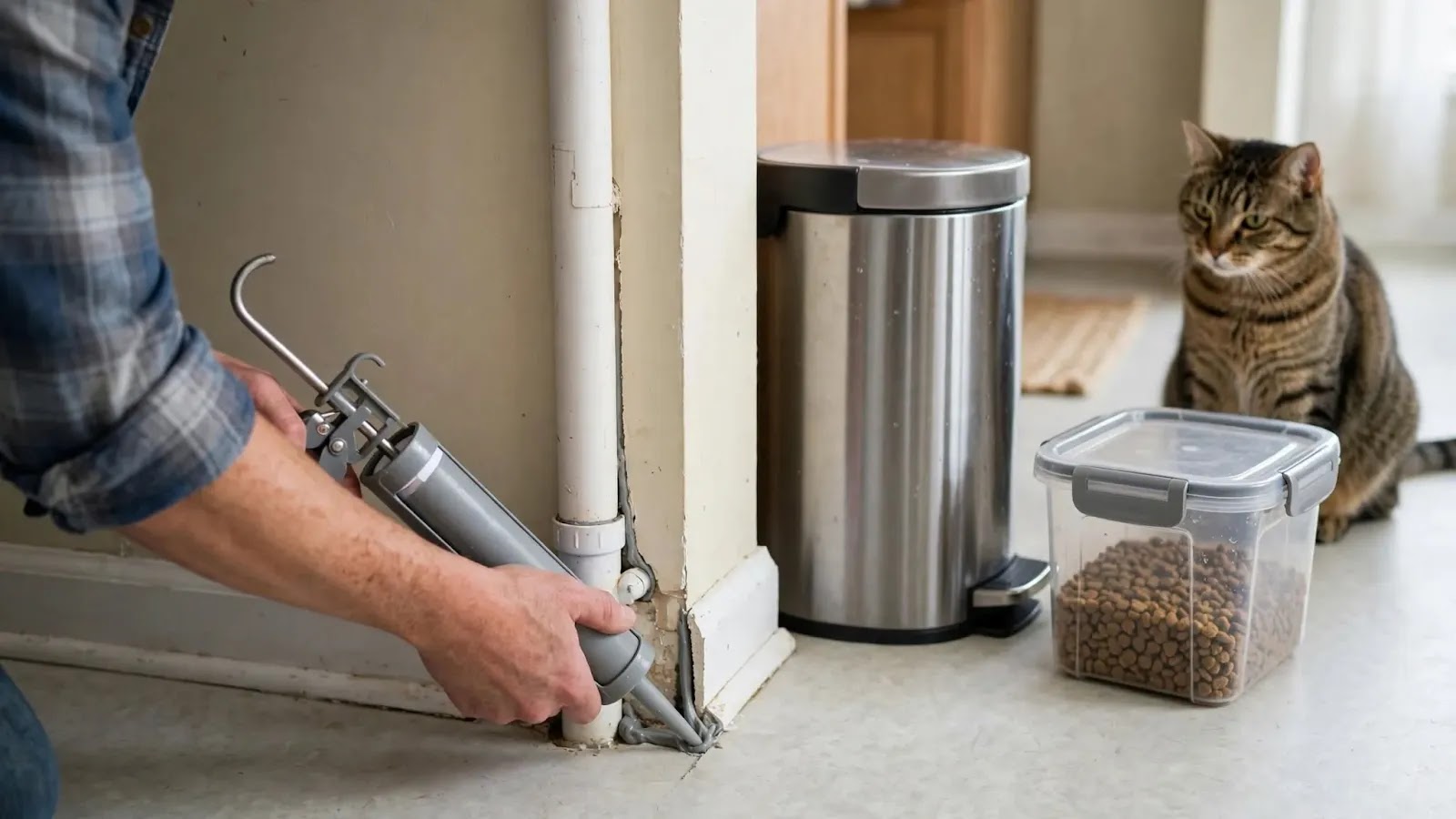
- Seal access: Inspect gaps around pipes, cabinets, baseboards, doors, windows, screens, and utility openings.
Your cat still needs normal access to fresh food and water. The goal is to remove resources for pests—not inconvenience the pet.
Step 3: Match the Control Method to the Pest
| Pest | Start With | If More Control Is Needed |
|---|---|---|
| Ants | Clean food residue, reduce moisture, trace trails, and close appropriate entry gaps. | Use a labeled targeted treatment or bait only where the cat genuinely cannot access it. |
| Cockroaches | Sanitation, leak repair, clutter reduction, exclusion, and monitoring. | Target harboring and travel areas instead of automatically spraying broad accessible surfaces. |
| Mice or rats | Seal access points and secure food, pet food, and waste. | Use appropriate traps or professionally managed control while preventing access to traps, bait, and poisoned prey. |
| Pantry pests | Find and discard infested food, clean shelving, and inspect nearby packages. | Use sealed storage and continued monitoring. |
| Fleas | Use flea prevention specifically labeled or prescribed for cats. | Ask your veterinarian for a cat-appropriate environmental and on-pet control plan if needed. |
Targeted treatment can reduce unnecessary exposure, but “targeted” does not mean harmless. Cats can chew bait housings, paw at exposed gel, walk through dust, or contact traps.
If ants are involved, see our guide to what to do if your cat gets into an ant bait station.
Permethrin Is a Special Warning for Cats
Some synthetic pyrethroids are less well tolerated by cats, and permethrin can be highly toxic.
Significant exposure can cause neurological signs such as muscle twitching or fasciculations, tremors, poor coordination, seizures, weakness, and other serious abnormalities.
Never apply a flea or tick product labeled only for dogs to a cat. A cat can also be exposed by grooming or closely contacting a recently treated dog. Follow the product’s instructions about separating pets after treatment.
This does not mean every household insecticide containing a pyrethroid carries the same risk in every situation. The active ingredient, concentration, formulation, dose, route of exposure, and product directions still matter.
If your cat may have contacted a dog-only permethrin product, see our cat permethrin exposure emergency guide and contact a veterinarian promptly.
Step 4: Read the Label Before You Buy or Apply
A phrase such as “pet-friendly” should never replace the pesticide label.
Before using a product, verify:
- the exact pest it is labeled to control
- where it may legally be used
- the permitted application method and amount
- pet-removal instructions
- ventilation requirements
- re-entry conditions
- storage directions
- disposal and first-aid information
More does not mean safer or more effective. Do not increase the concentration or amount, mix pesticides unless the label specifically instructs you to, or move a treatment to an unlabeled location.
If the label feels difficult to interpret, see how to read a pesticide label when you have pets.
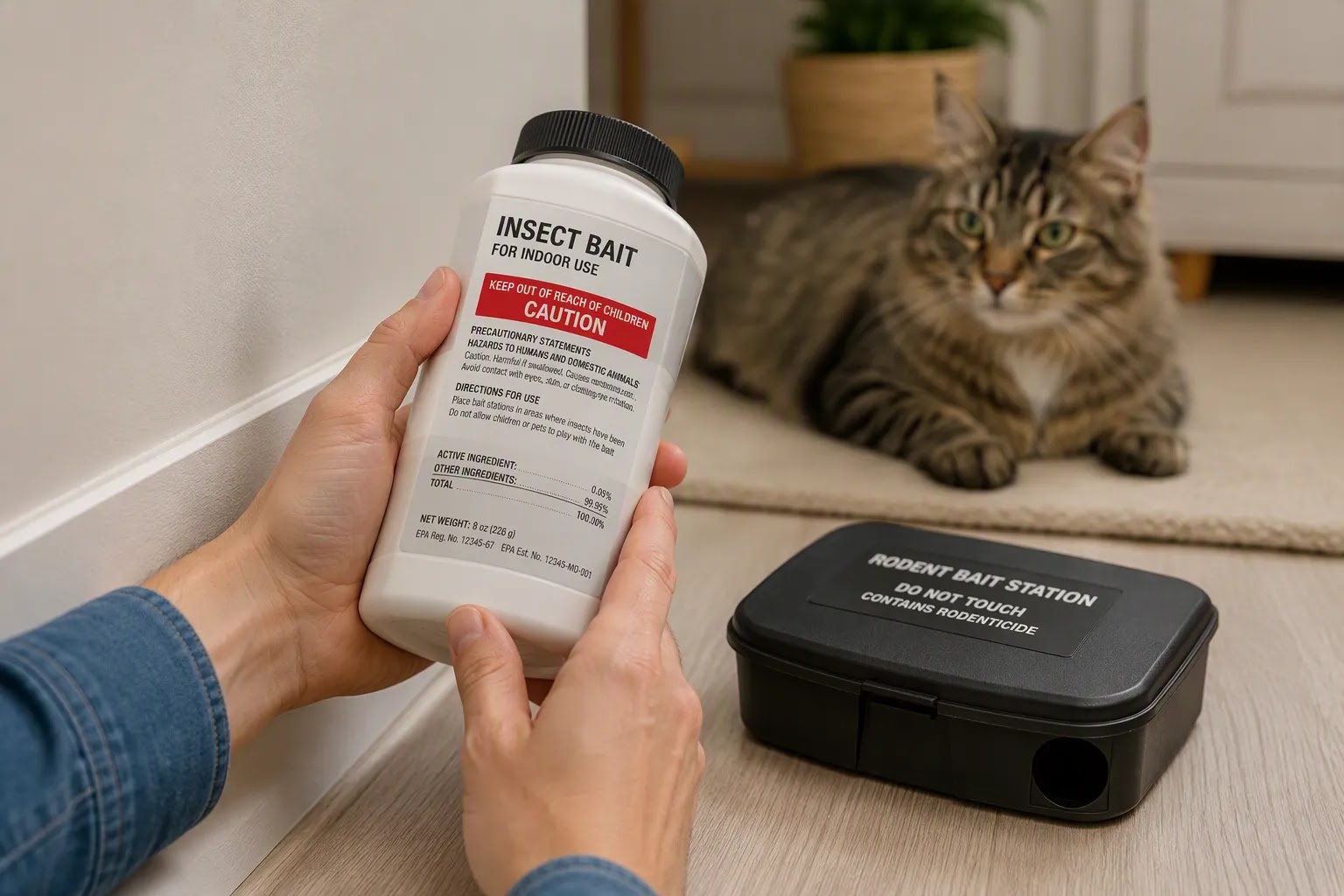
Step 5: Reduce Exposure During and After Treatment
Remove your cat from the treatment area during mixing and application when required by the label. Remove food and water bowls, toys, bedding, scratching items, and other belongings that could become contaminated when relevant.
Do not let your cat return just because the odor has faded.
Many pesticide instructions require keeping pets away until the treatment is completely dry, but other products may require longer exclusion, ventilation, watering, or additional conditions. Granules, foggers, indoor sprays, dusts, gels, and outdoor treatments do not all follow the same timetable.
The individual label takes priority over any universal waiting period.
Think like the cat, not the installer: If your cat can climb above a barrier, reach behind a cabinet, pull an object out with a paw, knock it down, or chew the housing, the product is not genuinely inaccessible to that cat.
What About “Natural” Pest Control?
Natural describes origin or marketing. It does not tell you whether a substance is safe for a cat at a particular concentration or exposure route.
Plant-derived insecticides, concentrated botanical products, essential-oil mixtures, powders, and homemade recipes can still cause harm or irritation. Poorly effective DIY products may also result in repeated applications and greater exposure without controlling the infestation.
Health Canada specifically advises against homemade pesticides because they may not have been scientifically evaluated for safety, effectiveness, application rate, or appropriate precautions.
Before introducing another chemical or botanical substance, ask whether sanitation, exclusion, trapping, leak repair, or removal of a breeding source can solve the problem with less uncertainty.
Mothballs are a good reminder that familiar household products can still be pesticides. See our guide to mothball poisoning in dogs and cats.
When Professional Pest Control Makes Sense
Professional help may be useful when an infestation is widespread, recurrent, moving between apartment units, involves termites or bed bugs, includes a significant rodent problem, or requires treatment you cannot safely manage yourself.
Tell the company before treatment day that cats live in the home. Ask:
- Which pest was identified?
- What exact product and formulation will be used?
- What is the active ingredient?
- Where will it be applied?
- What should be removed or protected beforehand?
- What are the pet re-entry conditions?
- Will baits, gels, traps, dusts, or residual treatments remain afterward?
“Everything we use is pet-friendly” is not enough information. Product identity, placement, and specific re-entry instructions are much more useful.
What If Your Cat May Have Been Exposed?
If your cat may have eaten, licked, inhaled, walked through, or had substantial skin contact with a pesticide, stop further exposure when it is safe to do so and locate the original product container or label.
Gather the:
- product name
- active ingredient and concentration
- estimated amount involved
- route of exposure
- approximate time of exposure
- signs your cat is showing
If a pest-control company performed the treatment, ask them for the exact product information.
Contact your veterinarian, an emergency veterinary hospital, or a veterinary poison-control service promptly after a potentially significant exposure. Management can differ dramatically between pesticide classes.
Seek urgent veterinary care for tremors, muscle twitching, seizures, marked weakness, collapse, difficulty standing or walking, breathing difficulty, loss of consciousness, or rapid deterioration after a possible pesticide exposure.
Do not induce vomiting or give milk, oil, salt, food, activated charcoal, hydrogen peroxide, or another home remedy unless a veterinarian or veterinary poison professional specifically directs you to do so for that exact exposure. Hydrogen peroxide should not be used at home to induce vomiting in cats.
The Bottom Line
The safest-looking pest-control plan in a cat household is often the least dramatic one: clean the food residue, repair the leak, seal the entry point, identify the pest, and monitor what happens before reaching for a chemical treatment.
If a pesticide is needed, choose one labeled for the actual pest and location, follow the instructions exactly, remove your cat when required, and plan re-entry and product access before treatment begins.
Then run one final check: where can those paws go—and where will the tongue go afterward?
Veterinary & Pesticide Safety Disclaimer: This article is for general educational purposes and cannot determine whether a specific pesticide, pest-control method, or exposure is safe for an individual cat. Risk varies with the active ingredient, concentration, formulation, amount, route of exposure, product use, and the cat’s health. Always follow the registered product label. If your cat may have swallowed pesticide, contacted a concentrate or spill, received a dog-only flea or tick product, or develops abnormal signs after exposure, contact a veterinarian or veterinary poison-control service promptly.
Sources & Editorial Standards
Integrated Pest Management principles were checked against the U.S. Environmental Protection Agency’s IPM guidance.
Pet exclusion, re-entry, treated-surface precautions, direct-on-pet products, and bait exposure were reviewed against the National Pesticide Information Center’s current Pets and Pesticide Use guidance.
Registered-product use, removal of pet belongings, re-entry, bait precautions, secondary poisoning, and homemade pesticide warnings were checked against Health Canada’s guidance for keeping pets safe when using pesticides.
Species-specific pyrethroid and permethrin risks were reviewed against the Merck Veterinary Manual and VCA Animal Hospitals guidance on toxic household hazards for cats.
Because pesticide products and exposure routes vary substantially, this guide intentionally does not assign one universal re-entry period, toxic dose, or home decontamination procedure to every pesticide exposure.