Cat Ate Ant Bait? What to Do & When to Call a Vet
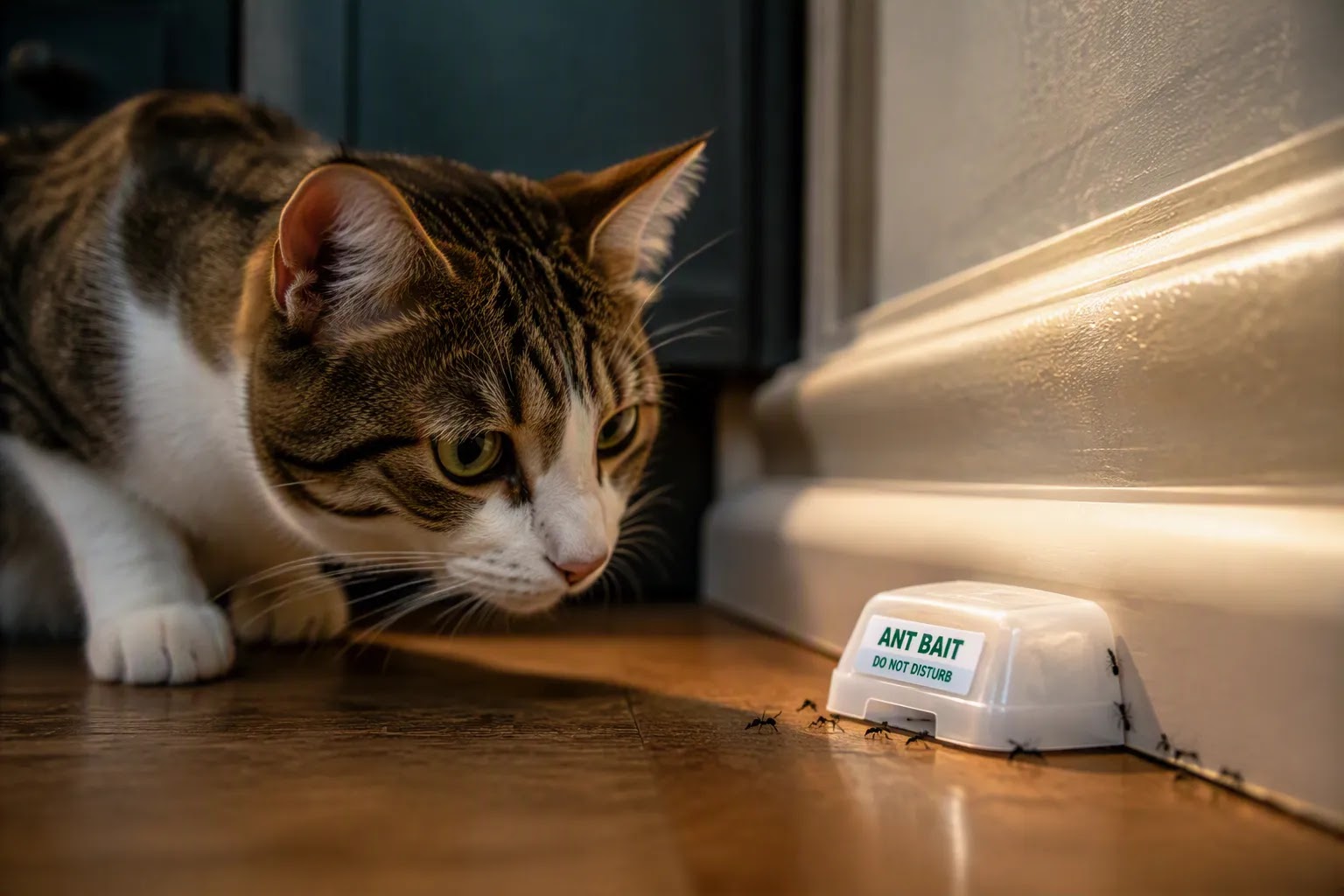
You hear a plastic rattle under the kitchen cabinet.
When you look down, your cat is batting an ant bait station across the floor—and there are fresh tooth marks along one edge.
The words “ant bait” alone don’t tell you how dangerous the exposure is.
Different products contain different active ingredients and concentrations, and a chewed station creates a second question too:
Did your cat swallow any of the plastic or other packaging?
Quick Answer: Remove the ant bait, save the product and package, and check how much bait and casing may be missing. Note the exact product name, active ingredient, concentration if listed, your cat’s weight, the approximate time of exposure, and any symptoms. Contact your veterinarian, an emergency veterinary clinic, or a veterinary poison-control service for product-specific advice. Do not try to make your cat vomit at home.
What Should You Do Right Now?
- Remove the bait. Prevent your cat or another pet from accessing more.
- Save everything. Keep the bait station, box, wrapper, and label.
- Check what’s missing. Look at both the pesticide-containing bait and the plastic, foil, or cardboard casing.
- Note when it happened. Even an approximate time helps.
- Check your cat. Look for vomiting, drooling, weakness, abnormal walking, tremors, breathing problems, or other unusual behavior.
- Don’t give home remedies. Do not give hydrogen peroxide, salt, oil, milk, activated charcoal, or another treatment unless a veterinary professional specifically directs you.
- Get product-specific advice. Contact your veterinarian, emergency clinic, ASPCA Animal Poison Control Center, or Pet Poison Helpline.
Go to an emergency veterinary hospital immediately if your cat has seizures, collapses, struggles to breathe, becomes unresponsive, is profoundly weak, cannot stand or walk normally, or is rapidly deteriorating.
How Dangerous Is Ant Bait to Cats?
There is no single toxicity level for every product sold as ant bait.
Risk depends on:
- The active ingredient
- Its concentration
- How much bait was consumed
- Your cat’s body weight and health
- Whether exposure was oral, skin, or eye contact
- Whether the casing was also swallowed
Many household bait stations contain relatively low concentrations of insecticide, so a very small exposure may cause no signs or only mild gastrointestinal irritation.
But that does not make ant bait safe for cats.
Eating several stations, accessing a concentrated formulation, swallowing an unknown amount, or developing symptoms can create a very different risk.
Use the Two-Part Exposure Check
Check both the bait and the casing. First estimate how much pesticide-containing material disappeared. Then reconstruct the station and check whether a meaningful piece of plastic, foil, cardboard, or wrapper is missing. The second problem can matter even if the chemical dose itself was small.
This distinction is important because pesticide toxicity and gastrointestinal foreign-body obstruction are two different problems.
The Label Matters More Than What the Trap Looks Like
Two ant bait stations that look nearly identical may use different active ingredients or concentrations.
Don’t identify the exposure by saying only that your cat chewed a “black ant trap.”
Have these details available when you call:
- Brand and exact product name
- Active ingredient
- Concentration
- EPA registration number, if listed
- Approximate amount of bait missing
- Your cat’s weight and age
- Relevant health conditions or medications
- Approximate time of exposure
- Symptoms, if any
- Whether part of the station or wrapper is missing
If pesticide labels are confusing, see our How to Read a Pesticide Label When You Have Pets guide.
What Symptoms Can Ant Bait Cause?
Symptoms depend on the ingredient and dose.
Some small household bait exposures cause no obvious effects.
Possible signs after insecticide exposure can include:
- Drooling
- Vomiting
- Diarrhea
- Reduced appetite
- Lethargy
- Weakness
- Unsteady walking
- Muscle twitching or tremors
- Other abnormal neurological behavior
Severe neurological or systemic signs are possible with certain ingredients or sufficiently large exposures.
Contact a veterinarian promptly for repeated vomiting, marked lethargy, weakness, abnormal walking, tremors, unusual neurological behavior, or an exposure involving a large or unknown amount. Severe weakness, seizures, collapse, breathing difficulty, or unresponsiveness require emergency care.
A sick cat may also become unusually quiet or hide. See Why Is My Cat Suddenly Hiding? 7 Reasons & When to Worry if withdrawal is part of the change.
Don’t Forget the Plastic Bait Station
Sometimes the chemical isn’t the only concern.
A cat that chews through a bait station may swallow pieces of plastic, foil, cardboard, or wrapper along with the bait.
Small smooth fragments may pass, but a larger or awkwardly shaped foreign body can irritate or obstruct the gastrointestinal tract.
Tell your veterinarian if part of the casing is clearly missing.
Signs that deserve veterinary assessment after known packaging ingestion include:
- Repeated vomiting or retching
- Loss of appetite
- Marked lethargy
- Abdominal pain or discomfort
- Inability to keep food or water down
- Significant changes in stool production
These signs don’t prove an obstruction, but a known foreign-body exposure makes them more important.
Does Every Ant Bait Exposure Require an ER Visit?
No.
A healthy adult cat that briefly licked a known low-concentration bait and remains normal is not automatically in the same situation as a kitten that consumed several bait stations or a cat developing neurological signs.
Depending on the exact product and estimated dose, a veterinary toxicology professional may recommend:
- Home monitoring
- A veterinary examination
- Prompt emergency treatment
The important part is that the decision comes from the actual product and actual exposure, not a blanket claim that ant traps are either harmless or deadly.

Do Not Give Hydrogen Peroxide to a Cat
This deserves its own section because vomiting advice written for dogs is often copied and incorrectly applied to cats.
Do not give hydrogen peroxide to your cat to induce vomiting.
Hydrogen peroxide is unreliable as a feline emetic, and cats are particularly susceptible to severe stomach irritation, including hemorrhagic gastritis.
There is no safe universal at-home method for making a cat vomit.
Whether veterinary decontamination is useful depends on the substance, amount, timing, symptoms, and individual cat.
What Might the Veterinarian Do?
There is no single treatment for “ant bait poisoning.”
Management depends on:
- Active ingredient
- Concentration
- Estimated dose
- Time since exposure
- Your cat’s symptoms
- Whether foreign material was swallowed
Depending on the case, treatment may involve observation, gastrointestinal support, intravenous fluids, treatment of neurological signs, ingredient-specific therapy when indicated, or diagnostic imaging if a swallowed piece of casing raises concern for obstruction.
Who Should You Call?
Your veterinarian or nearest emergency veterinary hospital is a good starting point.
In the United States, 24/7 veterinary poison resources include:
- ASPCA Animal Poison Control Center: 888-426-4435
- Pet Poison Helpline: 855-764-7661
Consultation fees may apply.
Keep the product and label with you during the call so the toxicology professional can evaluate the formulation rather than guessing from the words “ant bait.”
How to Use Ant Baits More Safely Around Cats
Follow the pesticide label exactly.
EPA guidance recommends keeping pesticide products in their original containers and making sure animals cannot access bait products while they are being used.
Remember that with cats, “out of the way” does not necessarily mean inaccessible.
A windowsill, countertop, shelf, or cabinet top may still be easy for a cat to reach or knock something from.

If ant bait is needed, place it only where your cat genuinely cannot reach, chew, knock down, or drag it away.
Also reduce what attracts ants:
- Clean crumbs and food spills
- Store food in sealed containers
- Clean around pet bowls
- Fix unnecessary moisture sources
- Seal practical entry points around pipes, windows, cabinets, and baseboards
For a broader prevention strategy, see our Pet-Safe Pest Control for Cats: A Practical IPM Guide.
Do not assume that a homemade or “natural” pest-control product is automatically safer. Safety depends on the actual ingredients, concentration, route of exposure, and how the product is used.
When a cat gets into an ant bait station, investigate two things: the pesticide and the packaging. Save the label, estimate what’s missing from both, avoid at-home vomiting remedies, and base the next step on the actual exposure.
Veterinary & Poison Safety Disclaimer: This article is for general educational purposes and cannot determine whether a specific ant bait exposure is safe for your cat. Pesticide risk varies with the active ingredient, concentration, dose, formulation, and individual animal, while swallowed packaging may create a separate foreign-body risk. If your cat has eaten or chewed ant bait and you are unsure of the exposure—or your cat develops abnormal symptoms—contact your veterinarian, an emergency veterinary clinic, or a veterinary poison-control service for case-specific guidance.
Sources & Editorial Standards
- Pet Poison Helpline — Insecticides and Ant Bait Stations
- ASPCA Animal Poison Control — When a Potential Poison Exposure Needs Veterinary Care
- ASPCApro — Proper Use of Emetics in Dogs and Cats
- Merck Veterinary Manual — Gastrointestinal Foreign Bodies and Obstruction in Cats
- U.S. Environmental Protection Agency — Read the Label First: Protect Your Pets
Editorial note: Ant bait products vary widely in active ingredient, concentration, formulation, and packaging. Many household bait products contain relatively low concentrations, but that does not establish that an individual exposure is safe. This guide therefore avoids assigning one toxicity level or treatment plan to every ant bait and treats swallowed packaging as a separate potential hazard.
The Bottom Line
A chewed ant bait station can look terrifying, but its appearance doesn’t tell you the dose.
Save the product. Read the label. Estimate how much bait disappeared. Then look at the casing and determine whether any part of it may also be inside your cat.
Check the bait, check the plastic, keep the label, and let the actual exposure—not the appearance of the trap—determine the next step.