
Dog Is Choking: How to Recognize an Airway Emergency
Emergency: If your dog cannot breathe normally, makes only weak or squeaky attempts to cough, develops pale or blue gums, or collapses, seek emergency veterinary help immediately. A blocked airway can become life-threatening within minutes.
Call the nearest open emergency veterinary hospital. If your dog is conscious and appears unable to move air, begin appropriate choking first aid while another person arranges transport. Do not reach into a conscious dog’s mouth.
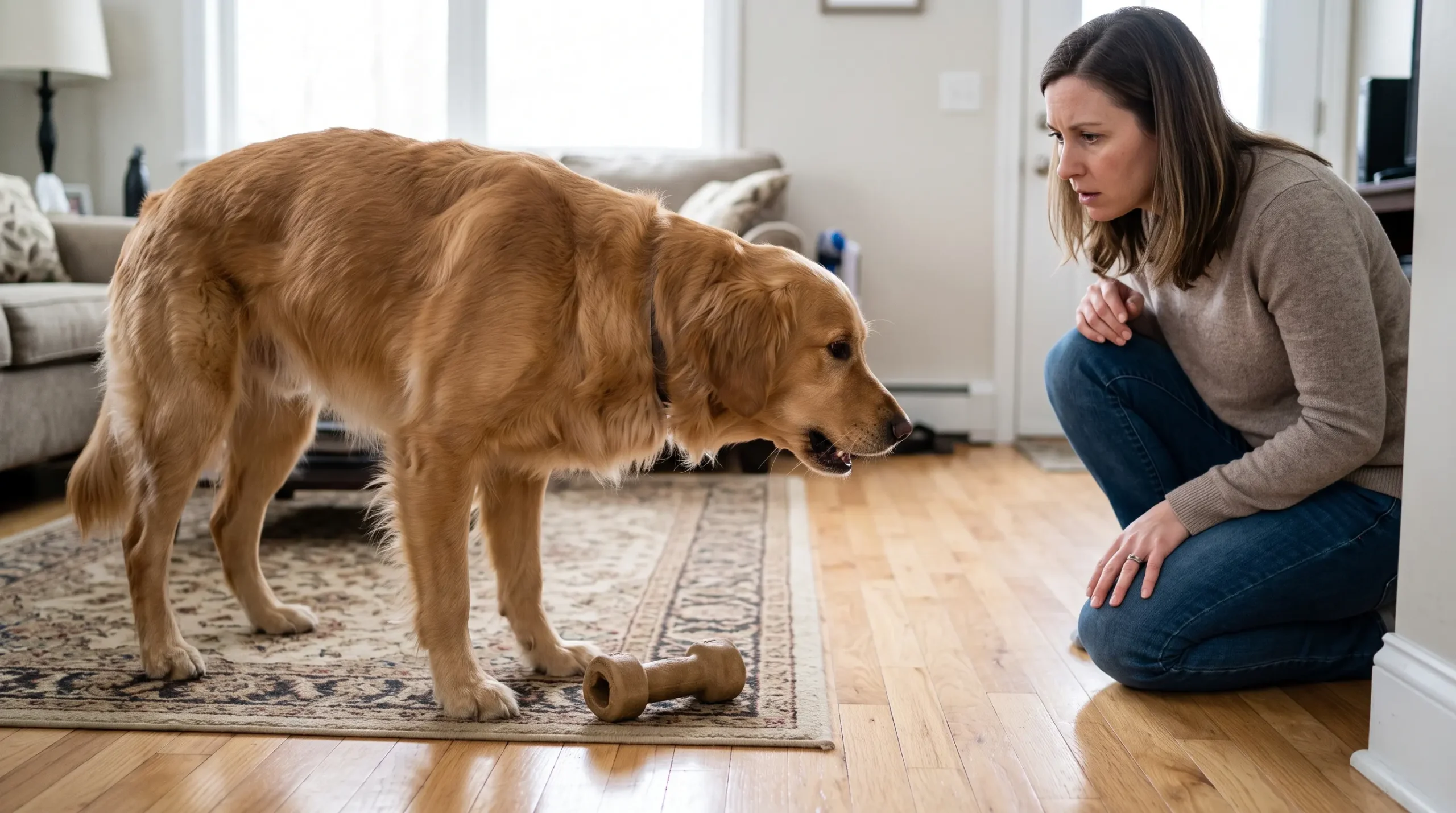
A dog may suddenly paw at their face, extend their neck, or struggle to breathe after chewing a toy or swallowing food. These signs can indicate a foreign object blocking the airway, but coughing and gagging alone do not always mean choking.
The critical question is whether your dog can still move air effectively. A dog making strong, productive coughs needs careful monitoring and prompt veterinary advice. A dog struggling silently or making only weak, high-pitched sounds may have a severe airway obstruction requiring immediate action.
What to Do Immediately if Your Dog Is Choking
The following first-aid approach reflects the 2026 RECOVER First Aid Guidelines for Dogs and Cats, which recommend back blows as the initial maneuver for a conscious animal with suspected choking.
- Get emergency veterinary help started. Have someone call the nearest open emergency clinic and prepare transport. If you’re alone, use speakerphone if possible without interrupting urgent assistance.
- Assess whether air is moving. If your dog is breathing and coughing forcefully, avoid forceful choking maneuvers. Keep them as calm as possible while arranging veterinary assessment. If they cannot cough effectively or appear unable to breathe, act immediately.
- Give up to five firm back blows if your dog is conscious and severely choking. Strike the rear portion of the rib cage, to the side of the spine, rather than directly over the spinal column. Stop if the obstruction clears.
- If the obstruction remains, try another recognized airway-clearing maneuver. If safe, positioning the dog’s head lower than the body may help. Abdominal thrusts are another option: position your hands just behind the rib cage and deliver quick inward-and-upward thrusts toward the chest. The American Red Cross describes sets of five abdominal thrusts. Chest thrusts are also recognized in the RECOVER guidance.
- Continue urgent care and transport. If the blockage does not clear, continue appropriate first-aid efforts while arranging immediate veterinary treatment. Do not continue a maneuver that puts you at serious risk of being bitten or injured.
Important: Choking first-aid maneuvers can cause injury and are intended for a suspected serious airway blockage, not ordinary coughing, gagging, or reverse sneezing. Even if the obstruction clears, your dog needs an immediate veterinary examination.
How to Recognize a Serious Airway Obstruction
A choking dog may show several warning signs together, especially if breathing becomes increasingly difficult.
- Weak or silent coughing: Your dog appears to cough or gag but makes little sound and cannot move air normally.
- High-pitched or squeaky breathing: Air struggles to pass through a narrowed airway.
- Pawing at the mouth: Your dog may repeatedly scrape at their face or muzzle.
- Head and neck extension: Your dog stretches their neck while attempting to breathe.
- Heavy drooling and agitation: Sudden distress may accompany an obstructed airway.
- Pale, gray, or blue gums: These can indicate a critical oxygen problem.
- Collapse or unresponsiveness: This is an immediately life-threatening sign.
Not every choking dog will display all these signs. Do not wait for blue gums or collapse before seeking emergency care. Severe breathing difficulty alone is enough to justify immediate help.
Is Your Dog Choking, Coughing, or Reverse Sneezing?
These episodes can look similar, particularly when a dog suddenly makes unfamiliar throat noises.
When Your Dog Is Coughing
A strong cough generally indicates that at least some air can move through the airway. However, a dog can still have a partial obstruction or another serious respiratory problem.
If coughing is persistent, your dog is struggling to breathe, or the episode began immediately after swallowing an object, contact a veterinarian urgently. Do not assume that a noisy cough guarantees safety.
When Your Dog Is Reverse Sneezing
Reverse sneezing often produces repeated, forceful snorting sounds as a dog draws air inward through the nose. Many dogs remain alert and recover quickly once the episode ends.
Unlike severe choking, a typical reverse-sneezing episode does not completely prevent airflow. Still, sounds alone are not enough to make a reliable diagnosis during an emergency.
If breathing looks difficult, your dog collapses, or you’re unsure whether air is moving, treat the situation as urgent rather than spending time trying to identify the noise.
What if Your Dog Becomes Unconscious?
An unresponsive dog that is not breathing normally needs immediate resuscitation and emergency veterinary transport.
The 2026 RECOVER first-aid guidance recommends starting chest compressions immediately when an animal becomes unconscious from a suspected foreign-body airway obstruction.
- Start chest compressions at approximately 100–120 per minute.
- After 30 compressions, briefly check the mouth for a visible obstruction. Remove an object only if it can be seen and safely grasped. Do not perform a blind finger sweep.
- If safe and feasible, provide two rescue breaths over the nose, following appropriate pet CPR technique.
- Repeat the 30-compression, two-breath cycle while emergency veterinary help and transport are arranged. If rescue breaths are unsafe, perform chest-compression-only CPR.
Correct compression technique depends on a dog’s chest shape and size. The American Red Cross dog CPR guide explains the different hand positions and rescue-breath technique.
If another person is available, have them drive while you provide assistance where it can be done safely. Do not attempt CPR while driving or compromise vehicle safety.
What You Should Never Do During a Choking Emergency
- Do not reach into a conscious dog’s mouth. A frightened dog may bite, and manipulating an obstruction can make the situation worse.
- Do not perform a blind finger sweep. This risks pushing an unseen object deeper into the airway.
- Do not give water, food, oil, or other home remedies. They will not reliably clear an obstruction and may increase aspiration risk.
- Do not perform abdominal or chest thrusts on a dog that is breathing and coughing effectively. These forceful maneuvers can cause injury.
- Do not muzzle a dog with breathing difficulty. A muzzle may further interfere with breathing.
- Do not delay emergency care to search for a demonstration video. Contact the veterinary team and follow their instructions.
Why Your Dog Still Needs a Vet After Choking
Even when a piece of food or a toy comes out and breathing improves, the emergency may not be completely over.
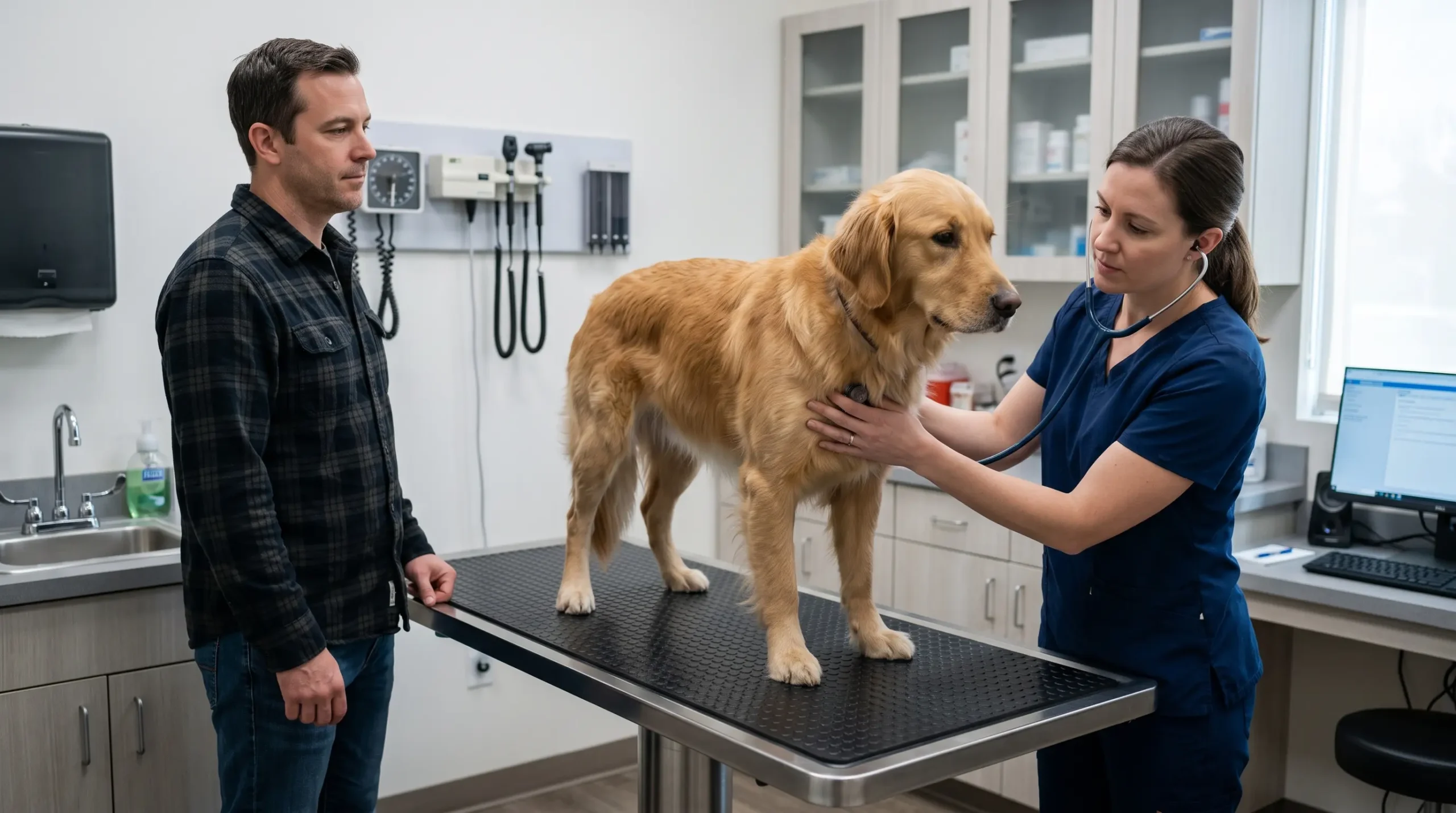
A choking incident can leave behind throat irritation, swelling, or airway injury. Material may also have entered the lungs, potentially leading to aspiration-related complications. Forceful first-aid maneuvers can cause additional injuries.
The 2026 RECOVER guidelines recommend immediate veterinary evaluation for any dog that required hands-on choking assistance.
During transport, minimize unnecessary handling, avoid pressure around the neck, and allow your dog to remain in a position that supports comfortable breathing when possible.
Tell the veterinary team what your dog was eating or chewing, when the episode began, what breathing changes you observed, and which first-aid maneuvers were performed.
The veterinarian may examine the airway, assess oxygenation, provide supportive treatment, or investigate a remaining obstruction or injury as needed.
Be Prepared Before an Emergency Happens
A choking episode can develop too quickly to learn first aid from scratch. Consider taking an instructor-led pet first-aid and CPR course, and save the contact information for your nearest 24-hour veterinary emergency hospital.
Our pet first-aid kit checklist for dogs and cats can help with general emergency preparedness, although a kit cannot replace hands-on airway first aid or veterinary treatment.
If your dog is struggling to breathe right now, prioritize emergency veterinary care. A suspected severe airway obstruction requires immediate action, and temporary improvement should never replace a veterinary examination after assisted choking relief.
Sources & Editorial Standards
This guide prioritizes current veterinary first-aid recommendations, especially the updated RECOVER guidance published in August 2026:
- RECOVER Initiative — First Aid for Dogs and Cats: Clinical Guidelines (2026)
- RECOVER — First Aid Evidence Review and Treatment Recommendations (2026)
- American Red Cross — How to Help a Dog Choking
- PDSA — Reverse Sneezing in Dogs
Editorial note: This information is educational and is not a substitute for emergency veterinary treatment or practical first-aid training. Choking maneuvers may cause injury if performed incorrectly or when they are not needed. Follow instructions from your emergency veterinary team whenever possible.