Pyrethrin and Pyrethroid Sprays Near Fish Tanks: Aquatic Toxicity & Exposure Routes
You find an insect spray labeled with pyrethrins or permethrin. Your aquarium is across the room, away from where you plan to spray. Is that distance enough to protect your fish?
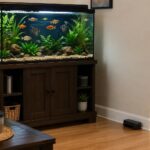
Not necessarily. Pyrethrins and many pyrethroids are highly toxic to fish and aquatic invertebrates. Drifting spray droplets, contaminated air drawn into aquarium equipment, and pesticide residue transferred on hands or tools can all create exposure routes—even without spraying directly into the tank. The safest approach is to prevent these chemicals from reaching aquarium water.
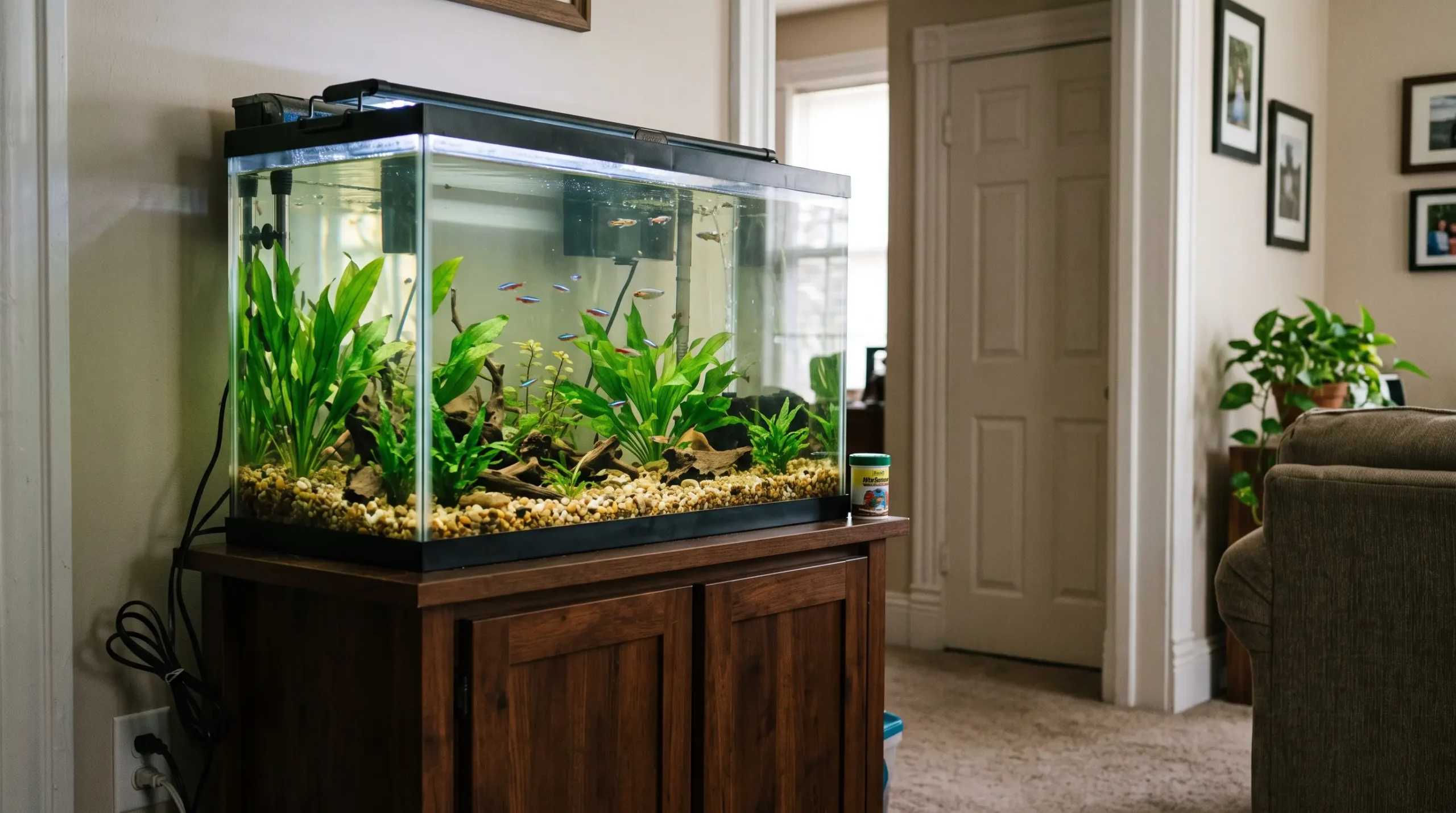
Why Pyrethrins and Pyrethroids Are Dangerous to Fish
Pyrethrins are insecticides derived from chrysanthemum flowers. Pyrethroids, including permethrin and deltamethrin, are synthetic compounds modeled on them. Both affect nerve signaling and appear in various household and outdoor insect-control products.
The National Pesticide Information Center (NPIC) describes pyrethrins as highly to very highly toxic to fish and very highly toxic to aquatic invertebrates such as shrimp. The U.S. Environmental Protection Agency also identifies aquatic risks from pyrethroids, including pesticide movement into water.
Risk varies by chemical, product formulation, amount reaching the water, exposure duration, and species. But that uncertainty is no reason to assume a small aquarium can tolerate contamination.
Pyrethrin vs. Pyrethroid: Does Natural Mean Safer?
No. Plant-derived pyrethrins are not automatically safe for aquarium animals.
| Feature | Pyrethrins | Pyrethroids |
|---|---|---|
| Origin | Derived from chrysanthemum flowers | Synthetic compounds modeled on pyrethrins |
| Examples | Pyrethrin I and related natural compounds | Permethrin, bifenthrin, deltamethrin, cypermethrin |
| Aquatic concern | Highly to very highly toxic to fish | Many are highly toxic to fish and aquatic invertebrates |
| Practical rule | Avoid aquarium exposure | Avoid aquarium exposure |
Some pyrethrins break down relatively quickly in sunlight, while pyrethroids differ in persistence and may bind to particles or sediment. Neither natural origin nor a claim of rapid breakdown makes accidental aquarium exposure acceptable.
Formulations may also contain synergists such as piperonyl butoxide and other ingredients. Assess the complete product and its label, not just one active ingredient.
The Exposure Routes That Matter Most
1. Direct spray and drifting droplets
Spraying a windowsill, wall, plant, or nearby surface can send fine droplets beyond the intended target. Open tanks, feeding openings, uncovered sumps, and exposed filter chambers may allow those droplets to reach the water.
More distance may reduce exposure opportunities, but no universal number of feet makes every indoor spray safe around an aquarium.
2. Air pumps and equipment that draw room air
An external aquarium air pump draws in surrounding air and sends it through tubing into the water. If pesticide droplets are suspended near its intake, the pump may carry contamination toward the tank. Air-driven sponge filters use this pathway, and saltwater protein skimmers also mix surrounding air with water.
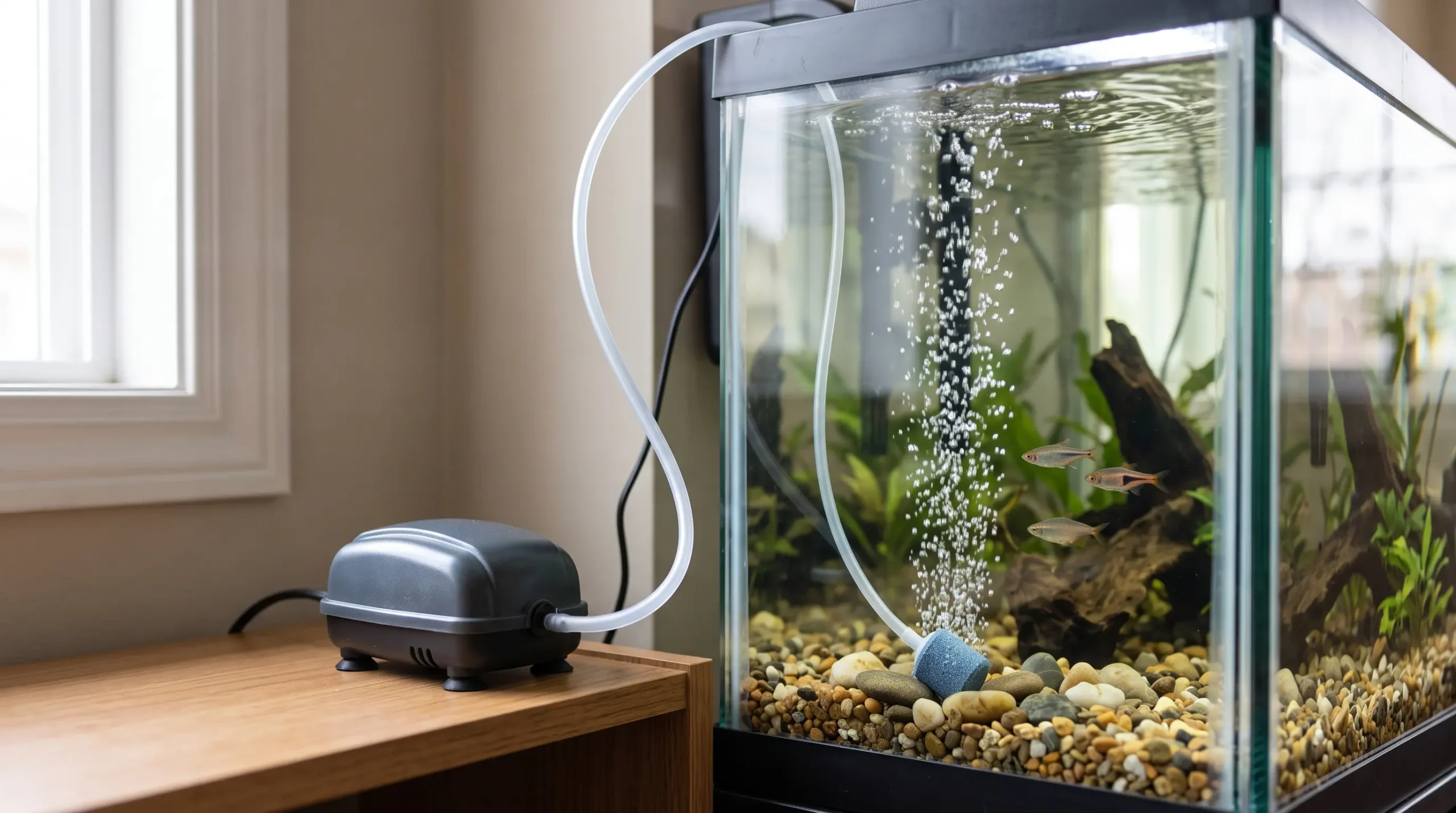
A submerged circulation pump that moves existing tank water is different: it does not normally draw room air into the water in the same way.
Do not switch off aquarium equipment indefinitely as a precaution. Aeration, circulation, and filtration may be essential for oxygen and water quality. Any temporary changes must follow the pesticide label and a plan that keeps the aquarium’s life support safe.
3. Residue carried on hands or aquarium tools
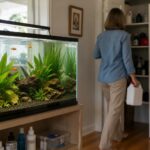
After handling pesticide products or treated surfaces, residue may transfer from hands, sleeves, or tools into the aquarium. Exposed nets, buckets, food containers, siphons, and spare filter media can also become contaminated.
Keep aquarium supplies separate from pesticide-handling areas. Our Pesticide Storage Near Aquariums guide covers cross-contact and storage in more detail.
4. Exposed water in connected equipment
A lid on the main display tank may leave an open sump, overflow chamber, or connected reservoir unprotected. Consider every exposed water surface and air intake—not just the visible aquarium.
How to Read the Insecticide Label for Aquarium Risk
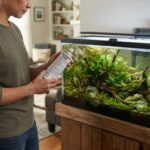
Check the exact product rather than relying on general claims that an insecticide is suitable for homes with pets.
- Active ingredients: Look for pyrethrins, permethrin, bifenthrin, deltamethrin, cypermethrin, and other pyrethroids.
- Environmental hazards: Read warnings about fish, aquatic invertebrates, and contamination of water.
- Application method: Note whether it is an aerosol, directed surface spray, fogger, or outdoor treatment.
- Aquarium instructions: Follow directions about covering tanks, fish, air pumps, and treatment near water.
- Ventilation and reentry: Follow the product’s requirements before restoring normal room use.
In the United States, check the EPA registration number where applicable. In Canada, check the applicable Health Canada registration and label requirements. Our pesticide label guide for pet owners explains how to find relevant directions.
Never apply an ordinary household insecticide directly to aquarium water. Such sprays are not treatments for aquarium pests.
Reducing Exposure Before Someone Sprays
Keep treatment away from the aquarium when possible
First, consider whether the pest problem can be managed without using pyrethrins or pyrethroids in the aquarium room or near its ventilation equipment.
If you hire a professional, explain the aquarium setup before treatment: open water, sumps, air pumps, and connected equipment. Ask for the exact product, application method, and whether the aquarium room can remain untreated.
Protect the whole system, not just the glass tank
If treatment cannot be avoided, follow the product’s aquarium-specific instructions and obtain a protection plan suitable for the actual setup. Depending on the product and equipment, precautions may involve isolating the room, protecting connected reservoirs, relocating the tank when feasible, or managing air-intake equipment.
A loose cover does not guarantee protection against airborne droplets or residue. Our Pest Control Around Fish Tanks guide provides the broader preparation checklist.
Don’t create a second risk by shutting down life support
Some pesticide applications require aquarium air pumps to be turned off to avoid drawing treated air into the water. But stopping aeration or filtration can also endanger fish.
There is no universally safe shutdown duration. Oxygen demand, stocking, temperature, filtration, and treatment time all matter. If you cannot meet the pesticide label’s requirements while keeping the aquarium safe, do not proceed until you have a better plan.
During and After Treatment: What Still Matters?
During application, protect aquarium water and supplies from the spray pathway. Avoid touching tank equipment with contaminated gloves, hands, or tools.
Afterward, complete the label’s ventilation and reentry instructions before removing temporary protection. If a cover was used, lift it carefully so residue on its exterior does not fall into the water. Restore and check any equipment that was intentionally shut down, including aeration, filtration, circulation, and temperature control.
No pesticide odor does not mean no contamination. A treated surface being dry also does not prove that an exposed aquarium is safe.
What If Pyrethrin or Pyrethroid Spray May Have Entered the Tank?
Possible contamination needs prompt attention. Stop further pesticide application near the tank, prevent additional exposure, and identify the exact product.
Contact an aquatic veterinarian or qualified aquatic-health professional promptly for product-specific advice. Severe distress or sudden changes in several animals require urgent assessment.
Possible signs include erratic swimming, loss of balance, unusual agitation, weakness, rapid gill movement, or multiple fish suddenly appearing distressed. These symptoms are not specific to pesticide poisoning; low oxygen and water-quality emergencies can look similar.
Keep the product label, ingredient information, and treatment records available. Ordinary ammonia, nitrite, and pH test kits do not measure pyrethrins or pyrethroids. Nor should you assume that an improvised amount of activated carbon, a chemical neutralizer, or a fixed water-change percentage will resolve every exposure.
For detailed response steps, see our Pesticide in a Fish Tank? Emergency Steps guide. This article focuses on preventing exposure.
Common Questions About Pyrethrin Sprays and Aquariums
Is a natural pyrethrin spray safe around fish?
Not automatically. Pyrethrins are plant-derived but highly to very highly toxic to fish. Risk depends on the formulation and how much, if any, reaches the aquarium.
Can I spray the opposite side of the room?
Don’t rely on distance alone. Air movement, drifting droplets, pump placement, and product instructions affect exposure. Avoid spraying in the aquarium room when a suitable alternative is available.
Are aquarium shrimp also at risk?
Yes. Aquatic invertebrates, including shrimp, may be especially sensitive to these insecticides. A product that appears not to affect fish cannot be assumed safe for shrimp.
Does covering the aquarium make spraying safe?
Not by itself. Open sumps, equipment that draws room air, cover gaps, and deposited residue can leave exposure routes. Follow the product label and a treatment-specific protection plan.
The Bottom Line
For fish keepers, the crucial question is whether pyrethrins or pyrethroids could reach aquarium water—not how far the tank sits from the spray nozzle.
Prevent spray drift and residue transfer, account for equipment that draws room air, and follow the exact product label. If safe aquarium protection cannot be arranged, choose another pest-control approach rather than risk contamination.
Aquatic Health & Pesticide Safety Disclaimer: This article provides general prevention information, not a guarantee that any pesticide application is safe near an aquarium. Risks depend on the product, formulation, application, aquarium design, and animals present. Follow registered labels and consult an aquatic veterinarian or qualified pesticide-information service if exposure is suspected.
Sources & Editorial References
- National Pesticide Information Center — Pyrethrins General Fact Sheet
- National Pesticide Information Center — Permethrin General Fact Sheet
- U.S. EPA — Pyrethrins and Pyrethroids Reregistration and Labeling
- U.S. EPA — Registration Review of Pyrethrins and Pyrethroids
- National Pesticide Information Center — Pets and Pesticide Use
- National Pesticide Information Center — Minimizing Exposure Around Pesticides
- Veterinary Clinics of North America: Exotic Animal Practice — Toxicology of Aquarium Fish