
How to Introduce a New Cat to Your Home, Room by Room
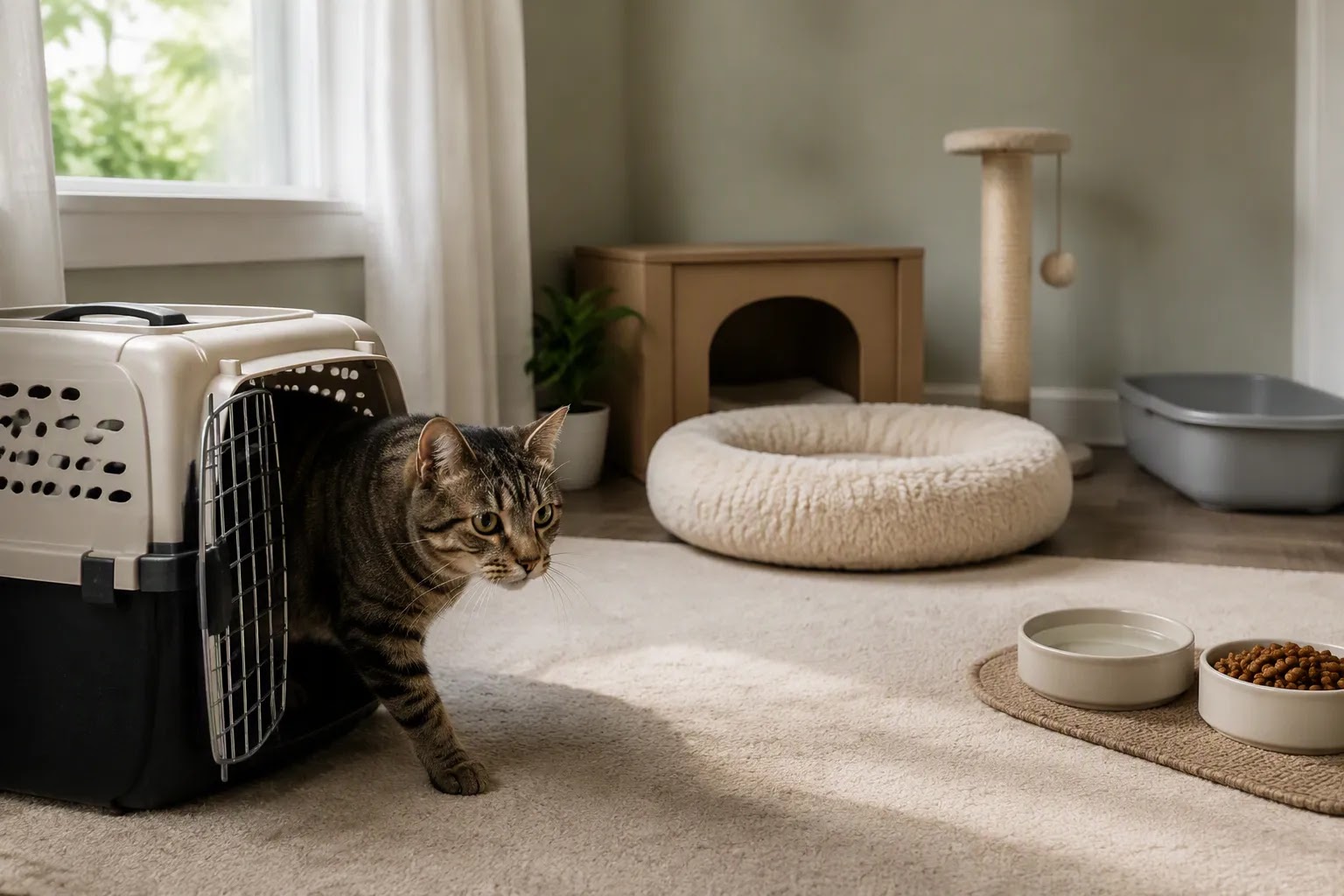
You bring your new cat home, carry the carrier inside, and open the door.
Nothing happens. Two eyes stare back from the far end. Maybe one paw appears, followed by a nose—then both disappear again.
That can feel anticlimactic after days of preparation, but your cat has just lost nearly everything familiar at once: smells, sounds, furniture, hiding places, people, and territory.
The goal on Day 1 is not to convince them to explore the whole house. It is to give them one small part of the home that quickly becomes understandable and safe.
Quick Answer: Start your new cat in one quiet, secure room with food, fresh water, a litter box, safe hiding places, a comfortable bed, scratching options, toys, and a perch when possible. Let the cat settle there before gradually opening access to quieter parts of the house. There is no universal number of days—use eating, litter-box habits, exploration, resting behavior, and growing curiosity to decide when your cat is ready for more space.
Why Start a New Cat in One Room?
An entire house may feel ordinary to you, but to a newly arrived cat it can mean dozens of unfamiliar smells, sounds, surfaces, openings, and hiding places at once.
A smaller starting area reduces how much information the cat has to process while keeping important resources easy to find.
Think of the first room as a home inside the home. Your cat learns where to eat, drink, eliminate, rest, scratch, hide, and observe. Once those locations become familiar, exploring the next part of the house no longer starts from zero.
Cat-Proof the Home Before Your Cat Arrives
Cat-proofing is much easier before a curious—or frightened—cat is already exploring.
Check future access areas for:
- loose or insecure window screens
- exterior doors that could become escape routes
- string, ribbon, yarn, blind cords, and dangling cables
- small objects that could be swallowed
- accessible medications, cleaners, and chemicals
- plants that may be toxic to cats
- recliners or folding furniture with dangerous moving parts
- open washers, dryers, dishwashers, and similar appliances
- gaps behind appliances or cabinets where a frightened cat could become trapped
Block dangerous hiding places. Don’t eliminate hiding itself.
A cardboard box, open carrier, covered bed, stable perch, or another secure retreat gives your cat somewhere to observe the new environment without feeling exposed.
If this is your first cat, our first-time cat owner guide covers additional home setup and safety basics.
Step 1: Create a Safe Room
Choose a quiet bedroom, office, or another secure room that does not have constant household traffic.
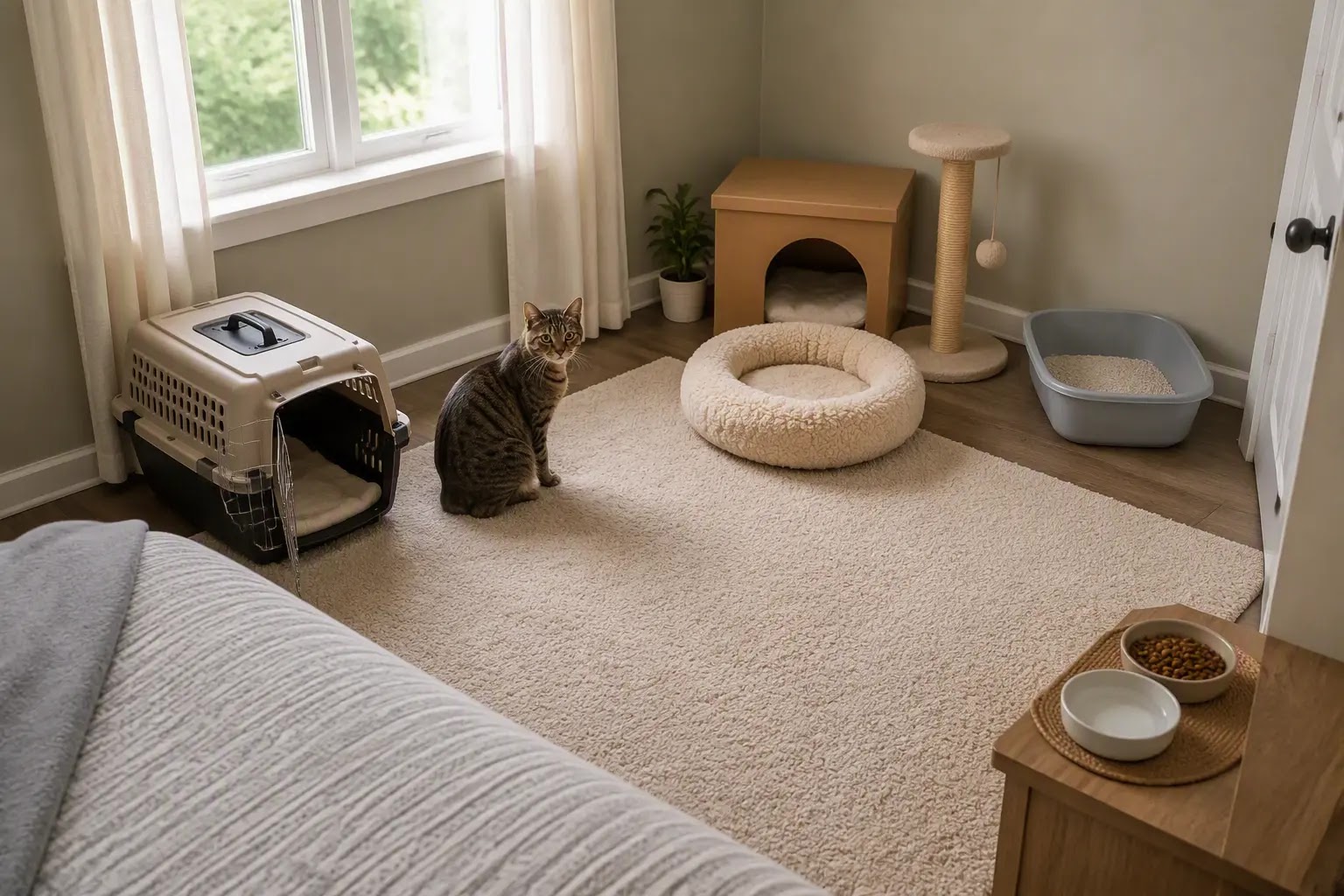
Set it up before your cat arrives with:
- a clean, accessible litter box
- the cat’s normal food when possible
- fresh water
- an open carrier, box, covered bed, or another safe hiding option
- a comfortable resting surface
- a scratching surface
- a few simple toys
- a secure perch or elevated resting spot when possible
- a familiar-smelling blanket or safe item from the previous home, if available
Keep the litter box away from food and water as much as the room reasonably allows. Avoid clustering every resource into one small corner simply for human convenience.
If you’re preparing a multi-cat household, our guide to how many litter boxes cats need explains the broader household setup.
When You First Open the Carrier
Carry the closed carrier directly into the prepared room and close the room door behind you.
Place the carrier securely on the floor, open it, and give your cat something surprisingly difficult for an excited new owner to offer: time without pressure.
Don’t tip the carrier forward, pull the cat out for a tour, or repeatedly reach inside to encourage exploration.
Let the cat decide when to emerge.
If you remain in the room, sit quietly and give them space. A cat watching silently from the carrier may appear to be doing nothing, but they are gathering information about the room—and about you.
Don’t Measure the First Day by Cuddles
Some cats leave the carrier and seek attention almost immediately. Others disappear into a box and stay there for much of the first evening.
Neither response predicts what your long-term relationship will look like.
Watch instead for basic functions and a gradual trend toward normal behavior:
- eating and drinking
- urinating and defecating
- using the litter box
- changing resting positions or locations
- grooming
- stretching and scratching
- playing or investigating the room
- relaxing enough to sleep
Progress can be quiet.
How Do You Know Your Cat Is Ready for More Space?
Don’t expand the territory simply because a certain number of days has passed.
Signs that your cat may be ready include:
- coming out voluntarily while you’re present
- eating and drinking normally
- using the litter box reliably
- exploring instead of remaining frozen in one hiding place
- grooming, stretching, scratching, playing, or resting more openly
- calmly observing household activity
- approaching you voluntarily
- showing repeated curiosity about the doorway
You do not need every sign before proceeding.
A useful question is: Is curiosity beginning to compete with caution?
Some hiding is normal during adjustment. If you’re unsure whether it is ordinary decompression or something more concerning, see our guide to why cats hide and when hiding may need attention.
Step 2: Use the Two-Way Door Rule
Once your cat seems comfortable in the base room, thoroughly cat-proof an adjoining area and choose a quiet period for the first expansion.
Open the door without turning the moment into a ceremony.
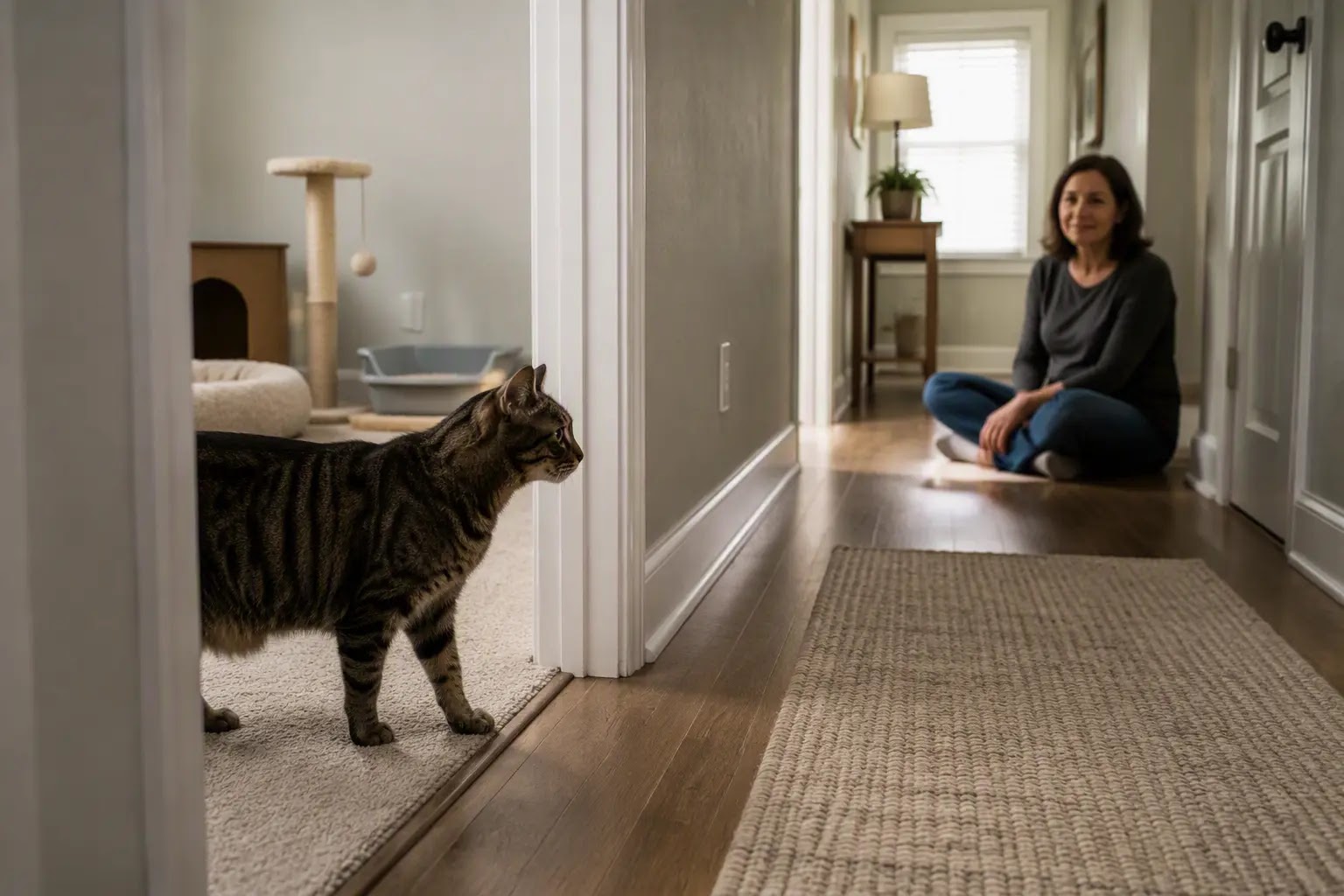
Your cat may walk confidently into the hallway. Or one paw may cross the threshold, followed by a long sniff and an immediate retreat.
Both count as exploration.
The Two-Way Door Rule: Early exploration works best when your cat can move in both directions. The doorway should lead to something new while preserving an easy route back to something familiar. Leaving the safe room and then immediately returning is not failure—the retreat option is working exactly as intended.
Carrying a hesitant cat into the middle of an unfamiliar room may move them farther into the house, but it also removes the choice that helps many cats feel secure.
Step 3: Add Easy Rooms Before Difficult Ones
Room-by-room does not need to mean a literal numbered sequence. Think in terms of difficulty.
A quiet bedroom or office may be easier than a kitchen full of cooking activity or a living room with television, children, visitors, and constant movement.
During early exploration, let your cat sniff edges, inspect furniture, climb safe surfaces, observe household sounds, and return to the base room whenever they choose.
You don’t need to follow two feet behind giving a guided tour. Quiet supervision leaves more room for voluntary exploration.
Scent is part of how unfamiliar territory gradually becomes familiar. Our guide to how cats use scent communication explains that part of feline behavior in more detail.
Step 4: Introduce Busy Spaces Later
Living Rooms and Shared Areas
Choose a relatively calm period for the first exploration rather than introducing the room during a party, vacuuming session, or children’s playtime.
Check windows, cords, recliners, unstable objects, dangerous hiding spaces, and available scratching areas first.
Kitchens
Kitchens combine appealing smells with hot surfaces, food, trash, cleaners, packaging, cabinets, appliances, and objects that may be swallowed.
Keep hazards inaccessible and check cabinets and appliances before closing doors or starting machinery.
Garages, Laundry Rooms, and Utility Areas
Some spaces do not need to become cat territory at all.
Garages may contain automotive fluids, tools, chemicals, vehicles, exterior doors, and hard-to-monitor hiding spaces. Utility and laundry areas can contain chemicals, machinery, cords, heat sources, and narrow gaps.
If a room cannot be made reliably safe, keeping the door closed is a completely reasonable part of cat-proofing.
What If Your Cat Gets Scared and Runs Back?
Let them.
A dropped pan, doorbell, visitor, vacuum, or other unfamiliar sound may send even a confident explorer back toward the base room.
That does not erase previous progress.
If exploration repeatedly leads to freezing, crouching, bolting, prolonged hiding, or increasing avoidance, reduce the accessible area to the last stage where your cat seemed comfortable and progress more gradually.
Going back one room can be part of moving forward.
If You Have Other Pets, Treat Introductions Separately
Learning the layout of a new home and meeting another animal are related, but they are not the same task.
Keep resident animals separated while your newcomer establishes the base room. Don’t let the first confident trip into the hallway accidentally become an unscheduled face-to-face meeting.
If another cat already lives in the home, provide sufficient separated resources and use a deliberate scent, visual, and physical introduction process rather than simply opening both doors.
Our guide to introducing a new cat to a resident cat covers that process separately.
How Long Before a New Cat Can Explore the Whole House?
There is no universal countdown.
A confident kitten or social adult may seek more space quickly. A cautious adult, a cat from a shelter, or a cat that has experienced several recent changes may need much longer.
The calendar tells you how long your cat has been home. It doesn’t tell you how safe the cat feels.
Use behavior instead.
Even after your cat comfortably explores much of the house, consider leaving the original room or some of its familiar hiding and resting options available. Familiar territory can remain useful long after the rest of the house stops feeling new.
When Adjustment May Be More Than Stress
Hiding, reduced social interaction, and cautious exploration can occur after a move. But not every new behavior should automatically be blamed on adjustment.
Contact your veterinarian when your new cat appears ill or is not returning toward normal basic functions. Repeated vomiting, difficulty breathing, marked lethargy, apparent pain, or a major appetite reduction deserve attention. A mature cat that has not eaten for about 24 hours should not simply be assumed to be “still settling in.”
Repeated attempts to urinate with little or no urine are an emergency, especially in a male cat. Straining, repeatedly entering the litter box, vocalizing, licking the genital area, vomiting, weakness, or a painful abdomen can accompany urinary obstruction and require immediate veterinary care.
The important distinction is simple: being frightened does not prevent a cat from also being sick.
The Bottom Line
Eventually, there may be a completely ordinary afternoon when your new cat walks out of the original room, crosses the hallway, jumps onto the couch, circles twice, and falls asleep.
No dramatic graduation happened. The house simply stopped feeling unfamiliar.
That is the point of progressing gradually. You’re not trying to prove that every room is safe. You’re giving your cat enough control, familiar resources, and retreat options to discover the home at their own pace.
If today’s progress is one cautious paw through the doorway followed by a retreat, it still counts. The door worked both ways.
Sources & Editorial Standards
Safe places, hiding and climbing options, separated environmental resources, predictable interaction, and gradual exposure were checked against current Feline Veterinary Medical Association environmental guidance and its 2025 Indoor Cats Position Statement.
Safe-room setup, litter-box placement, and basic new-cat care were cross-checked against the Cornell Feline Health Center.
Gradual introduction to a new environment and allowing a cat time to become familiar with a smaller space before expanding access were reviewed against VCA Animal Hospitals guidance on bringing a new cat home and VCA guidance on moving with cats.
The appetite warning was checked against Cornell guidance on feline anorexia. Urinary-obstruction warnings were checked against the Merck Veterinary Manual.
This guide uses the individual cat’s behavior rather than a rigid number of days to determine when territory should expand. Introductions to resident animals are treated as a separate process because comfort with the physical home does not automatically mean readiness for direct social contact.