Aquarium Surface Agitation: Oxygen, Gas Exchange & Flow
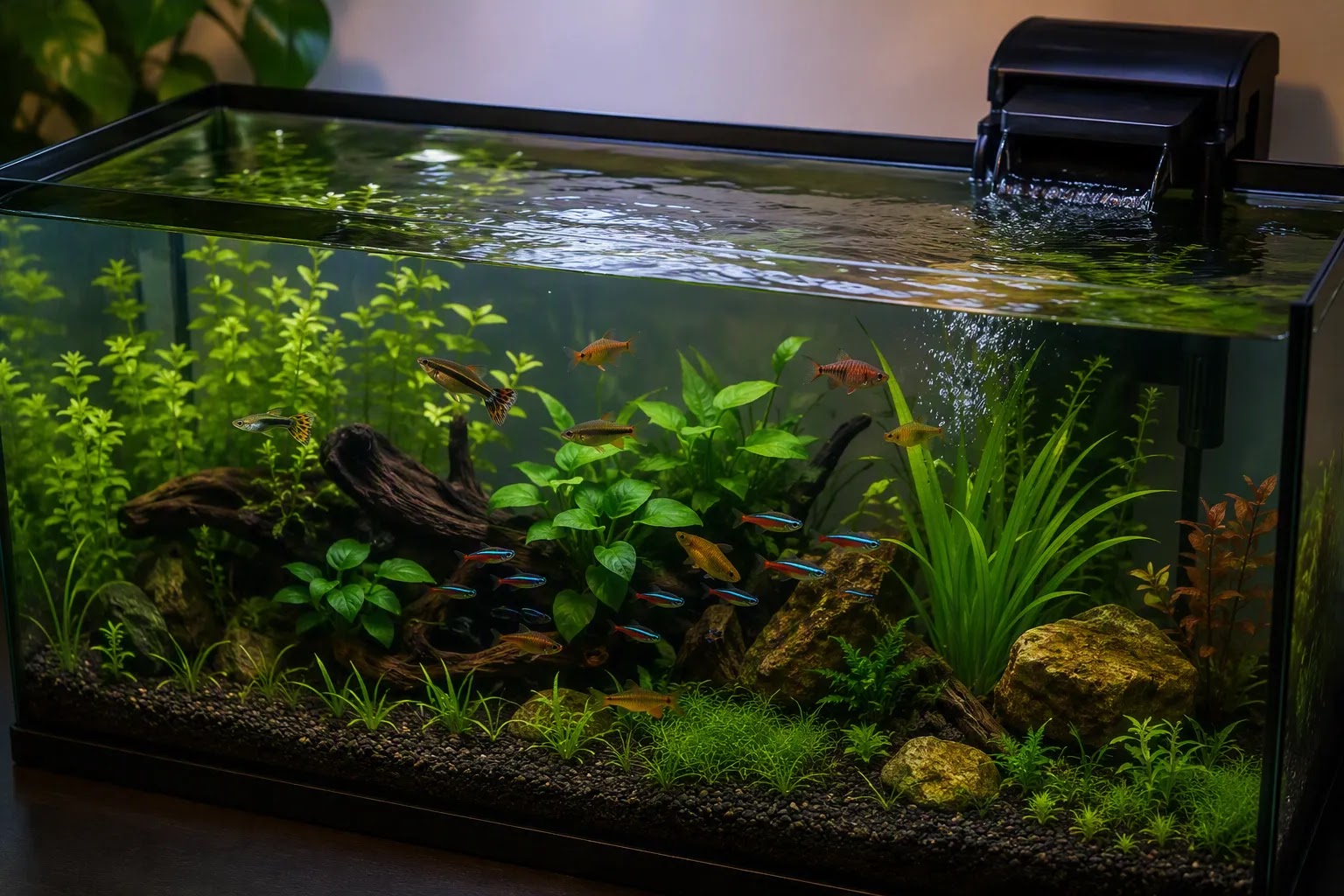
You adjust the filter until the aquarium surface becomes perfectly still. No splashing. No shimmer. No trickling sound. It looks peaceful.
Then you start wondering: Is it too calm? Are the fish getting enough oxygen?
Or perhaps you have the opposite problem—the filter churns so aggressively that your fish spend much of the day fighting the current.
The answer is usually somewhere between those extremes.
Quick Answer: For many freshwater aquariums, a visible, continuous ripple across much of the surface is a useful starting point. You do not need violent splashing. The real goal is enough surface turnover for healthy gas exchange while preserving comfortable flow for the fish. Temperature, stocking, plants, CO₂ injection, filtration, and species preferences all affect how much aeration a particular tank needs.
What Surface Agitation Actually Does
Fish do not breathe the oxygen atom chemically bound inside water molecules.
They depend on dissolved oxygen—oxygen gas dissolved in the water.
Oxygen and carbon dioxide move between aquarium water and the surrounding air at the air-water boundary. Surface movement helps this exchange by continually bringing new water to that boundary and mixing oxygenated surface water through the aquarium.
A perfectly calm surface does not automatically mean the aquarium is dangerously low in oxygen.
But good surface turnover generally makes gas exchange more effective and gives the system more breathing room when oxygen demand rises.
Why Does an Air Stone Help?
An air stone does more than release visible bubbles.
As bubbles rise, they move surrounding water upward. When they reach the top, they disturb the surface and help circulate water through the air-water boundary.
Some gas transfer can occur around the bubbles themselves, but much of the practical benefit comes from water movement and surface gas exchange.
That is why an aquarium can be well aerated without an air stone if its filter already creates good surface turnover.
Surface Agitation Is Not the Same as Flow
This distinction solves a lot of aquarium confusion.
Surface agitation is movement at the air-water boundary. Flow is water movement throughout the aquarium.
The two interact, but they are not the same thing.
A powerful pump can create a strong current in the middle of the tank while leaving the surface surprisingly calm.
On the other hand, angling a modest filter outlet slightly upward can create useful surface movement without turning the entire aquarium into a high-current environment.
The Direction-of-Flow Rule: Before buying a stronger pump, try changing where your existing flow goes. Redirecting part of the filter return toward the surface can improve gas exchange while leaving calmer areas below for fish that dislike strong current.
How Much Surface Agitation Do You Need?
There is no universal percentage or ripple height that fits every freshwater aquarium.
For many community tanks, a good visual starting point is a steady gentle ripple across a substantial part of the surface.
The reflection should move. The water does not need to splash over the rim or sound like a fountain.
Try this:
- Position the filter outlet near the upper part of the aquarium.
- Angle part of the flow toward the surface.
- Aim for broad movement rather than one violently turbulent spot.
- Watch the rest of the aquarium. Fish should still be able to swim, feed, and rest comfortably.
- Recheck after changes. Warmer water, added fish, plant growth, clogged filters, and shifted outlets can all alter the balance.

If you are still designing filtration and circulation, our freshwater aquarium setup guide covers the rest of the system.
Signs Your Aquarium May Need More Aeration
A glassy surface alone does not diagnose low dissolved oxygen.
Pay more attention when limited surface movement appears alongside changes in fish behavior, temperature, stocking, or equipment performance.
Several Fish Are Gasping Near the Surface
Fish experiencing hypoxia may gather near the surface, remain close to stronger aeration, breathe rapidly, or appear to gulp at the air-water boundary.
But gasping is not specific to low oxygen.
Nitrite toxicity, gill disease, ammonia problems, excessive heat, toxins, and other water-quality or health issues can produce respiratory distress too.
If several fish suddenly begin gasping: Increase aeration or surface movement promptly while checking temperature, ammonia, nitrite, filter operation, and other water-quality conditions. Do not assume the visible ripple tells you the cause.
Our fish-gasping emergency guide walks through that troubleshooting process separately.
The Tank Is Running Hotter Than Usual
Warm water holds less dissolved oxygen than cooler water.
At the same time, fish and microorganisms continue using oxygen, and metabolic demand may increase as temperatures rise within a species’ tolerable range.
That means a tank that normally has an adequate oxygen margin can become less forgiving during unusually warm weather.
Extra surface movement and aeration can help while you also address the temperature problem itself.
A Surface Film Keeps Returning
Organic material, oils, microorganisms, dust, and proteins can collect at the air-water boundary, especially where surface circulation is weak.
A surface film does not prove that fish are oxygen deprived.
But persistent buildup is a reason to review surface movement, feeding, circulation, and routine maintenance.
Your Biofilter Needs Oxygen Too
Fish are not the only organisms using dissolved oxygen.
The nitrifying microorganisms responsible for processing ammonia and nitrite also require oxygen.
Reliable water flow through biological filter media therefore serves two purposes:
- it carries nitrogen waste to the biofilter
- it supplies oxygen needed for nitrification
A clogged filter, reduced circulation, or prolonged loss of aeration can therefore affect both fish respiration and biological-filtration performance.
Can You Have Too Much Surface Agitation?
Yes, but the practical problem is often too much overall current and turbulence rather than simply seeing a lively surface.
Excessive turbulence can create:
- unnecessary splashing
- more evaporation
- noise
- mineral deposits around the rim
- strong current that some fish cannot comfortably escape
- greater CO₂ loss in injected planted aquariums
Watch the fish rather than judging current only by the surface.
Flow may be excessive if fish are continually pushed sideways, struggle to remain in place, hide behind decorations to escape the current, or cannot feed normally because food immediately blows away.
Different species have very different flow preferences.
Instead of eliminating surface agitation, try redirecting or diffusing the return and arranging plants or hardscape so fish can choose calmer zones.
What About Planted and CO₂-Injected Aquariums?
A planted tank still needs healthy gas exchange.
Plants produce oxygen during photosynthesis when conditions support it, but plants, fish, nitrifying microorganisms, and other organisms also respire and consume oxygen.
When CO₂ is artificially injected above its equilibrium level with the surrounding air, stronger gas exchange can also increase the rate at which that added CO₂ escapes.
This creates a genuine balancing act.
Too little gas exchange: oxygen margin can shrink and CO₂ may accumulate excessively.
Needlessly aggressive turbulence: maintaining injected CO₂ can become less efficient.
The solution is not a mirror-flat surface.
A better goal is consistent surface turnover with controlled CO₂ injection, adjusted according to the fish, plant demand, water movement, and measured response of the tank.
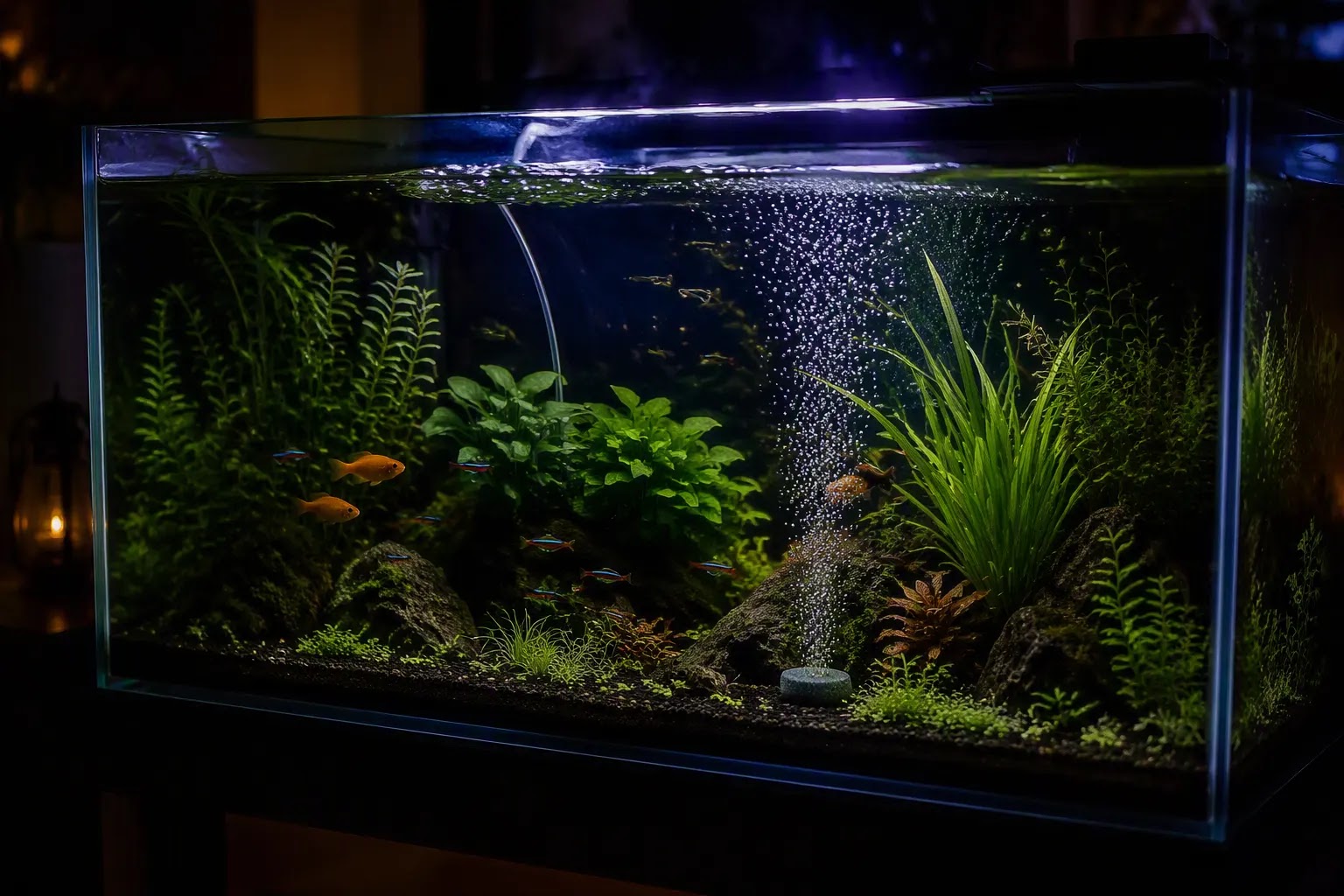
Do You Need an Air Stone?
Not necessarily.
If your filter already provides reliable surface turnover, temperature is appropriate, circulation reaches the tank effectively, and the fish show no respiratory distress, an additional air stone may not noticeably improve everyday conditions.
Extra aeration becomes more useful when:
- water temperature is unusually high
- stocking creates higher oxygen demand
- the main filter produces little surface movement
- a medication or treatment calls for increased aeration
- nighttime oxygen is a concern in a heavily planted system
- you want backup aeration during emergencies or filter problems
A sponge filter can add both biological filtration and gentle surface movement. A simple air stone can provide aeration without becoming the primary filter.
If you’re choosing backup or routine aeration equipment, see our aquarium air pump guide.
The Reflection Check
You do not need laboratory equipment to make a basic visual adjustment.
Look across the water surface from a low angle.
You are not looking for bubbles. You are watching the reflection.
The Reflection Check: If light is gently moving across much of the surface while your fish can still swim, feed, and rest comfortably below, the setup is usually closer to the goal than either a mirror-flat surface or a miniature wave machine.
Then check the context:
- Are the fish breathing normally?
- Can weaker swimmers leave the main current?
- Is the aquarium unusually warm?
- Are several fish clustering near the surface?
- Has the filter outlet shifted?
- Has flow dropped because the filter or intake needs maintenance?
- Have floating plants covered more of the surface?
Sometimes improving gas exchange requires no new equipment at all. A filter outlet may simply need to be cleaned, raised, or angled differently.
The Bottom Line
Surface agitation does not need to be dramatic.
Its job is to help the aquarium exchange gases efficiently while the rest of the tank remains comfortable for the animals living there.
A gentle, continuous ripple is a useful visual starting point—not a dissolved-oxygen measurement and not a rigid rule.
Watch the surface, but also watch the fish, temperature, filtration, stocking, and water quality.
If several fish suddenly start gasping, increase aeration promptly and investigate the cause rather than assuming that making bigger waves is the complete solution.
Sources & Editorial Standards
Dissolved oxygen, atmospheric oxygen exchange, water movement, and the relationship between water temperature and oxygen-holding capacity were checked against current U.S. Geological Survey dissolved-oxygen guidance.
Fish hypoxia signs, surface piping, temperature effects, dissolved-oxygen considerations, and alternative causes of surface gasping were cross-checked against the Merck Veterinary Manual guidance on environmental disease in aquatic systems.
The oxygen requirements of biological filtration and the importance of water movement through nitrifying biofilters were checked against the Merck Veterinary Manual guidance on aquatic life-support systems.
The practical effects of air stones and surface gas exchange were also compared with Aquarium Co-Op dissolved-oxygen testing.
CO₂-injected planted-aquarium discussion was cross-checked against current Aquarium Co-Op CO₂ guidance and 2Hr Aquarist guidance on gas exchange in CO₂-injected tanks.
Because dissolved-oxygen requirements and preferred current vary by species, temperature, stocking, altitude, salinity, plant load, and system design, this article intentionally does not assign one universal ripple strength or dissolved-oxygen target to every home aquarium.