Aquarium Power Outage: Emergency Priorities for Oxygen, Heat & Filtration
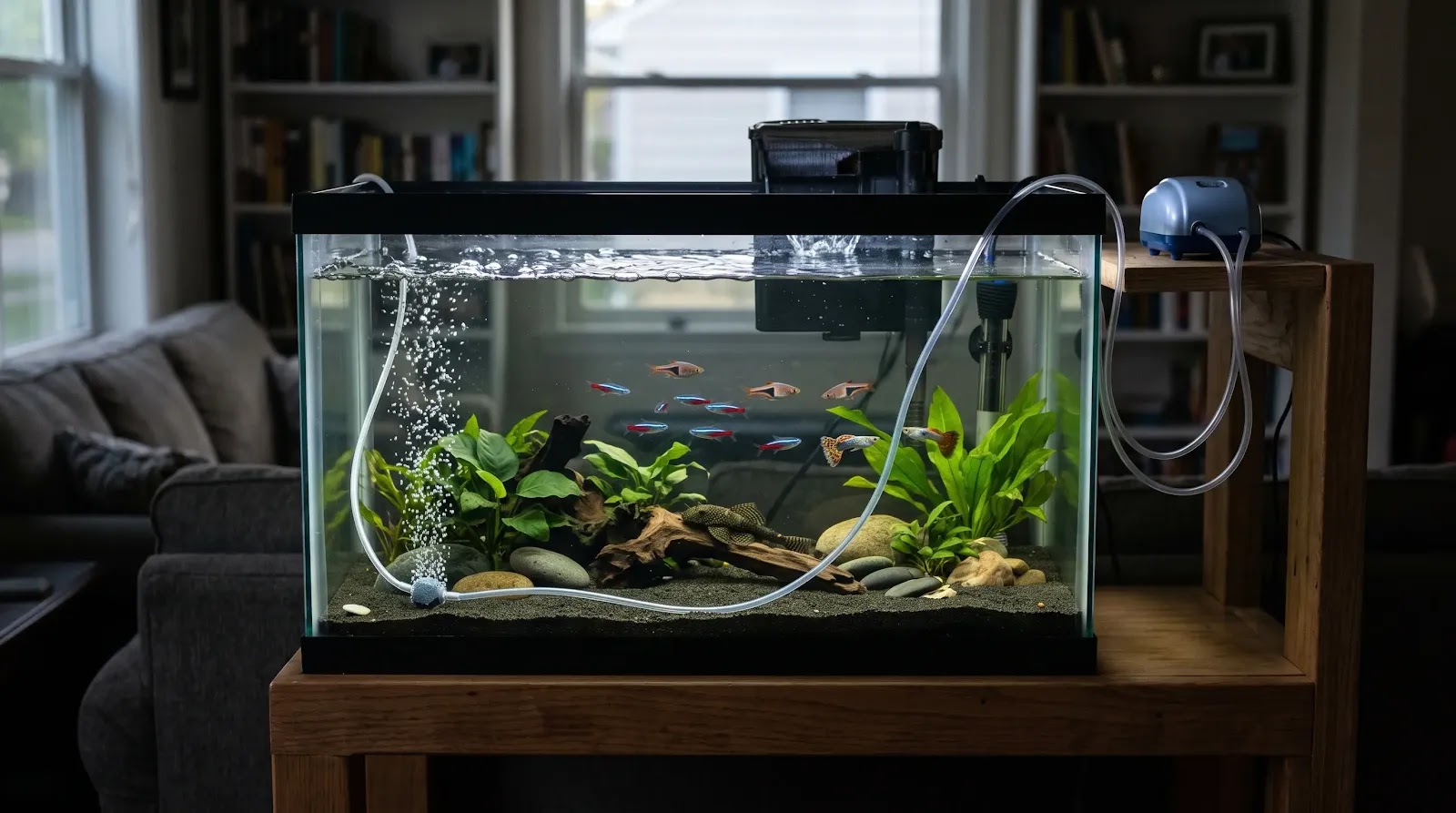
If the power goes out, the aquarium becomes a life-support problem before it becomes a lighting problem. Filters, pumps, air stones, heaters, chillers, and circulation equipment may all stop at once.
Your first priority is oxygen. Then protect temperature stability and biological filtration while watching the fish closely.
What to Do Right Now
- Start aeration or surface movement. Use a battery air pump if you have one.
- Stop routine feeding. Do not add unnecessary waste while filtration is compromised.
- Check the water temperature. Prevent rapid heating or cooling, but do not make abrupt corrections.
- Watch the fish. Gasping, rapid gill movement, severe weakness, or loss of normal swimming control requires faster action.
- Do not wait for a fixed number of hours. A warm, heavily stocked tank can develop trouble much sooner than a cool, lightly stocked one.
Do not pour ice or very hot water into the aquarium, deep-clean the filter, or spend limited backup power on lights while oxygenation is failing.
Oxygen Comes First
When pumps and filters stop moving water, surface agitation can fall quickly. Fish continue consuming oxygen, along with other organisms in the aquarium and the bacteria involved in biological filtration.
Low dissolved oxygen can cause fish to gather near the surface, breathe rapidly, or appear to gulp air. Warm water deserves extra caution because it holds less dissolved oxygen than cooler water.
If you have a battery-powered air pump, connect it to an air stone or air-driven sponge filter and make sure it creates visible movement at the water surface.
If backup power is limited, aeration or useful circulation is generally a higher immediate priority than aquarium lighting.
Our guide to aquarium air pumps and battery backups covers emergency equipment options for future outages.
If You Have No Battery Air Pump
Manual aeration can serve as a temporary fallback.
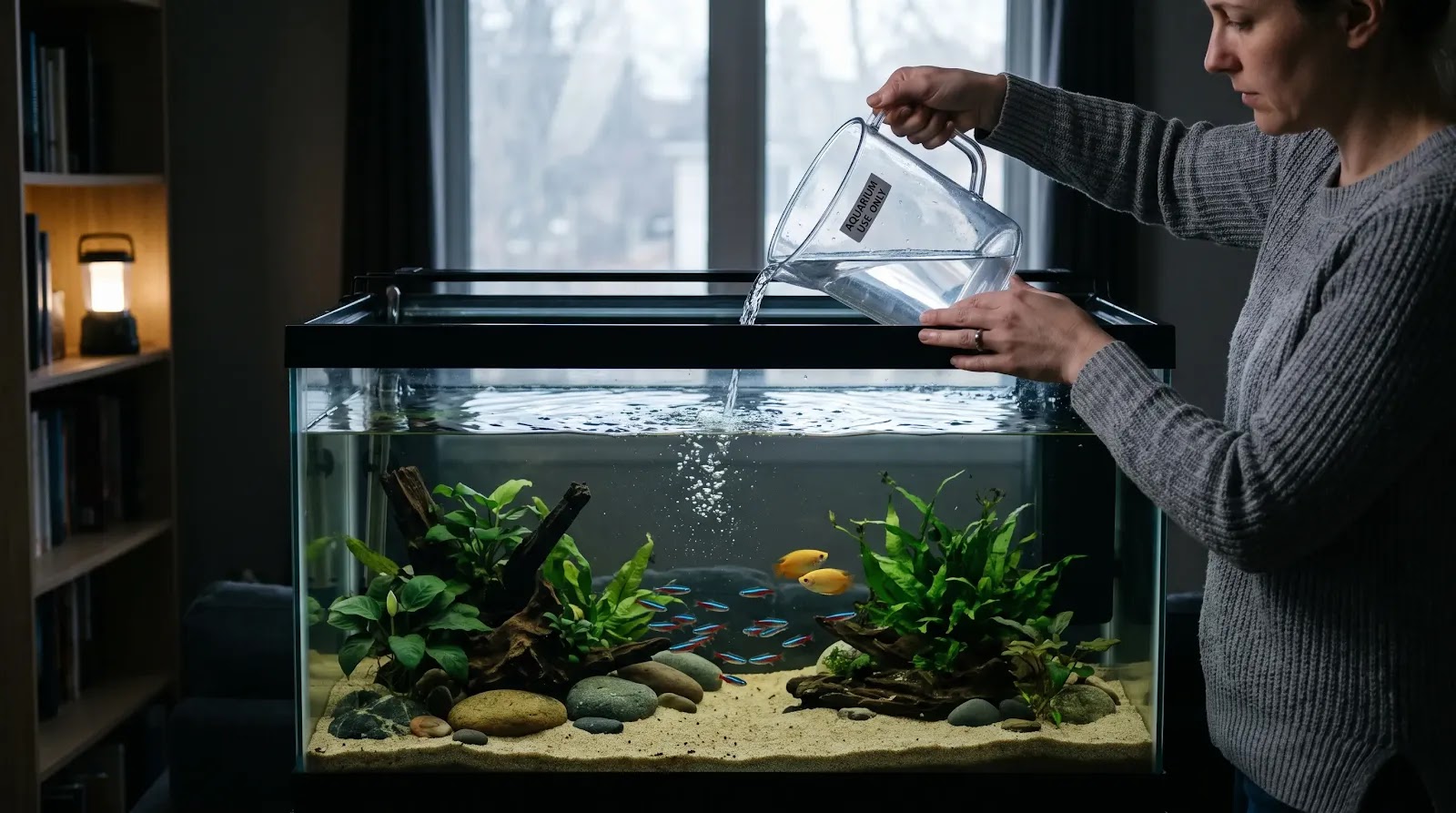
Use a clean container that has never held soap or household chemicals. Scoop aquarium water and gently pour it back across the surface so the returning water creates agitation.
Repeat as needed while watching the fish rather than relying on a fixed timetable that may not match your tank’s oxygen demand.
Do not stir deeply into the substrate or create violent turbulence around weak fish simply to make more movement.
If you want the background on why surface movement matters, see our guide to aquarium surface agitation and gas exchange.
Stop Feeding Until the System Is Stable
Pause routine feeding during the outage.
Food adds material the aquarium eventually has to process while circulation and biological filtration may already be compromised. For most otherwise stable adult aquarium fish, temporarily missing routine meals is generally less concerning than adding unnecessary waste during an equipment failure.
Fry, very small species, or fish with special nutritional or medical needs may require different planning.
If an automatic feeder continues operating independently from household power, disable it until the aquarium is stable again.
Protect Temperature Without Shocking the Fish
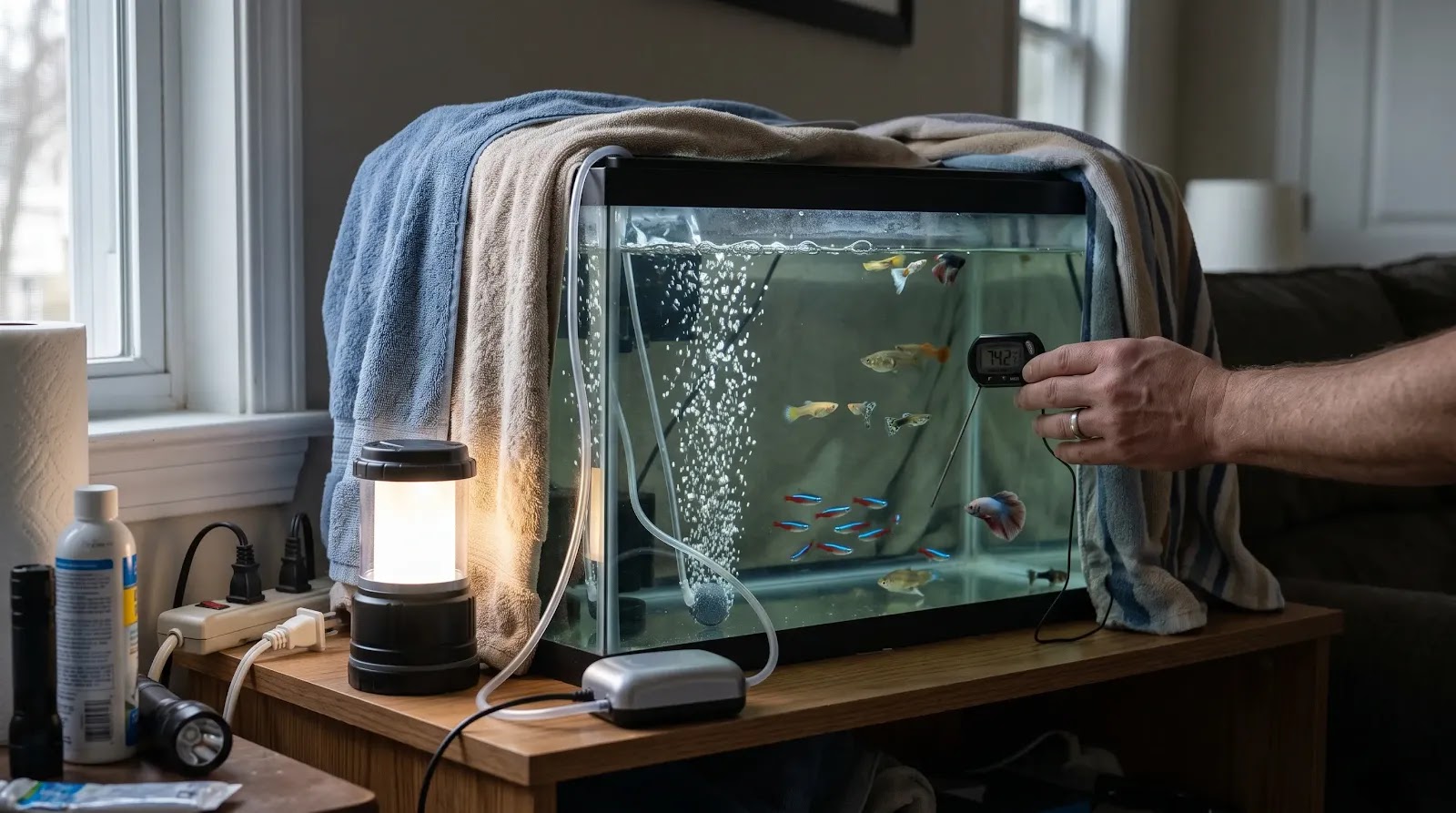
Once oxygenation is addressed, check the water with a separate thermometer.
In a cold room, slow heat loss by insulating the sides and back of the aquarium with towels or blankets. Do not completely seal the water surface, block emergency aeration, or cover electrical equipment in a way that creates a hazard.
In hot conditions, keep the aquarium away from direct sunlight and reduce unnecessary heat in the room. As the water warms, oxygen becomes even more important.
Do not add ice, boiling water, or very hot water directly to the aquarium. Sudden local temperature changes can create additional stress.
If temperature correction becomes necessary, make controlled changes while monitoring the thermometer.
With limited battery capacity, do not automatically exhaust your backup supply on a high-wattage heater while ignoring severe oxygen loss. The correct balance depends on the species and how far the water temperature has moved from its safe range.
Protect the Biological Filter
A power outage does not instantly erase the nitrogen cycle, but nitrifying bacteria depend on oxygenated water reaching the biological media.
As flow remains stopped, conditions can deteriorate—particularly inside enclosed filters where water becomes stagnant or media is allowed to dry.
If removable biological media is at risk of drying during a prolonged outage, keep it wet with aquarium water. When practical, suitable media can be kept where emergency aeration exposes it to oxygenated aquarium water.
Do not rinse established biological media in untreated chlorinated tap water during the emergency.
Be Careful Restarting a Filter That Has Sat Stagnant
Different filter designs behave differently during a long loss of flow. A sponge filter sitting in the aquarium is not the same situation as an enclosed canister full of stagnant water.
If a sealed canister or other enclosed filter has been stagnant for a prolonged period, inspect it before immediately pumping its contents back into the aquarium.
If you find obvious decomposition or an unusually foul odor, service the filter carefully with aquarium water or properly dechlorinated water rather than simply flushing stagnant material into the tank.
For a more detailed filter-specific emergency, see our Fish Filter Stopped Overnight guide.
What Not to Do During a Power Outage
- Do not keep feeding normally. Avoid adding unnecessary biological load.
- Do not wait for a universal “safe” outage time. Risk varies too much between aquariums.
- Do not add ice or very hot water directly.
- Do not deep-clean the substrate and filter during the emergency.
- Do not replace established filter media simply because circulation stopped.
- Do not prioritize aquarium lighting over oxygenation.
- Do not touch wet electrical plugs, power strips, or damaged equipment. Human electrical safety comes first.
Red Flags: Watch the Fish, Not the Clock
Increase aeration and treat the situation as urgent if several fish are gasping or piping at the surface, showing markedly rapid gill movement, crowding around the only source of water movement, becoming severely weak, or losing normal swimming control.
Gasping does not prove low dissolved oxygen is the only problem—nitrite, gill disease, and other water-quality problems can create similar signs—but widespread respiratory distress during a blackout requires prompt action.
Large fish, active species, warm aquariums, heavily stocked tanks, and systems with high biological demand may run into oxygen problems sooner than lightly stocked aquariums.
That is why the condition of the fish is more useful than counting hours.
When the Power Comes Back On
Do not assume the emergency is over when the lights return.
- Confirm aeration and circulation. Make sure pumps and filters have actually restarted and are moving water normally.
- Check heaters or chillers. Confirm they are operating correctly rather than merely receiving power.
- Inspect for electrical problems. If there was a leak, splash, damaged cord, or wet outlet, address human safety first.
- Check temperature. Avoid abruptly correcting any drift.
- Test ammonia and nitrite. This matters especially after a prolonged outage or disrupted biological filtration.
Our aquarium water test kit guide explains the practical differences between common testing methods.
If ammonia is elevated, follow our aquarium ammonia spike emergency guide. If nitrite is the problem, use the separate aquarium nitrite spike guide rather than trying to solve either issue by simply resuming normal feeding.
Resume feeding after circulation and filtration are working, fish behavior is stable, and water quality is acceptable. Start modestly rather than trying to compensate for skipped meals.
When Fish Need Urgent Veterinary Help
Most aquarium blackout emergencies begin as environmental problems, so restoring oxygen, temperature stability, and safe water quality is the immediate priority.
Contact a veterinarian with fish experience promptly if fish:
- Remain in severe respiratory distress despite restored aeration
- Cannot remain upright
- Become minimally responsive
- Develop persistent abnormal swimming
- May have suffered electrical or thermal injury
- Continue deteriorating after the environmental problem is corrected
Professional help is also appropriate if several fish become critically ill or die, or if temperature or water chemistry has moved into a dangerous range that you cannot stabilize safely.
For readers in North America, the American Association of Fish Veterinarians’ Find a Fish Vet tool can help locate a veterinarian with fish experience.
The Emergency Order to Remember
Oxygen first. Temperature stability second. Then protect filtration and water quality.
Do not wait for an arbitrary outage deadline if your fish are already showing respiratory distress. Start safe aeration, stop routine feeding, avoid abrupt temperature changes, preserve the biological filter where practical, and reassess the entire system when electricity returns.
Sources & Editorial Standards
Fish emergency signs, low-dissolved-oxygen risk, temperature hazards, and post-emergency water-quality principles were checked against the Merck Veterinary Manual — Emergencies of Fish, the Merck Veterinary Manual — Common Environmental Hazards for Fish, and Merck Veterinary Manual — Environmental Diseases of Aquatic Animals.
Biological-filtration and nitrification guidance was checked against the Merck Veterinary Manual — Aquatic Life Support System Components and Oklahoma State University Extension guidance on nitrification, oxygen, and power loss.
Veterinary note: This guide provides immediate aquarium-system first aid and does not replace advice or examination from a veterinarian experienced with fish when animals remain seriously ill or distressed.