Why Does My Hamster Chew the Cage Bars?
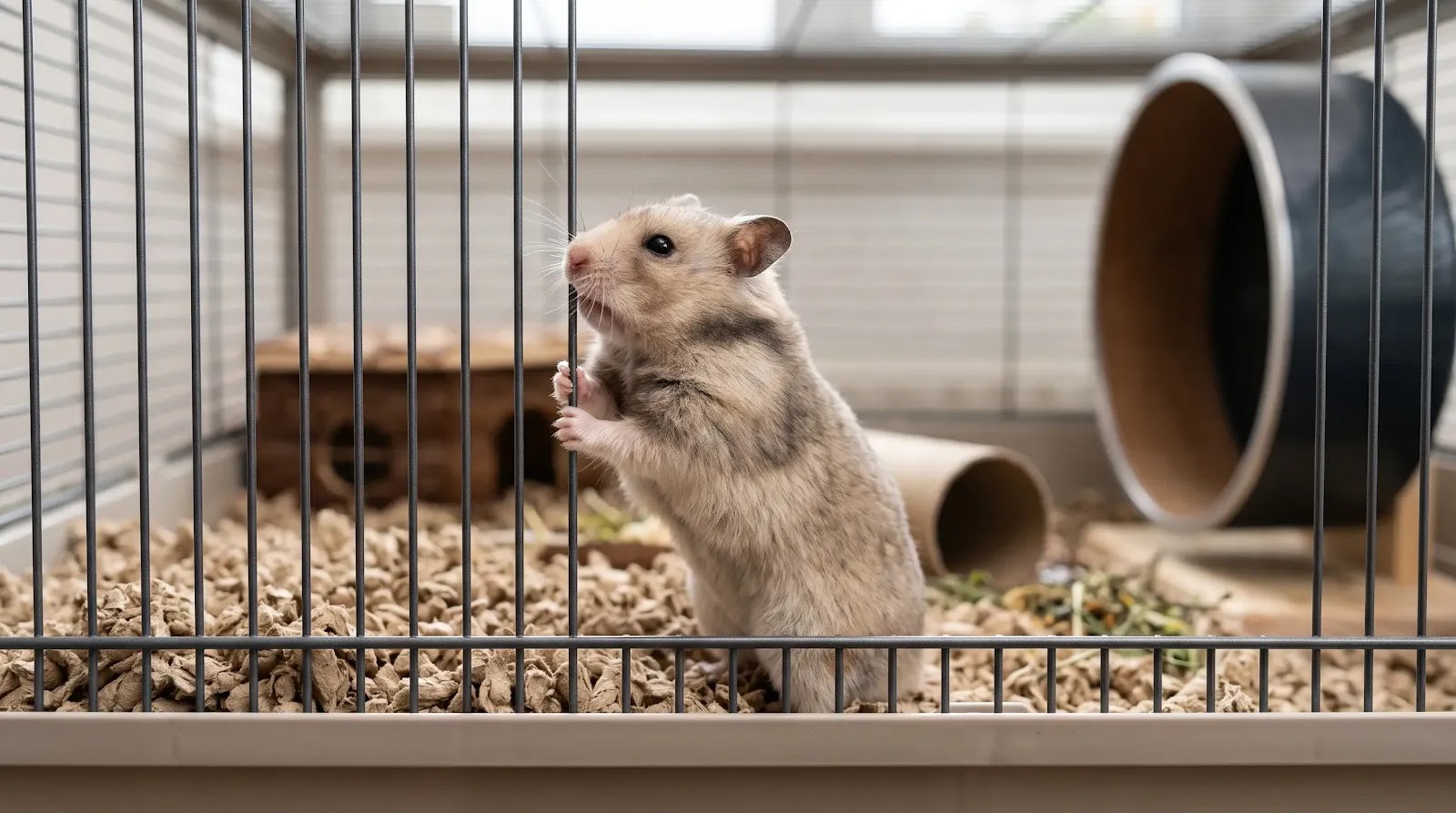
Your hamster keeps returning to the same section of cage bars, gripping them with their paws and chewing again and again. Food is available. The wheel is there. Maybe you have even added chew toys—so why are they still doing it?
It is easy to wonder whether they are bored, stressed, trying to escape, or simply doing something normal.
Hamsters naturally gnaw, but persistent chewing on metal cage bars is different from simply needing something safe to chew. Repetitive bar chewing can be associated with frustration, stress, or a habitat that is not giving the hamster enough opportunity to dig, forage, hide, explore, and move normally.
What to check first: look at the whole habitat rather than the bars alone. Usable enclosure space, bedding depth, wheel setup, enrichment, and the enclosure’s location can all matter. An occasional nibble does not prove that your hamster is severely stressed, but frequent or prolonged bar chewing is useful feedback about the setup.
Repeated Bar Chewing Is Worth Paying Attention To
Research supports looking at housing rather than dismissing wire chewing as a harmless way to wear down the teeth.
In a controlled study of female golden hamsters housed in four cage sizes, stereotypic wire gnawing occurred in every group but was significantly longer and more frequent in the smaller cages.
A 2024 owner survey of Syrian hamsters also found that shallower substrate depth was significantly associated with more owner-reported bar biting.
Those findings do not mean every hamster that touches a bar has the same welfare problem, and an association does not prove one single cause.
They do support a practical response: when bar chewing becomes frequent or repetitive, audit the habitat rather than treating the bars themselves as the problem.
Start With Usable Enclosure Space
A hamster can have a food bowl, wheel, house, tubes, and toys yet still have very little continuous space for normal activity.
If your hamster repeatedly patrols the perimeter, climbs toward the lid, or keeps returning to the bars, consider whether the enclosure gives enough usable floor area for burrowing, a correctly sized wheel, hiding places, and exploration.
Do not assume platforms and narrow connected sections replace continuous ground space.
If the current enclosure is the limiting factor, our guide to hamster enclosures, including tanks, bins, and barred cages compares those options separately.
Check Whether the Bedding Allows Real Burrowing
Bedding is not simply a soft layer over the floor. Digging and burrow construction are important parts of normal hamster behavior.
A very shallow layer can leave the hamster with little opportunity to build tunnels or create a secure underground area.
Adding more toys does not fully replace that missing activity.
If the enclosure cannot safely accommodate useful bedding depth, that can be a more important limitation than adding another chew block.
Our deep bedding guide for hamsters covers burrowing setup in more detail without repeating it here.
Enrichment Should Give the Hamster Something to Do
An enclosure can look busy while offering surprisingly few activities.
Useful enrichment gives the hamster choices and encourages natural behavior. Depending on the setup, that can include:
- Several secure hiding places
- Cardboard tunnels and boxes
- Safe wooden gnawing materials
- Scatter feeding or hidden food for foraging
- Different safe textures and digging areas
- Selected enrichment rotated occasionally without constantly rebuilding the entire home
A useful way to judge the setup is to ask:
Where can the hamster dig? Where can they hide? What can they search for? Where can they run? What can they safely gnaw?
Those questions tell you more than simply counting how many toys are present.
Make Sure the Wheel Is Actually Usable
A wheel is an important activity outlet, but its presence alone does not mean the hamster can use it comfortably.
Check that the wheel is solid, stable, easy to turn, not blocked by bedding, and large enough for the hamster to run without an obviously curved back.
If you are unsure about the current setup, our hamster wheel size and species guide covers that decision separately.
Stress Can Come From Outside the Enclosure Too
The cage itself is only part of the environment.
Frequent disturbance during normal sleeping hours, bright or unpredictable lighting, loud noise, repeated cage movement, or a dog or cat regularly hovering near the enclosure can make the hamster’s surroundings less predictable.
RSPCA guidance recommends a secure environment with appropriate bedding, hiding opportunities, and protection from disturbing conditions and other pets.
If the enclosure is in a busy location, improving the surroundings may help more than adding another accessory.
What to Change First
You do not need to replace every item at once. Work through the habitat in a useful order:
- Assess the enclosure. Does it provide enough continuous usable area for normal movement, bedding, hides, and the wheel?
- Improve burrowing opportunity. Provide suitable substrate depth where the enclosure safely allows it.
- Check the wheel. Make sure it is appropriately sized, stable, solid, and accessible.
- Add activities rather than clutter. Prioritize foraging, hiding, tunneling, digging, shredding, and safe gnawing.
- Reduce avoidable disturbance. Protect daytime sleep and keep the enclosure away from persistent noise, bright light, and predator pets.
Why One Chew Toy May Not Stop the Behavior
Hamster incisors grow continuously, so safe things to gnaw are important.
But if bar chewing is being driven by limited space, shallow bedding, lack of foraging opportunities, an unsuitable wheel, or another environmental frustration, adding one wooden chew does not address the underlying issue.
That is why an enclosure audit is usually more useful than searching for one anti-chewing product.
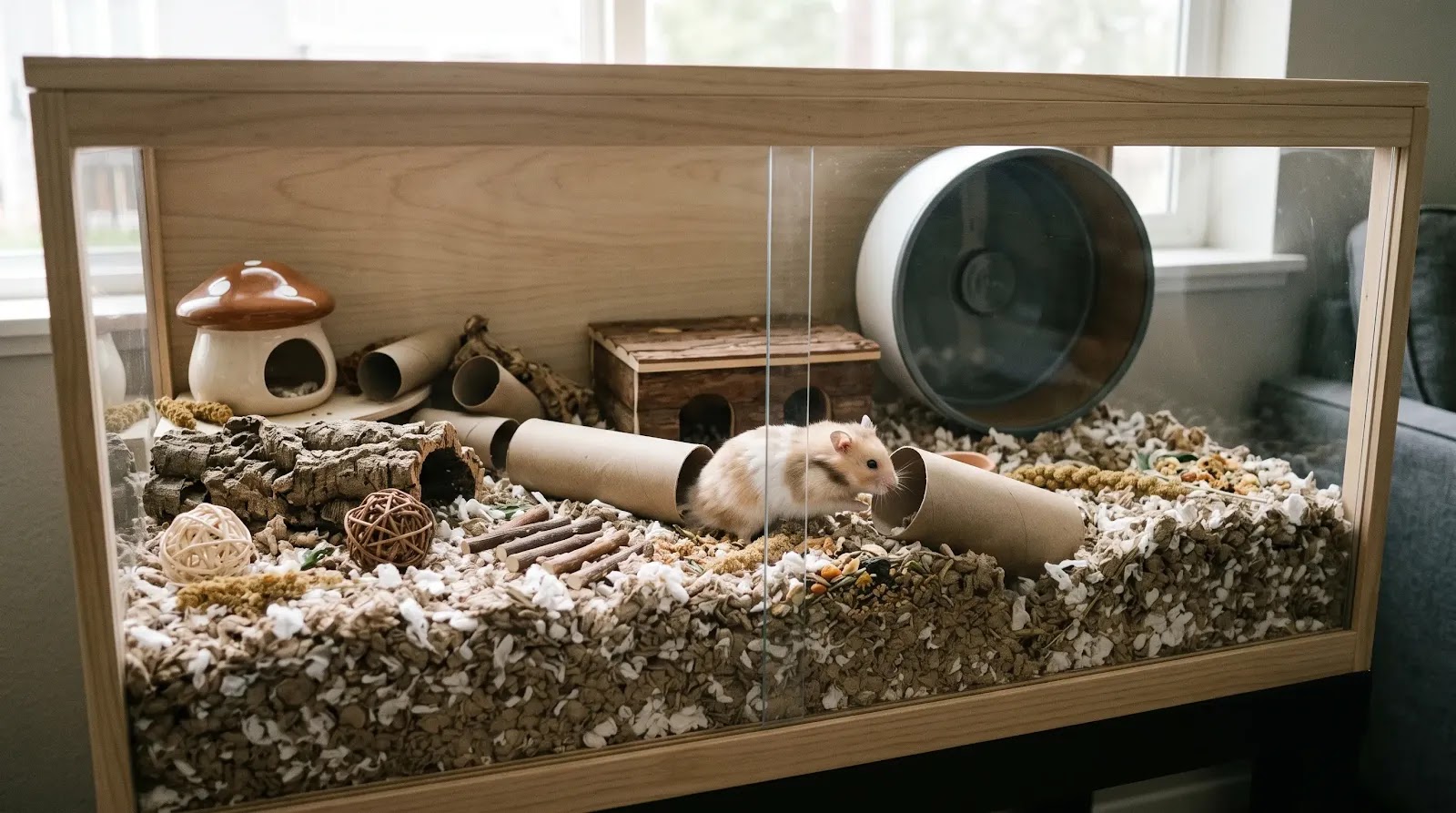
If the habitat is otherwise strong but the hamster remains intensely focused on the bars, moving to a suitable solid-sided enclosure can remove access to that specific behavior. The new enclosure still needs appropriate ventilation, usable space, bedding, a wheel, hides, and enrichment—removing the bars alone does not fix the habitat.
The Habit May Take Time to Fade
Repeated behavior does not always disappear immediately after the environment improves.
Instead of expecting one overnight change, watch the overall pattern across several active periods.
Useful signs of improvement include:
- More time spent burrowing
- More foraging and exploration
- Regular wheel use
- Greater use of hides and tunnels
- Shorter or less frequent episodes of bar chewing
If the chewing remains intense, reassess the habitat rather than continuously adding random toys.
Check the Mouth and Teeth if Bar Chewing Is Frequent
Regular cage-bar chewing can put the incisors at risk of damage.
Contact an exotic-pet veterinarian if you notice a broken or misaligned tooth, bleeding or sores around the mouth, drooling, difficulty eating, reduced appetite, or weight loss.
Do not try to trim a hamster’s teeth yourself.
The Bottom Line
An occasional nibble on a cage bar does not automatically mean something is seriously wrong.
Persistent or repetitive bar chewing is different: treat it as information about how well the habitat is meeting your hamster’s behavioral needs.
Start with usable enclosure space, meaningful bedding depth, a comfortable wheel, hiding and foraging opportunities, safe things to gnaw, and a quiet predictable location.
If those changes reduce the behavior, the setup was likely part of the problem. If the chewing remains intense despite a strong environment—or the mouth or teeth have already been injured—an exotic-pet veterinarian is the appropriate next step.
Sources & Editorial Standards
The relationship between enclosure size and wire gnawing was checked against the Animal Welfare study of golden hamsters housed in different cage sizes.
The association between shallower substrate and greater owner-reported bar biting was checked against the 2024 Veterinary Record study of Syrian hamster husbandry and welfare.
Current habitat, enrichment, and dental-care guidance was cross-checked against Woodgreen hamster-care guidance, RSPCA hamster environment guidance, and the Merck Veterinary Manual hamster health-care guidance.