Why Do Cats Knock Things Off Tables? Reasons & How to Stop It
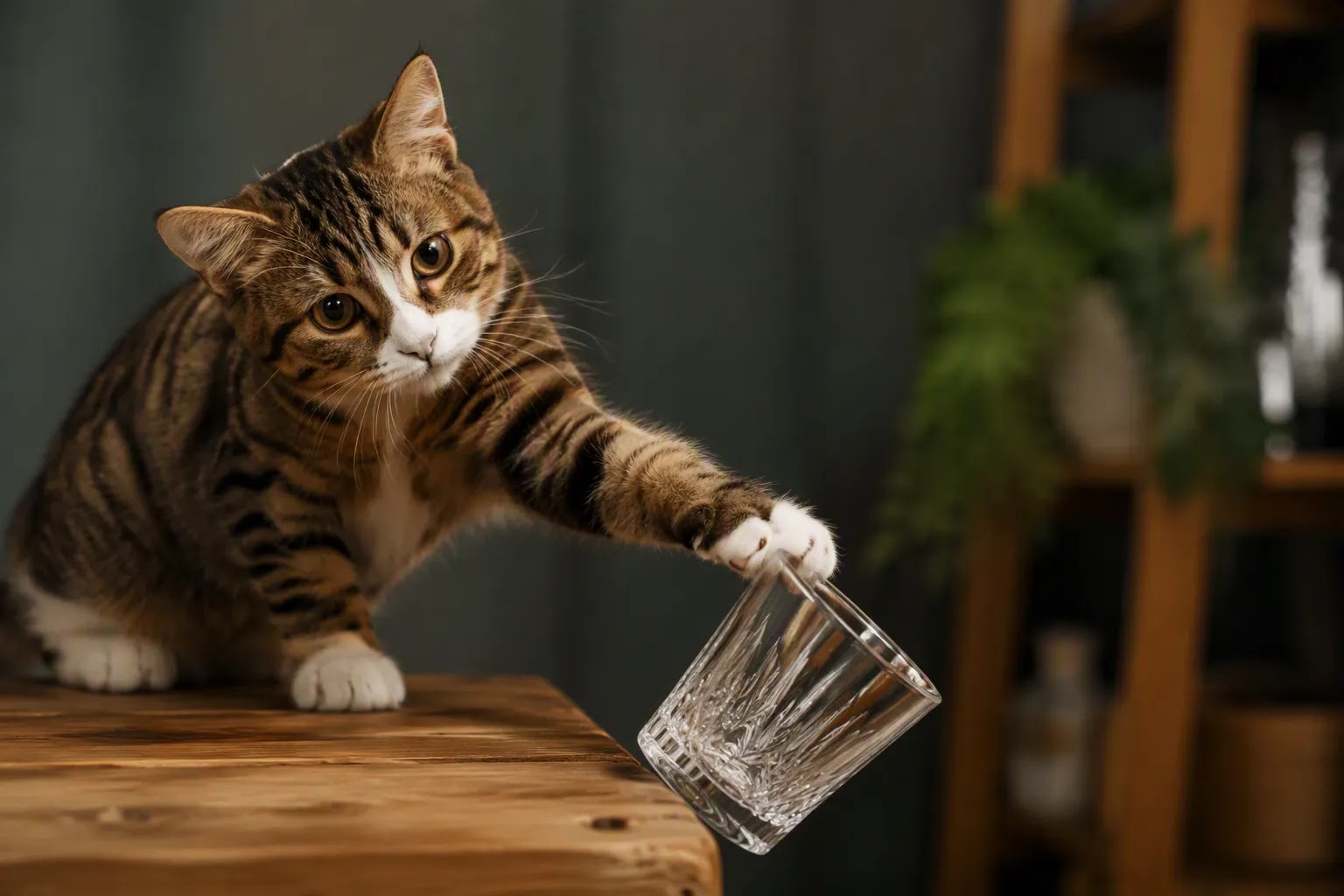
You leave a pen, your keys, or a glass near the edge of the table.
Your cat walks over, reaches out one paw, gives the object a careful push—and watches it disappear.
It can look remarkably deliberate, especially when your cat looks at you afterward.
But your cat probably isn’t plotting revenge against your favorite mug.
Object-knocking makes more sense as a mix of play, exploration, learned consequences, routine, and the simple appeal of something that moves when touched.
Quick Answer: Cats may knock things off tables because moving small objects fits normal play and hunting-related behavior, because they’re exploring what happens when an object moves, or because they’ve learned that knocking something down gets a fast human response. Protect dangerous objects first, provide better play and exploration opportunities, and avoid making harmless knocking a reliable way to summon you.
Why Do Cats Knock Things Off Tables?
There probably isn’t one explanation for every cat or every object.
A kitten batting a bottle cap across a desk may simply be playing.
A cat pushing your phone toward the edge every morning before breakfast may have learned something very specific about how quickly that gets you moving.
Look at the pattern rather than assigning one motive to every push.
1. Batting Objects Fits Normal Cat Play
Cats naturally stalk, chase, paw, swat, pounce on, and capture moving objects.
That’s why many cat toys roll, bounce, dangle, or change direction when touched.
A pen, bottle cap, key ring, or other lightweight object can provide similar movement.
That doesn’t mean your cat literally believes the pen is prey.
It simply means that something small that moves when pawed can be interesting to a cat.
2. Your Cat May Be Exploring What Happens
Cats investigate objects with their noses, eyes, mouths, and paws.
A gentle push can reveal whether something rolls, tips, makes noise, or stays in place.
The edge of a table makes the result especially noticeable:
Push → movement → sound → object disappears.
A cat doesn’t need to understand gravity as a scientific concept to learn that this sequence is interesting enough to repeat.
3. Your Reaction May Have Rewarded the Behavior
This becomes particularly relevant when knocking happens mostly while you’re nearby.
Your cat pushes a pen.
You look over.
Then you speak, stand up, pick it up, chase the cat away—or perhaps give them food or attention.
From the cat’s perspective, that tiny paw movement produced a large and reliable change in the environment.
Knock object → human responds.
If that happens repeatedly, your reaction can become part of what maintains the behavior.
This doesn’t mean your cat is “manipulative” in a human moral sense. They simply learned what happens next.
Cats can develop similar learned patterns with vocalization. See Why Does My Cat Meow So Much? 8 Reasons & When to Worry.
4. Your Cat May Need Better Play and Exploration Opportunities
Indoor cats still need opportunities to stalk, chase, pounce, scratch, climb, forage, explore, and manipulate safe objects.
A cat with few appropriate outlets may be more likely to invent activities using whatever happens to be available.
That doesn’t mean every knocked-over spoon proves your cat is bored.
But improving enrichment is still useful when object-knocking happens in a home with limited play or environmental variety.
5. Knocking Things Down Can Become Part of a Routine
Timing can reveal a lot.
Does your cat push things off the nightstand shortly before breakfast?
Do they do it when you begin working at your desk?
Does it happen when you stop playing or turn your attention to your phone?
If the behavior repeatedly produces food, play, attention, or movement from you, it can become part of that routine.
6. Sometimes the Object Is Simply in the Way
Cats often value elevated resting and observation areas.
If a desk, table, shelf, or counter is already part of your cat’s preferred route, an object occupying that space may get nudged while the cat walks, turns, lies down, or investigates it.
Not every fallen object needs a behavioral theory.
Use the No-Audience Test
The No-Audience Test: Does your cat bat and knock lightweight objects around even when nobody reacts? Play and exploration may be major drivers. Does it happen mainly when you’re present, busy, sleeping, or preparing food? Learned attention or routine may be contributing more strongly.
This isn’t a diagnostic test.
It’s simply a practical way to understand what the behavior appears to produce for your individual cat.
More than one motivation can exist at the same time.
Why Does My Cat Look at Me While Doing It?
Eye contact is probably what makes the behavior feel personal.
But looking at you does not prove that your cat understands how much the object cost, predicts your frustration, and deliberately wants to upset you.
If knocking things down has previously made you speak, move, laugh, chase, or provide food, watching you makes perfect sense.
You have become part of the consequence.
Do Cats Knock Things Over Out of Spite?
There is no good reason to interpret ordinary table-knocking as revenge.
Cats can experience frustration, fear, arousal, and other emotional states.
But a fallen pen does not demonstrate a human-like plan to punish you.
If object-knocking appears as part of a broader behavior change, look at appetite, hiding, social interaction, litter-box habits, activity, sleep, posture, and recent changes in the household rather than focusing on the object alone.
How to Stop Your Cat From Knocking Things Over
1. Remove Dangerous Objects First
Safety comes before training.
Keep these away from surfaces your cat regularly explores:
- Glasses and fragile ceramics
- Medications
- Batteries
- Sharp objects
- Candles
- Hot drinks
- Toxic plants
- Small objects that could be swallowed
Don’t leave something dangerous on the edge of a table to “teach the cat not to touch it.”
Environmental management is much more reliable.
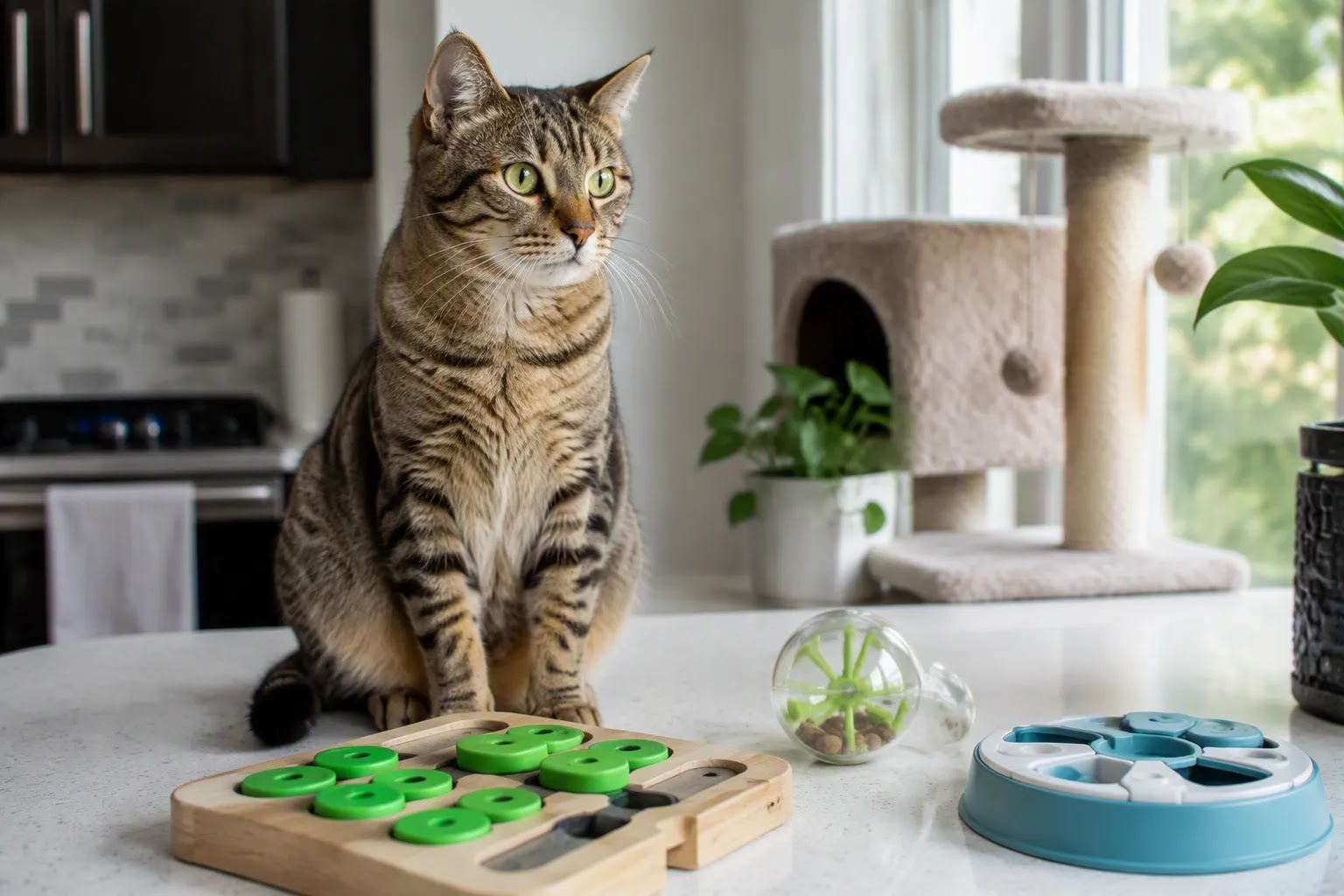
2. Provide Better Things to Bat, Chase, and Catch
Offer safe toys that roll, move, bounce, or can be chased and captured.
Useful options can include balls, toy mice, track toys, food puzzles, and interactive wand-style play.
Rotate toys instead of leaving every toy available indefinitely. Novelty can renew interest.
During interactive predatory-style play, allow your cat to catch the toy periodically rather than creating an endless chase with no successful capture.
3. Add Useful Vertical Space
If your cat repeatedly occupies a desk, bookshelf, or counter, provide another attractive elevated option nearby.
Cat trees, secure shelves, window perches, and other raised resting areas can give your cat legal places to observe the household.
For examples of vertical setups, see our Best Cat Trees for Small Apartments & Large Cats.
4. Be Careful What Your Reaction Teaches
If a harmless pen drops and you instantly run across the room, talk excitedly, and deliver breakfast, the behavior may become more valuable.
When the object is genuinely safe and no intervention is needed, keep your reaction low-key.
Then provide attention, play, or food through more appropriate behavior and predictable routines.
Don’t ignore danger just to avoid rewarding the behavior. If the object is breakable, toxic, hot, sharp, or otherwise unsafe, intervene immediately and change the environment so the opportunity cannot keep repeating.
5. Reward an Alternative
Give your cat another behavior that works.
You might reward:
- Using a nearby perch
- Sitting on a designated mat
- Playing with an appropriate toy
- Using a food puzzle
- Joining a scheduled play session
The goal isn’t simply to say, “Don’t touch my things.”
It’s to give your cat safe alternatives for movement, exploration, play, and interaction.
Should You Punish Your Cat?
No.
Yelling, spraying water, frightening the cat, or using physical punishment can increase stress without clearly teaching the behavior you want instead.
Management plus positive reinforcement is more useful:
Remove hazards. Provide better outlets. Reward appropriate behavior. Change your response when attention is maintaining the knocking.
When Is Object-Knocking Worth a Vet Visit?
A cat that has always enjoyed batting pens off the desk usually presents a behavior-management question rather than a medical emergency.
A sudden broader behavior change is different.
Talk with your veterinarian if new or dramatically increased repetitive behavior appears alongside:
- Confusion or disorientation
- Major sleep changes
- New vocalization
- Changes in appetite or thirst
- Mobility changes
- Changes in social interaction
- Litter-box changes
- Other unusual or repetitive behaviors
This deserves particular attention in an older cat, because medical disease, pain, sensory decline, and cognitive changes can all affect behavior.
Don’t ask whether your cat is being naughty. Ask what the push produces: movement, play, access to space, or a reliable response from you. Once you understand what is rewarding the behavior, preventing it becomes much easier.
Sources & Editorial Standards
- VCA Animal Hospitals — Why Cats Knock Things Over
- VCA Animal Hospitals — Cat Play and Play Toys
- Feline Veterinary Medical Association — Your Cat’s Environmental Needs, 2026
- FelineVMA — Environmental Needs Guidelines
- Merck Veterinary Manual — Behavior Problems of Cats
Editorial note: No single motivation explains every object-knocking episode. This guide distinguishes established feline play, exploration, environmental needs, and learned consequences from unsupported claims about spite, revenge, or a cat’s precise intention during an individual incident.
The Bottom Line
Your cat probably isn’t carefully planning the destruction of your favorite coffee mug.
Small movable objects are interesting to feline paws. Predatory-style play makes movement rewarding. And human reactions can turn one accidental push into a very effective habit.
Protect dangerous items first.
Then provide better opportunities to chase, bat, climb, explore, and interact.
If your attention is part of the pattern, make appropriate behavior the easier way to get it.
The fallen pen may look like mischief from your side of the table. From your cat’s side, it may simply be an object that moved—and taught them something interesting about what happens next.