Pesticide Got Into a Fish Tank? Emergency Steps Before You Add Anything
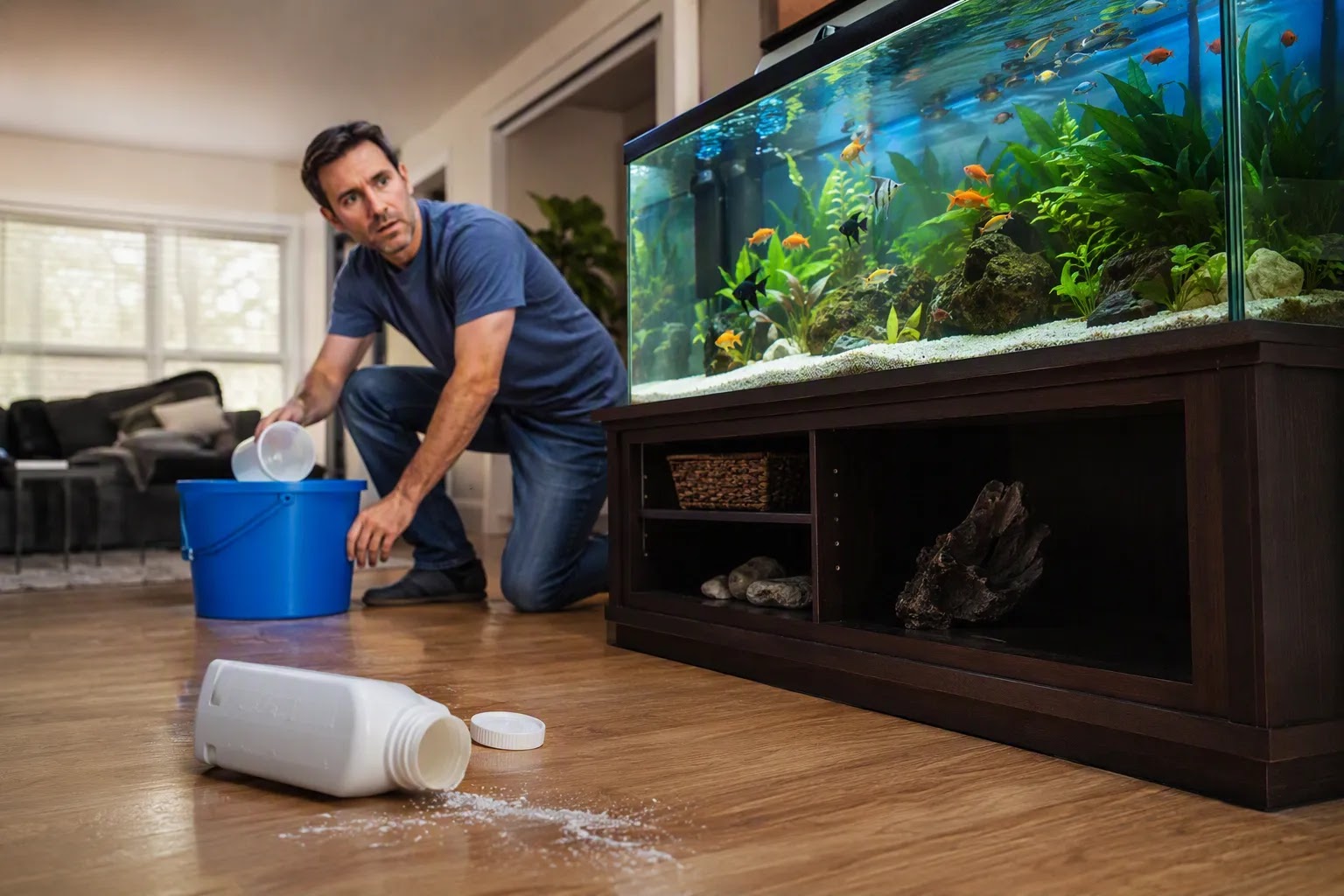
You hear something tip over beside the aquarium, look down, and realize pesticide may have splashed into the water. Or perhaps the tank was uncovered when an aerosol drifted through the room.
If pesticide is known or strongly suspected to have entered the aquarium, act before the fish look sick. Stop further exposure, identify the product, begin safely replacing contaminated water with properly prepared clean water, and get product-specific advice. Do not start adding random “detox” products.
What to do now: Stop any continuing contamination if you can do so safely, save the pesticide container or label, begin safe water replacement, and contact a veterinarian experienced with fish, the pesticide manufacturer, or a pesticide information service. If fish are gasping, losing balance, convulsing, becoming unresponsive, or several animals deteriorate together, treat the situation as urgent.
Emergency Steps After Pesticide Enters an Aquarium
1. Stop Any Continuing Exposure
If a leaking container, contaminated tool, pesticide-soaked object, bait, or other material is still reaching the water, prevent more from entering the aquarium if you can do so without exposing yourself.
Use any personal protective equipment required by the pesticide label. Do not handle concentrated pesticide bare-handed.
If the exposure came from an aerosol, fogger, or other airborne treatment, follow the product’s ventilation and re-entry instructions too. Replacing aquarium water will accomplish little if contamination is still entering from the room.
2. Identify the Exact Product
“Bug spray” or “weed killer” is not specific enough.
Find the original container, pesticide label, or pest-control service report and record:
- Product name
- Active ingredient or ingredients
- Concentration, if listed
- Formulation, such as aerosol, liquid, dust, or bait
- Approximate amount that may have entered the aquarium
- Time of exposure
- Approximate aquarium volume
- Fish and invertebrate species in the system
Photographing both sides of the label can make it easier to share accurate information with a veterinarian, manufacturer, or pesticide specialist.
Look particularly at the label’s Environmental Hazards section and any warnings involving fish or aquatic organisms.
3. Begin Safe Dilution With Properly Prepared Water
Once pesticide is in the aquarium water, physically removing contaminated water and replacing it with clean water is one of the most direct ways to reduce continued exposure.
Prepare the replacement water correctly:
- Freshwater aquariums: treat tap water appropriately for chlorine or chloramine when necessary and match temperature as closely as practical.
- Marine and brackish aquariums: use properly prepared replacement water with suitable temperature and salinity.
Do not become trapped by an arbitrary rule such as “always change exactly 25%” or “always change 100%.”
The goal is meaningful removal of contaminated water without creating another emergency through a severe temperature, pH, salinity, or chlorine mismatch.
If a substantial direct spill occurred, repeated partial replacement or more aggressive decontamination may be necessary. Get product-specific professional advice as quickly as possible while beginning safe dilution.
Water conditioner has one job here: use the normal amount needed to make replacement tap water safe from chlorine or chloramine. Do not add extra conditioner, ammonia binder, salt, medication, or another chemical in the hope that it will neutralize an unidentified pesticide.
4. Support Oxygenation With Clean Air
Keep filtration operating when it is safe to do so and support good surface movement and oxygen exchange.
If fish are already gasping or breathing rapidly, additional aeration may help support them while contaminated water is being removed.
Our guide to aquarium surface agitation and gas exchange explains how surface movement supports oxygen exchange.
If pesticide aerosol or vapor is still present in the room, however, avoid deliberately drawing that contaminated room air into the aquarium with an air pump until the area has been ventilated as directed.
5. Fresh Activated Carbon May Help—but It Is Not an Antidote
Fresh aquarium-grade activated carbon can remove many dissolved organic compounds and toxins from aquarium water and may be a useful supportive measure after some chemical contamination.
But activated carbon is not a universal pesticide antidote. How effectively it adsorbs a particular pesticide depends on the chemical and formulation involved.
Use fresh aquarium-grade carbon in the filter or an appropriate media bag according to its directions.
Do not pour powdered household charcoal or oral activated-charcoal products directly into the aquarium, and do not treat carbon as proof that the pesticide is gone.
6. Get Product-Specific Guidance
Different pesticides behave very differently in water, so the actual product can change the response.
In the United States, the National Pesticide Information Center provides science-based pesticide information. The pesticide manufacturer’s contact information may also be printed on the label.
If fish are showing abnormal signs, contact a veterinarian experienced with aquatic or exotic animals. If your regular clinic does not treat fish, ask whether they can refer you to an aquatic veterinarian.
Health Canada likewise advises contacting a veterinarian promptly when pesticide poisoning of a pet is suspected.

Why Pesticide Exposure Can Be So Serious for Fish
“Pesticide” describes many different chemicals, so there is no single toxic dose or universal treatment for an aquarium exposure.
Some pesticide classes are especially hazardous to aquatic animals. For example, the National Pesticide Information Center reports that pyrethrins are highly to very highly toxic to fish and very highly toxic to several aquatic invertebrates.
Formulation matters too. A household spray may contain solvents, propellants, synergists, or other ingredients in addition to the named active pesticide.
Fish also remain surrounded by the contaminated medium. Once a chemical is dissolved or dispersed in the aquarium, simply moving the pesticide container away does not end gill and body exposure.
Should You Move the Fish to Clean Water?
Sometimes—but transferring fish is not automatically safer than correcting the aquarium they are already in.
A temporary system may be appropriate when contamination is substantial or continuing and you already have clean, correctly prepared water available.
The temporary setup must have:
- Appropriate temperature
- Properly conditioned freshwater or correctly mixed saltwater
- Suitable salinity and chemistry for the livestock
- Adequate oxygenation
- A safe container for the species involved
A random bucket of cold untreated tap water can create an additional emergency.
If contamination appears limited and you can rapidly dilute and filter the existing aquarium, moving every fish may add unnecessary stress.
For a large spill, continuing exposure, or severely distressed fish, seek aquatic veterinary or other qualified fish-health guidance promptly while correcting the environment.
What Not to Add—or Remove—During the Emergency
The urge to “neutralize” the pesticide is understandable, but adding another substance without knowing the chemistry can make the water less stable while doing nothing useful to the toxicant.
Do not automatically add:
- Aquarium salt
- Baking soda
- Vinegar
- Hydrogen peroxide
- Methylene blue
- Antibiotics or antiparasitic medication
- Extra water conditioner
- Ammonia-binding products as a pesticide antidote
- Household cleaners
- Oils or homemade “detox” mixtures
These substances have legitimate uses in particular situations, but none should be assumed to neutralize an unknown pesticide.
Merck’s aquarium-fish guidance also discourages unnecessary medication without a diagnosis because treatment itself can create complications.
Do Not Automatically Throw Away the Entire Biofilter
Discarding every sponge, ceramic ring, and established filter cartridge can create another problem by removing large amounts of nitrifying bacteria and setting up an ammonia or nitrite spike.
If concentrated pesticide was spilled directly onto a particular filter component, that component may require product-specific cleaning or replacement.
But when contamination has dispersed throughout the aquarium water, blindly discarding all biological media does not guarantee that the pesticide has been removed.
Preserve biological filtration where practical while removing contaminated water and using appropriate chemical filtration.
Monitor the Fish and the Aquarium After the Initial Rescue
Once continuing exposure has stopped and clean water is going into the aquarium, monitor both the animals and the system.
Watch for:
- Persistent surface gasping
- Very rapid gill movement
- Loss of balance
- Rolling or lying abnormally on one side
- Sudden erratic or uncontrolled swimming
- Tremor- or spasm-like movements
- Marked lethargy or poor responsiveness
- Several fish becoming abnormal at approximately the same time
- Sudden deaths after the chemical incident
These signs do not prove pesticide poisoning. Low oxygen, chlorine, ammonia, nitrite, temperature shock, and other environmental emergencies can produce similar signs.
Check basic water quality as appropriate for your system, including temperature, ammonia, nitrite, pH, and salinity in marine or brackish aquariums.
If you have reliable equipment for measuring dissolved oxygen, that information can also be useful.
A normal aquarium test kit cannot tell you that the pesticide is gone. Zero ammonia and zero nitrite are useful results for those specific compounds, but most hobby test kits do not measure household insecticides, herbicides, rodenticides, solvents, or pesticide synergists.
If biological filtration is disrupted and ammonia begins to increase, use our aquarium ammonia emergency guide for that separate problem.
| Situation | Best Next Step |
|---|---|
| Pesticide definitely entered the water but fish still appear normal | Stop exposure, begin safe dilution, identify the product, use appropriate filtration, and get product-specific guidance. Do not wait for symptoms. |
| You cannot confirm whether a small amount actually reached the water | Prevent further exposure, identify the product, check the aquarium and equipment, and monitor closely while obtaining guidance. |
| Several fish are gasping, losing balance, or behaving abnormally | Continue emergency environmental correction and seek aquatic veterinary help urgently. |
| Fish are dying rapidly or the aquarium received a significant direct spill | Treat this as a serious chemical-exposure emergency. Rapid safe dilution or transfer to properly prepared clean water and professional guidance are priorities. |
Do Not Forget Shrimp, Snails, and Other Invertebrates
Aquatic invertebrates can be extremely sensitive to some pesticides.
NPIC reports that pyrethrins are very highly toxic to several aquatic invertebrates as well as being highly toxic to fish.
Sudden distress or losses among shrimp or other invertebrates after a chemical incident can therefore be important information even if some fish still appear normal.
Do not assume the concentration is harmless simply because one species appears unaffected.
Save Diagnostic Information Without Delaying the Rescue
If you can do so without delaying water replacement, save a sample of the aquarium water from before major dilution in a clean, clearly labeled container.
Keep the pesticide package or service paperwork too.
If laboratory testing may be considered, ask the veterinarian or diagnostic laboratory how any water or fish samples should be handled because storage requirements depend on the planned testing.
If a fish dies after the suspected exposure, contact an aquatic veterinarian or diagnostic laboratory before automatically discarding all affected fish.
Merck Veterinary Manual notes that recently deceased fish and tank-water samples can have diagnostic value.
Keep a simple timeline of:
- When the pesticide exposure occurred
- When abnormal behavior first appeared
- What water changes were performed
- What filtration media were added
- Water-test results before and after the incident
After the Emergency, Fix the Exposure Route
Once the aquarium is stable, identify how the pesticide reached the water so the same event cannot happen again.
If the incident occurred during indoor pest treatment, our guide to protecting an aquarium during home pest control covers tank protection, air pumps, and treatment-day preparation.
If the exposure came from a leaking container, contaminated bucket, dirty towel, or chemical stored beside aquarium equipment, see our pesticide storage and cross-contact guide for aquariums.
The emergency is not completely solved until both the contaminated water and the route that allowed contamination are addressed.
Sources & Editorial Standards
This guide focuses on immediate environmental response rather than attempting to diagnose a particular pesticide poisoning from symptoms alone. The appropriate response can vary substantially by active ingredient, formulation, concentration, aquarium conditions, and species.
- Merck Veterinary Manual — Emergencies of Fish
- Merck Veterinary Manual — Management of Aquarium Fish
- National Pesticide Information Center — Pesticide Use Around Pets
- National Pesticide Information Center — Pyrethrins General Fact Sheet
- U.S. EPA — Pesticide Incidents
- Health Canada — Keep Your Pets Safe When Using Pesticides
Veterinary disclaimer: This article provides general educational information and cannot diagnose an individual fish or replace advice from a veterinarian or pesticide toxicology professional. Pesticide toxicity varies by active ingredient, formulation, concentration, species, and exposure. If pesticide is known to have entered an aquarium or fish develop sudden distress afterward, seek product-specific professional guidance promptly.