
How to Introduce Two Dogs Safely: First Meeting & Home Entry
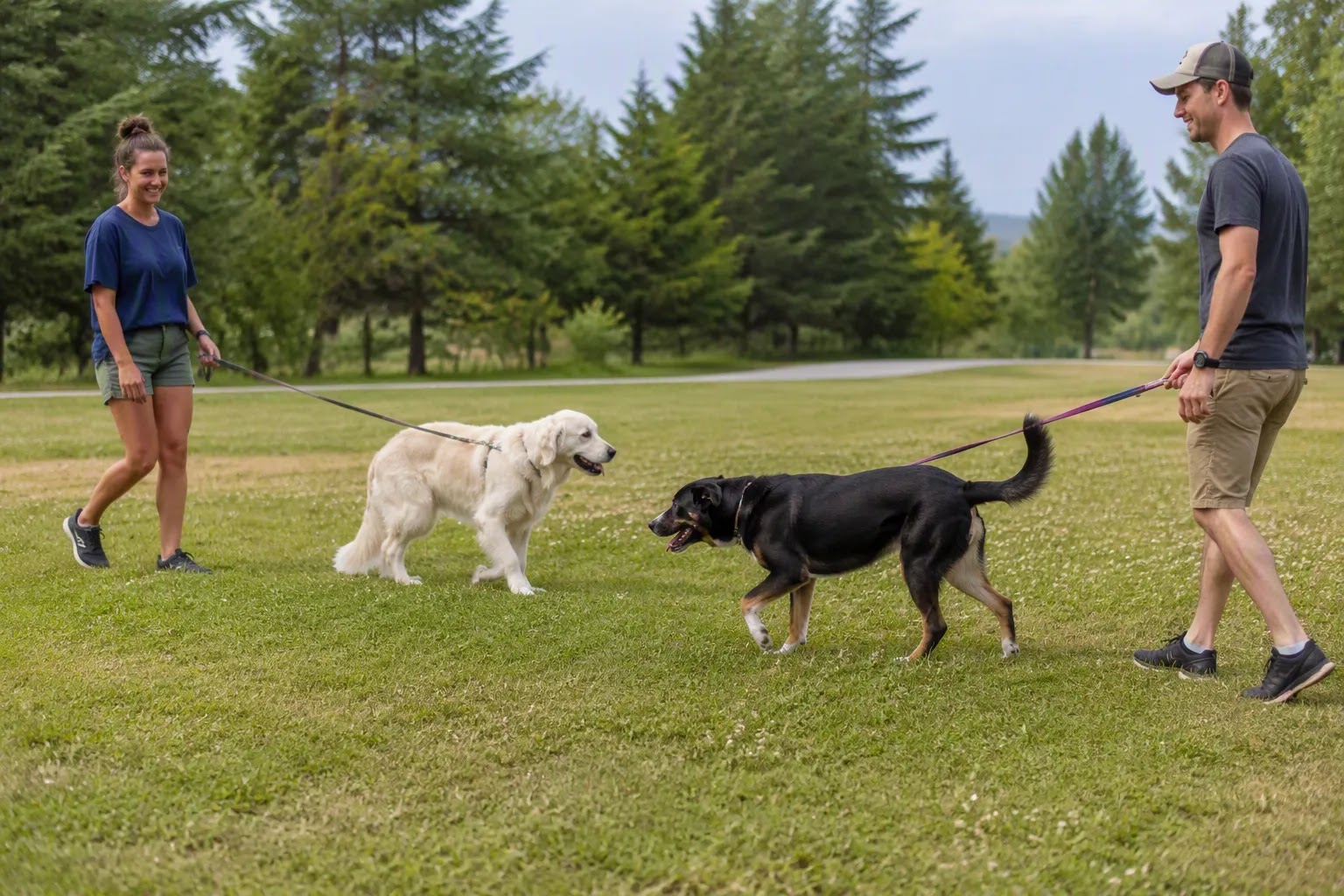
Two dogs do not need to become instant friends for a first meeting to go well.
A better goal is much quieter: both dogs can notice each other, move comfortably, disengage when they want to, and finish the interaction without being pushed beyond what they can handle.
Think of the first meeting as a short assessment, not a friendship test. Your job is to give both dogs enough space and choice to show whether they are comfortable moving closer.
Quick answer: Start outdoors in a neutral, low-distraction area with one handler per dog. Walk in the same direction at a comfortable distance, reduce that distance only while both dogs remain relaxed, and keep any first greeting brief. If things continue to go well, walk together a little longer before heading home, where food, chews, favorite toys, and other high-value resources should already be managed separately.
First, Decide Whether This Is a Routine Introduction
This guide is designed for dogs that can generally be around other dogs without a known history of serious dog-directed aggression.
Do not begin with a casual face-to-face introduction if either dog has:
- A history of biting or seriously injuring another dog
- Repeatedly lunged or attempted to attack dogs at close range
- Severe fear around unfamiliar dogs
- Serious conflict with other dogs around valued resources
- Behavior that you cannot safely manage on leash
Those situations deserve an individualized plan from a qualified reward-based behavior professional or veterinary behaviorist rather than a routine introduction.
For an ordinary first meeting, prepare two handlers, comfortable harnesses or collars, regular leashes, and small food rewards. Avoid retractable leashes because they make distance and leash tension harder to control during close interactions.
Choose Neutral Ground for the First Meeting
Do not begin by walking the newcomer through the front door while the resident dog waits inside.
An outdoor location that neither dog strongly considers their own gives both animals more space to move, observe, and disengage.
Possible locations include:
- A quiet park
- A wide walking path
- An open green area
- Another low-traffic place where you can control distance
A busy dog park is not a good choice. The goal is to observe these two dogs—not manage a crowd of unfamiliar dogs at the same time.
Current guidance from VCA Animal Hospitals, Dogs Trust, and Best Friends Animal Society similarly supports beginning introductions outdoors or in neutral surroundings rather than starting with the newcomer entering the resident dog’s indoor space.
Start With a Parallel Walk
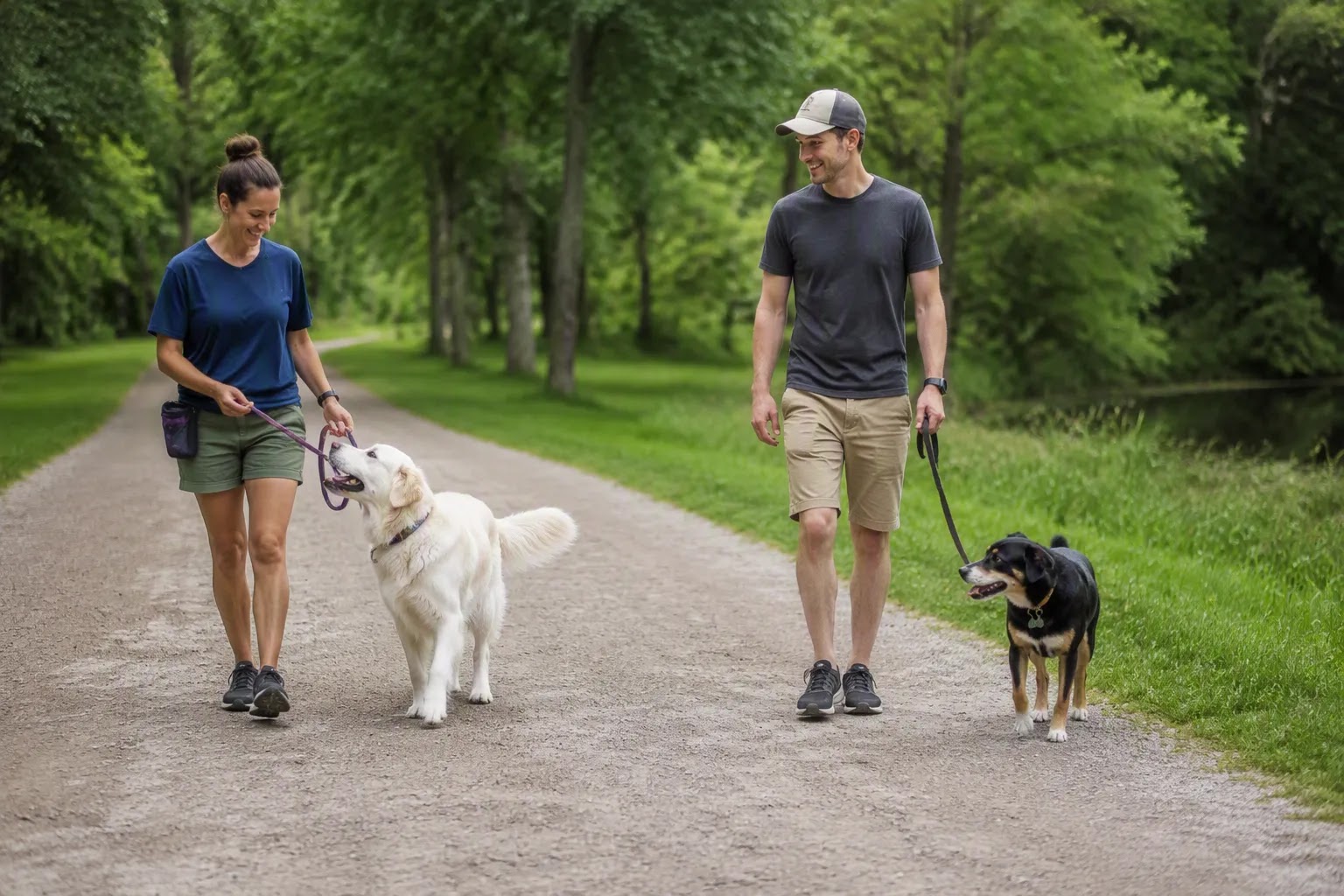
A parallel walk lets both dogs gather information without immediately asking them to stand nose-to-nose.
Give each dog their own handler and begin walking in the same direction with enough distance between them that both can still behave normally.
There is no magic starting distance.
If one dog is staring continuously, pulling hard toward the other dog, barking, freezing, or unable to respond to their handler, increase the distance.
During the walk:
- Keep leashes as loose as safety allows
- Do not force the dogs to walk shoulder-to-shoulder
- Reward calm check-ins with the handler
- Let the dogs sniff and investigate the environment
- Reduce distance gradually only while both remain comfortable
The dogs do not need to stare at each other.
Being able to notice the other dog and then return to sniffing, walking, or checking in with the handler can actually be useful information: the other dog’s presence is not consuming all of their attention.
Use a Go, Slow, or Stop Check Before Moving Closer
Do not move to the next stage simply because five or ten minutes have passed.
Let the dogs’ behavior determine the pace.
| What You See | What It May Mean | What to Do |
|---|---|---|
| GO: Loose bodies, curved movement, soft expressions, normal sniffing, ability to look away | Both dogs appear able to cope at the current distance | Continue walking and reduce distance gradually if the picture stays relaxed |
| SLOW: Increasing fixation, repeated pulling, very high excitement, tucked posture, repeated avoidance | The setup may be becoming too difficult | Add distance and allow more time before trying to move closer |
| STOP: Prolonged freezing, hard staring, lunging, snapping, escalating growling, inability to disengage | A direct greeting is not appropriate right now | Calmly create distance and end or reset the introduction |
A wagging tail by itself is not a green light. Tail movement can appear with many different emotional states, including high arousal.
Look at the whole dog: muscle tension, facial expression, movement, ability to disengage, and what happens as the distance changes.
If canine signals are difficult to read, our dog and cat body-language guide explains why individual signals should be interpreted in context.
When Is It Okay to Let the Dogs Greet?
If both dogs have been walking comfortably and continue to show relaxed interest, you can allow a short greeting.
Keep the leashes loose enough for normal movement and avoid pulling the dogs directly toward each other’s faces.
Let them sniff briefly, then cheerfully encourage them apart and resume walking.
Interrupting a good greeting may feel unnecessary, but the first meeting does not need to prove that the dogs can interact continuously for twenty minutes.
A few short, uneventful greetings can give you useful information without letting excitement build too far.
If both dogs remain relaxed afterward, another brief greeting can happen later.

Ignoring Each Other Is a Good Outcome
Many owners imagine the perfect introduction ending in play bows and immediate excitement.
That is not necessary.
If the dogs can comfortably walk near each other, investigate the environment, and mostly leave each other alone, that can be an excellent first meeting.
VCA Animal Hospitals specifically notes that dogs do not need to be forced to interact when they would rather explore their surroundings.
Comfortable coexistence comes before friendship.
Do not push the dogs together simply because you want confirmation that they like one another.
Do Not Punish a Growl
A growl is information that a dog is uncomfortable enough to communicate about it.
Do not scold the dog and then force the interaction to continue. Create more distance and look at what changed immediately beforehand.
VCA’s dog-introduction guidance similarly cautions against punishing growling or snarling because adding punishment can increase stress in an already difficult interaction.
This does not mean allowing threatening behavior to continue unchecked. It means treating the warning as a reason to change the situation safely rather than suppressing the warning itself.
How to Bring the Dogs Home Together
If the outdoor meeting goes well, do not undo that calm start by rushing both dogs through a narrow doorway into a room full of food, toys, and favorite possessions.
Prepare the home before you arrive.
Remove High-Value Resources First
Temporarily put away:
- Food bowls containing food
- Bones and long-lasting chews
- High-value toys
- Favorite items either dog may be reluctant to share
Prepare separate feeding areas and separate resting spaces so the dogs do not need to negotiate over valuable resources immediately.
Continue the Walk Toward Home
If practical, finish the parallel walk together and approach the property while both dogs are already calm.
If you have a secure yard, it may provide a useful transition before moving indoors.
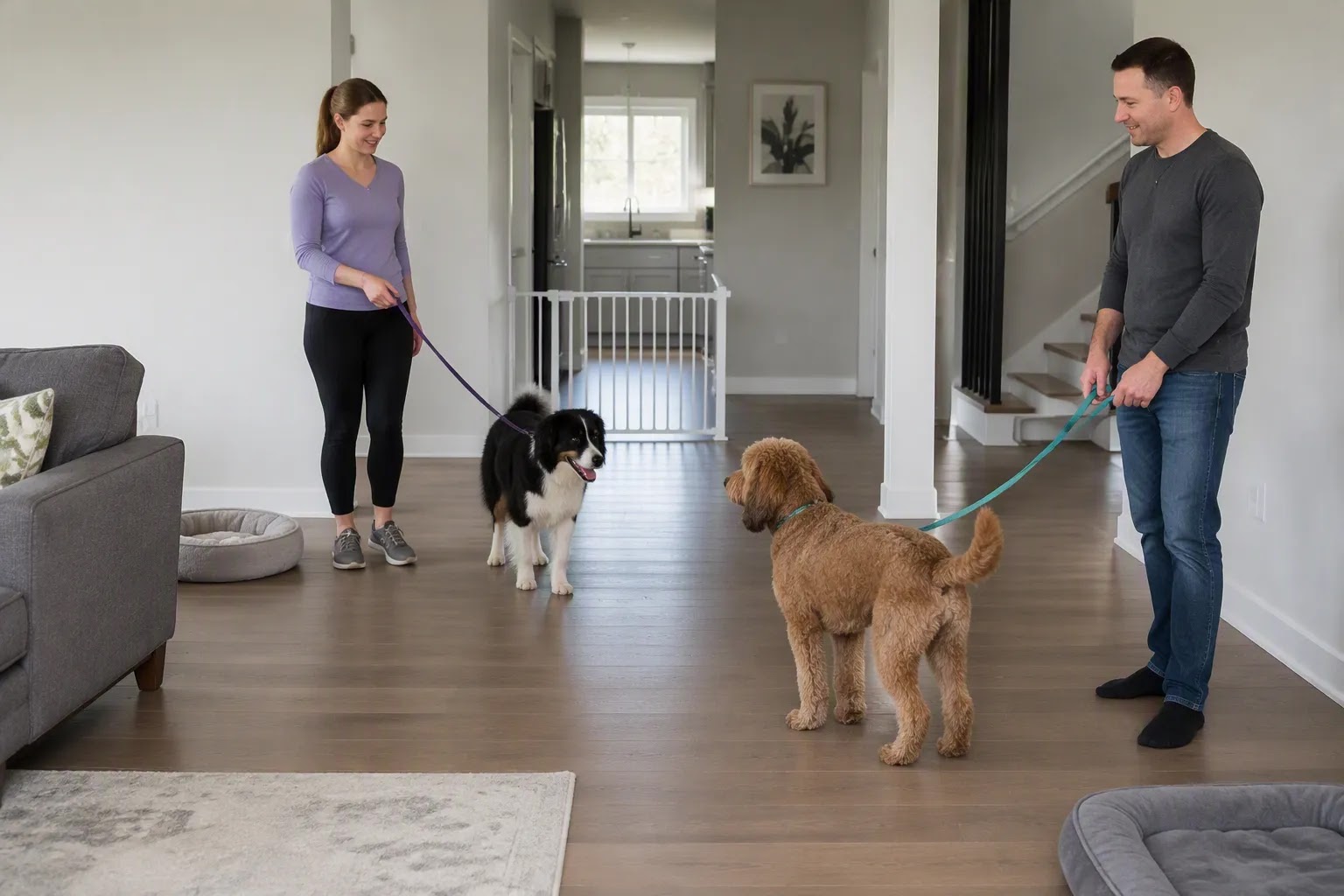
Otherwise, begin in a larger, less crowded indoor space rather than a narrow hallway or directly beside a food station, bed, or favorite toy area.
Keep Easy Separation Available
Baby gates, separate rooms, or other safe barriers make it easy to give either dog a break.
If lightweight house lines are used during the initial supervised period, remove them when you cannot actively watch the dogs because loose lines can catch on furniture or other objects.
Separation does not mean the introduction failed. It simply prevents fatigue or excitement from turning a successful first meeting into too much interaction at once.
Keep the First Indoor Period Simple
The first evening is not the time to test whether the dogs can share food, a chew, a favorite bed, and human attention all at once.
Keep things deliberately uneventful.
- Use short supervised periods together. Give the dogs breaks before either becomes tired or overwhelmed.
- Provide separate resting areas. Both dogs should be able to relax without being followed.
- Feed separately. VCA and Dogs Trust both recommend separate feeding while the relationship is new.
- Keep high-value chews and toys managed. There is no benefit to testing sharing immediately.
- Separate the dogs when nobody can supervise. A good first meeting does not yet tell you how they will handle every future situation.
The goal is to accumulate calm, ordinary experiences rather than manufacture intense bonding on the first day.
If One Dog Is a Puppy
A puppy may want far more interaction than an adult dog does.
Keep the same basic introduction structure, but make sure the adult dog can disengage and rest rather than being followed continuously.
For broader puppy socialization—not the first-meeting process covered here—see our guide to safe puppy socialization.
Common First-Meeting Mistakes
- Forcing a nose-to-nose greeting: Start with movement and space instead.
- Keeping leashes constantly tight: Use the leash for safety without unnecessarily restricting every movement.
- Starting in a busy dog park: Too many additional dogs make the interaction harder to read and control.
- Making the first greeting too long: Short successful contact is enough.
- Punishing warnings: Growling, freezing, or moving away should make you create space, not demand more contact.
- Introducing valuable food and toys immediately: Manage those resources while the dogs are still unfamiliar with each other.
- Leaving the dogs alone too soon: Use separation when you cannot supervise until you have much more information about their relationship.
When to Pause and Get Professional Help
Stop trying to progress the introduction if the dogs repeatedly become more distressed rather than more comfortable.
Professional guidance is especially appropriate when there is:
- A previous bite or serious dog-fight history
- Repeated lunging or snapping despite increased distance
- Severe conflict around resources
- Persistent fear that does not improve with a slower approach
- A large strength or size difference combined with unsafe behavior
- Conflict that becomes more frequent or intense after entering the home
Look for a qualified professional who uses reward-based, welfare-conscious methods. The American Veterinary Society of Animal Behavior recommends reward-based methods for dog training and behavior modification rather than techniques based on pain, fear, or intimidation.
If aggressive behavior appears suddenly in a dog that was previously comfortable around other dogs, medical discomfort can sometimes contribute to behavior changes. Our guide to sudden aggression in dogs explains why veterinary evaluation may be appropriate in that situation.
A Good First Introduction Can Look Boring
You do not need two dogs wrestling happily within fifteen minutes to call the meeting successful.
A very good first introduction may consist of walking together, sniffing the same area at different times, exchanging one or two brief greetings, and later resting in separate parts of the same room.
That may look boring from a human perspective.
For the dogs, boring can be exactly right.
Start with space, use movement instead of forced contact, let body language determine the pace, and prepare the home so neither dog has to compete immediately.
Friendship may develop later. The first job is simply to give both dogs enough comfort and choice for that relationship to have a chance.
Sources & editorial standards: The introduction and immediate home-entry recommendations in this article were checked against current dog-behavior guidance from VCA Animal Hospitals, Dogs Trust, Best Friends Animal Society, and the American Veterinary Society of Animal Behavior. This guide is intended for routine introductions between dogs without a known history of serious dog-directed aggression.