
How Many Litter Boxes Do Cats Need? Placement, Size & Cleaning
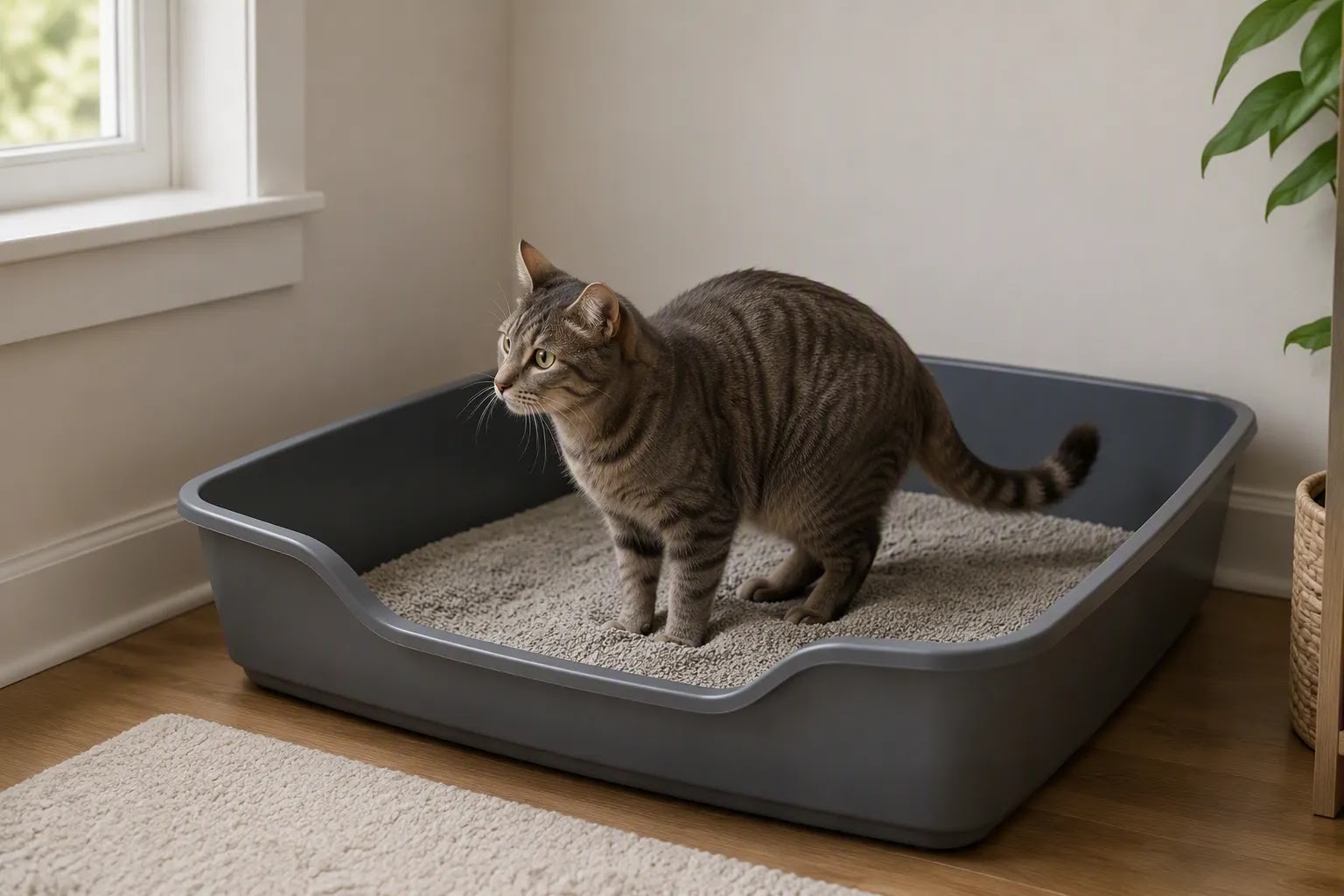
You scoop the litter box every day, keep fresh litter in it, and still find a surprise on the bathmat—or notice one cat waiting until another leaves before approaching the box.
It is easy to assume your cat is simply being picky. Often, though, the problem is more practical: there may not be enough litter-box options, several boxes may be grouped in the same vulnerable location, or the box itself may be too small or difficult to access comfortably.
A useful starting rule is one litter box per cat, plus one extra. That means two boxes for one cat, three for two cats, and four for three cats. But the number only helps when those boxes are large enough, kept clean, and distributed where cats can actually reach and use them comfortably.
Quick setup: Start with one litter box per cat plus one extra. Put them in separate, accessible areas rather than lining them all up together. Aim for a box around 1.5 times your cat’s body length from nose to the base of the tail, and scoop every box at least once daily.
How Many Litter Boxes Do Cats Really Need?
The familiar “number of cats plus one” rule is a practical starting point rather than a guarantee that every household will work perfectly.
| Number of Cats | Good Starting Number of Boxes |
|---|---|
| 1 cat | 2 boxes |
| 2 cats | 3 boxes |
| 3 cats | 4 boxes |
| 4 cats | 5 boxes |
Current Feline Veterinary Medical Association cat-friendly guidance uses the same general recommendation: provide one more litter box than the number of cats in the household.
The extra box creates another option.
Cats do not necessarily treat every litter box as interchangeable. One may favor a particular location, and another may become reluctant to approach a box when a housemate regularly sits near the route or doorway.
That additional box matters because it gives a cat somewhere else to go instead of forcing them to choose between a stressful litter-box trip and another place in the home.
Three Boxes Side by Side Are Not Three Separate Choices
This is one of the most important details in a multi-cat setup.
Imagine a house with three toilets—but all three are behind the same single doorway. If someone blocks that doorway, having three toilets inside does not help much.
Cats can face a similar problem.
Several litter boxes lined up together in one basement or laundry room provide more litter surface, but they do not create the same location choice as boxes placed in separate parts of the home.
Current feline guidelines recommend distributing litter boxes in different, accessible locations, particularly in multi-cat households.
The detail many multi-cat homes miss: count useful litter-box locations, not only plastic boxes. Three boxes in separate accessible areas can provide far more choice than three boxes touching each other in one room.
Where Should You Put Litter Boxes?
A good litter-box location is easy to reach, relatively quiet, and difficult for another animal to block.
Useful locations generally share a few characteristics:
- They remain accessible at all times
- They are away from heavy household traffic when possible
- They are not beside loud or unpredictable appliances
- They are separated from food and water
- They allow the cat to approach and leave comfortably
A laundry room may seem convenient because spilled litter is easy to sweep there. To a cat, however, a washer suddenly entering a loud spin cycle beside the box can make that location considerably less appealing.
Spread Boxes Across a Multi-Level Home
If your home has several floors, putting every litter box on one level can create an unnecessary barrier.
Having accessible boxes on different levels can be particularly useful for kittens, senior cats, cats with arthritis or reduced mobility, and any cat that may have difficulty reaching a distant box quickly.
Cornell’s feline house-soiling guidance likewise recommends quiet, easily accessible locations and multiple boxes in different parts of the home.
Avoid Social Dead Ends
In a multi-cat household, look at the route to the box as carefully as the box itself.
A litter box at the end of a narrow closet may seem private, but it also gives the cat only one obvious way in and out. If another cat waits there, the box can effectively become unavailable.
Whenever practical, choose locations that let a cat approach and leave without having to squeeze past another animal.

How Big Should a Cat Litter Box Be?
A box can technically hold litter and still be too cramped for the cat using it.
A widely used feline-behavior guideline is a box approximately 1.5 times the cat’s length from the nose to the base of the tail.
That gives the cat more room to enter, turn around, dig, position their body, eliminate, and cover waste without constantly pressing against the sides.
This is one reason a box marketed as “large” can still feel surprisingly small once an adult cat is standing inside it.
Take another look at usable space if your cat regularly:
- Hangs the front or back end over the edge
- Perches awkwardly on the rim
- Struggles to turn around
- Scratches the wall or floor instead of the litter
- Eliminates immediately beside the edge
If you have a particularly large cat or want to compare actual box dimensions, our guide to large litter boxes for big and multi-cat homes covers that separate buying decision.
Kittens and Senior Cats May Need an Easier Entrance
A larger box is usually helpful, but a huge box with an entrance the cat struggles to climb over is not automatically better.
Young kittens may have difficulty with very high sides. Older cats with arthritis, weakness, or reduced mobility may know exactly where the litter box is but find stepping into it uncomfortable.
For those cats, prioritize a low, easy entry with plenty of usable interior space.
The remaining walls can still be higher when necessary to contain litter or urine. The important part is that the entrance itself does not create an unnecessary obstacle.
How Much Litter Should Be in the Box?
You do not need to fill the box to the rim.
FelineVMA guidance notes that many cats prefer approximately 1.5 inches of litter, although individual preferences vary.
Treat that as a useful starting point rather than a rigid measurement.
If your cat digs comfortably, covers waste, and uses the box consistently, there is little reason to keep changing the depth. If they seem reluctant to step into a deep layer or repeatedly scrape against the bare bottom, adjust gradually and watch their response.
Litter texture and scent can also influence acceptance. If you are choosing between litter materials rather than setting up the boxes themselves, our cat litter guide for odor, tracking, and sensitive paws covers that separately.
How Often Should You Scoop and Clean the Litter Box?
A perfectly sized and positioned litter box becomes much less appealing once waste accumulates.
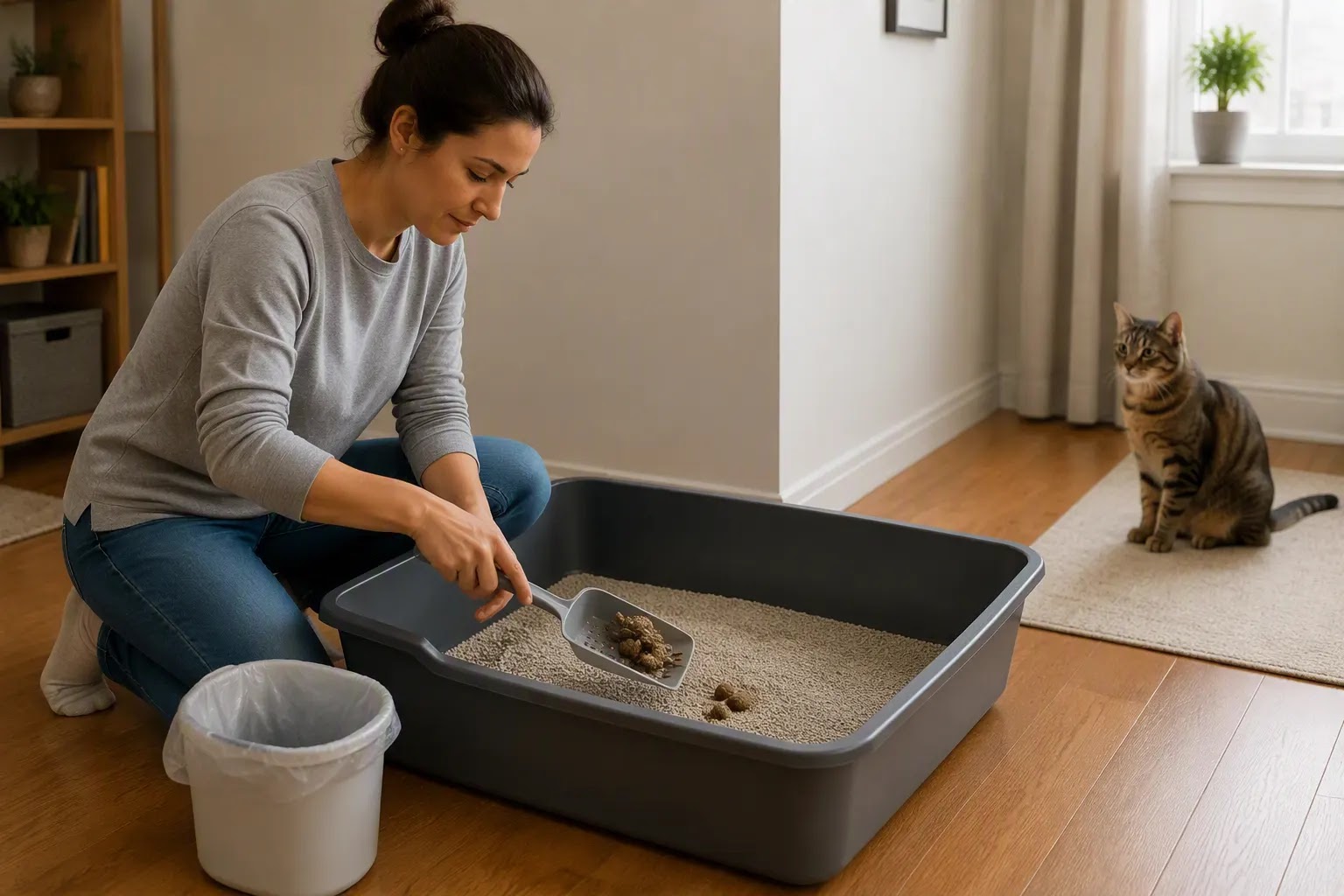
Scoop every box at least once daily. Scooping twice daily can be useful in busy multi-cat homes or for cats that are particularly sensitive to cleanliness.
Do not wait until the smell is obvious from across the room. Cats encounter the box at much closer range than you do.
A Simple Cleaning Routine
- Remove feces and urine clumps at least daily.
- Add clean litter as needed to maintain the normal depth.
- Check the surrounding floor for tracked litter or accidents.
- Replace litter when routine scooping no longer keeps it clean and dry.
- Wash the empty box periodically before residue and odor become heavily established.
What Should You Use to Wash the Box?
Simple cleaning is usually enough.
Use hot water and a mild soap or detergent when appropriate, rinse thoroughly, and let the box dry before refilling it.
Avoid leaving strong perfume or cleaning-product residue behind. Current feline guidance cautions against strongly scented products around litter boxes.
What If One Cat Uses Every Box?
That is not automatically a problem.
The point of providing multiple litter boxes is access and choice—not assigning every cat a private bathroom with their name on the door.
Some cats comfortably share resources. Others living in the same home may tolerate one another while still preferring more separation around toileting areas.
Instead of worrying about which cat uses which box, look for signs that access is not genuinely equal:
- One cat waits until another leaves before approaching
- A cat rushes away immediately after eliminating
- One cat repeatedly sits near the route to a box
- A cat relies on one distant box despite several being available
- A cat begins eliminating elsewhere in the home
If you notice those patterns, redistributing the existing boxes may be more useful than placing another identical box beside the others.
What If Your Cat Suddenly Stops Using the Litter Box?
A sudden change should not automatically be blamed on box placement, litter depth, or cleanliness.
Cornell’s feline health guidance notes that urinary disease, digestive problems, pain, mobility changes, kidney disease, diabetes, and other medical conditions can affect litter-box behavior.
A veterinary check is particularly important when a cat that previously used the box reliably suddenly changes toileting habits.
Watch for:
- Repeated trips to the box
- Straining
- Crying or obvious discomfort
- Blood in the urine
- Passing only tiny amounts of urine
- Constipation or diarrhea
- A sudden reluctance or inability to climb into the box
A cat repeatedly trying to urinate while producing little or no urine needs urgent veterinary attention. Urinary obstruction can become life-threatening, particularly in male cats. See our guide to cat urinary blockage warning signs if you are seeing unsuccessful attempts to urinate.
A Five-Minute Litter Box Audit
If your setup mostly works but you are not sure whether it could be better, walk through the house once from your cat’s point of view.
For each box, check:
- Number: Do you have roughly one box per cat plus one extra?
- Distribution: Are the boxes actually in separate useful locations?
- Access: Could another pet block the approach or exit?
- Size: Can the cat turn, dig, and position comfortably?
- Entry: Can kittens, senior cats, or cats with limited mobility get in easily?
- Location: Is the box reasonably quiet and away from food, water, and sudden noisy appliances?
- Cleanliness: Has waste been removed recently?
You may find that the solution is not complicated.
Sometimes it is one extra box upstairs, separating two boxes that were side by side, replacing a cramped tray with a larger one, or scooping more frequently.
The Best Litter Box Setup Gives Cats Real Choice
There is a reason the “one per cat plus one” rule remains useful: it creates options.
But the extra box only helps when a cat can reach it safely, fit inside it comfortably, and find it clean enough to use.
Start with the number, then look at the floor plan.
Spread boxes into useful locations. Give cats enough room to turn and dig. Make entrances manageable for kittens and older cats. Remove waste daily. And pay attention when a cat that previously used the box reliably suddenly changes behavior.
You are not trying to create a perfect row of matching litter boxes. You are creating enough clean, comfortable, accessible bathroom choices that your cats rarely have to negotiate over where they can go.