5 Best Aquarium Heaters for Stable Temperature Control
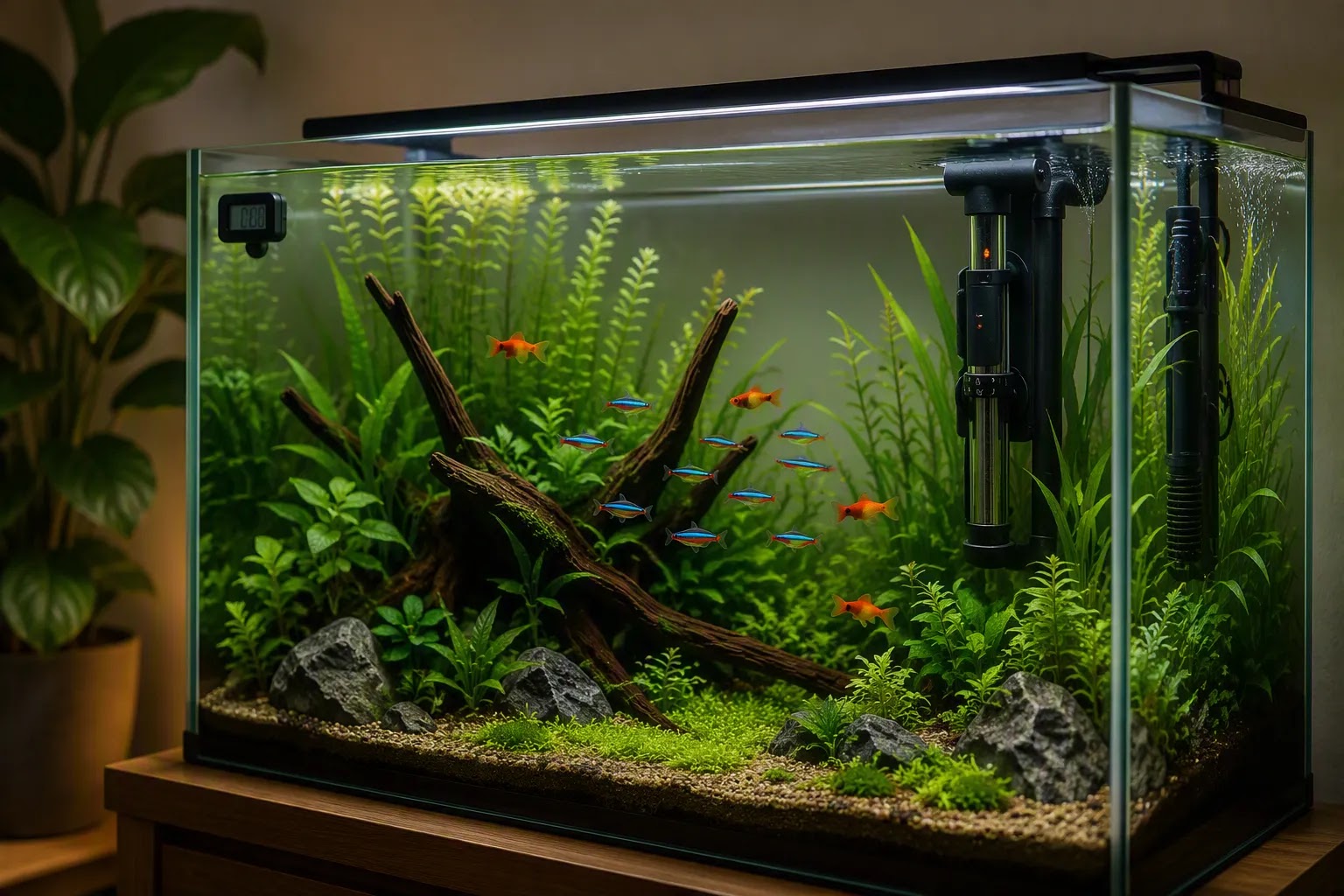
An aquarium heater is one of those products you would rather forget exists. When it works properly, the temperature stays boringly steady and you barely notice it. When it fails, however, a small piece of equipment can quickly become the most important device in the tank.
That changes how we compare aquarium heaters. A bright display or Wi-Fi control can be useful, but those features only matter when the heater also offers suitable wattage, dependable temperature regulation, sensible safety features, and a design that actually fits your aquarium.
For most freshwater or saltwater aquariums within its wattage range, our best overall pick is the Fluval E Series. It combines adjustable electronic heating with a digital display that shows measured water temperature, dual sensors, visible high/low alerts, and an integrated guard.
If you care more about shatter-resistant construction, straightforward controls, and value, the Aqueon Pro Adjustable Heater is the stronger practical alternative.
Quick buying answer: Choose Fluval E if visible temperature monitoring matters most; Aqueon Pro if you want strong safety features and value without a screen; EHEIM thermocontrol+ e if remote monitoring genuinely helps a large aquarium; Finnex HMA if you specifically want a guarded titanium heating element; and Fluval P25 only for a nano tank whose livestock suits its fixed 76–78°F range.
Best Aquarium Heaters at a Glance
| Heater | Best For | Wattages | Biggest Advantage | Main Trade-Off |
|---|---|---|---|---|
| Fluval E Series | Best Overall | 100W, 200W, 300W | Actual-temperature display and visual alerts | Premium price and no nano-size model |
| Aqueon Pro Adjustable | Best Value & Shatter-Resistant Pick | 50W, 100W, 150W, 200W, 300W | Thermal-plastic body plus documented safety protection | No actual-temperature display |
| EHEIM thermocontrol+ e | Best Smart Heater for Large Tanks | 150W, 200W, 250W, 300W | Wi-Fi control and temperature-deviation alerts | Expensive and unnecessary for small tanks |
| Finnex HMA Titanium | Best Titanium Option | 50W–500W | Compact guarded titanium heating tube | Short warranty and separate controller |
| Fluval P25 | Best for Nano Tanks | 25W | Compact shatterproof preset design | Fixed temperature and very limited tank size |
How We Chose These Aquarium Heaters
This is a research-based buying guide. We did not place every heater in calibrated aquariums and independently measure months of temperature performance.
Instead, we compared current manufacturer specifications, wattage ranges, adjustment options, published accuracy claims, monitoring features, safety systems, construction materials, tank-size recommendations, warranties, availability, and the practical problem each heater is designed to solve.
We gave more weight to features that can help maintain or monitor stable temperature than to features that simply make a heater look more advanced.
We also did not invent reliability percentages or proprietary “temperature stability scores.” Those would require controlled long-term testing that PNZ did not perform.
What Matters Most When Choosing an Aquarium Heater?
Correct Wattage Comes Before Extra Features
A premium heater is still the wrong heater if it cannot provide enough heat for the aquarium.
Heater demand depends on both tank volume and the difference between your target water temperature and the coolest normal room temperature.
A 50-gallon aquarium in a warm interior room does not place the same demand on a heater as the same aquarium beside a cold exterior wall in winter.
Adjustable vs. Preset
Preset heaters are simple, but they only make sense when the factory temperature matches the animals you keep.
An adjustable heater gives you more flexibility for different species, different room conditions, quarantine systems, or any setup that does not fit a fixed 76–78°F target.
Monitoring Is Different From Setting
A thermostat setting tells you what temperature you requested.
It does not necessarily tell you the actual temperature elsewhere in the aquarium.
That is why Fluval E’s measured-temperature display is useful—and why even a heater with a built-in display should still be checked against a separate thermometer elsewhere in the tank.
Construction Changes the Trade-Offs
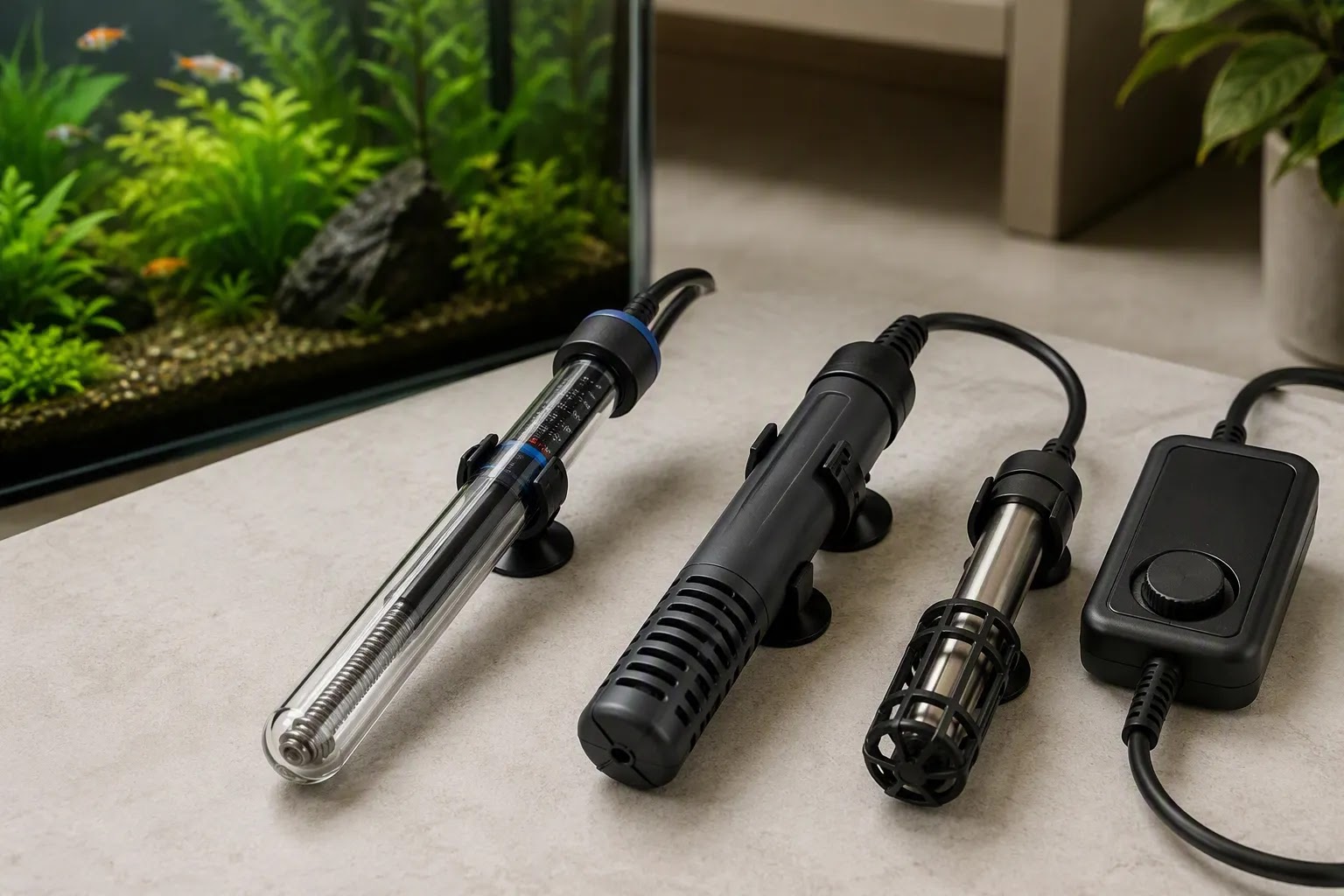
Glass, thermal plastic, and titanium heaters can all work well when properly designed and sized.
Non-glass options become especially attractive when large fish, heavy hardscape, or physical impact are genuine concerns.
Material alone does not make a heater failure-proof. Thermostat design, installation, monitoring, and correct wattage still matter.
How Much Heater Wattage Does Your Aquarium Need?
The familiar “watts per gallon” shortcut can be useful as a rough starting point, but it ignores one important variable: how far above room temperature the heater must raise the water.
Aqueon’s published heater guide illustrates the difference:
| Aquarium Size | About 5°F Above Room | About 10°F Above Room | About 15°F Above Room |
|---|---|---|---|
| 10 gallons | 50W | 50W | 100W |
| 20 gallons | 50W | 100W | 100W |
| 30 gallons | 100W | 100W | 150W |
| 55 gallons | 150W | 150W | 200W |
| 75 gallons | 200W | 200W | 300W |
| 100 gallons | 300W | 300W | 300W |
Those figures are a manufacturer sizing guideline, not a universal rule for every heater. Always check the sizing instructions for the specific model you plan to buy.
The detail many buyers miss: size the heater around the coolest realistic room temperature, not the comfortable afternoon temperature when you happen to be shopping.
The 5 Best Aquarium Heaters for Stable Temperature Control
1. Fluval E Series — Best Overall
Best for: Aquarists who want an adjustable heater that also makes actual water temperature and abnormal changes easy to see.
Who should skip it: Budget-focused buyers, nano-tank owners, or aquariums requiring wattages outside the 100W–300W range.
The Fluval E Series earns our top spot because its strongest feature is genuinely useful: it communicates what the heater is measuring.
Fluval’s VueTech system uses dual digital sensors and displays the water temperature directly. The screen changes color if measured temperature moves approximately 2°F / 1°C outside the selected safe zone and flashes when the deviation becomes substantially larger.
Current U.S. models are:
- E100: 100W, up to 30 US gallons / 120 L
- E200: 200W, up to 65 US gallons / 250 L
- E300: 300W, up to 100 US gallons / 375 L
The heater adjusts in 0.5-degree increments across approximately 68–93°F / 20–34°C. A protective casing surrounds the heater core to reduce direct contact with fish and décor.
The drawbacks are straightforward: it costs more than a conventional heater, takes up more physical space than minimalist designs, and the U.S. lineup starts at 100W.
Fluval’s current product page emphasizes its sensors, visual alerts, protective casing, and electronic monitoring rather than advertising dry-run protection, so we would not buy it assuming an undocumented shutoff feature is present.
- Pros: Actual-temperature display, dual sensors, visible high/low alerts, fine adjustment, integrated fish guard, freshwater and saltwater use.
- Cons: Premium price, only three U.S. wattages, unsuitable for many nano tanks, separate thermometer still recommended.
- Ease of use: Excellent once installed because routine monitoring is immediate.
- Value: Strong when the display and alerts are features you will actually use.
Verdict: Choose Fluval E because it makes temperature drift easier to notice—not simply because it has more electronics than a conventional heater.
Alternative: Choose Aqueon Pro if you prefer shatter-resistant construction and documented dry-condition protection without paying for a digital display.
View current Fluval E Series specifications
2. Aqueon Pro Adjustable Heater — Best Value & Shatter-Resistant Pick
Best for: Aquarists who want an adjustable everyday heater with non-glass construction and a strong documented safety feature set.
Who should skip it: Buyers who specifically want actual water temperature displayed on the heater or remote alerts.
The Aqueon Pro is less flashy than Fluval E, but its design is easy to justify.
Instead of an exposed glass tube, it uses a metal core covered in durable thermal plastic. Its electronic thermostat adjusts from approximately 68°F to 88°F, and Aqueon publishes accuracy within about ±1°F.
The current Pro line includes 50W, 100W, 150W, 200W, and 300W versions.
Aqueon also documents automatic overheat shutoff and protection against abnormal dry conditions. The Pro line carries a limited lifetime warranty.
- Pros: Shatter-resistant thermal-plastic body, electronic thermostat, ±1°F published accuracy, overheat and abnormal-dry-condition protection, five wattages, limited lifetime warranty.
- Cons: No actual-temperature screen and no remote monitoring.
- Ease of use: Very good—set the control and verify aquarium temperature with an independent thermometer.
- Value: Excellent for buyers who care more about practical construction and safety features than electronics.
Verdict: If you do not need a digital display, the Aqueon Pro may be the more sensible purchase than our overall winner.
Alternative: EHEIM thermocontrol e is worth considering when you prefer a traditional electronically regulated glass-heater format with additional wattage choices.
View current Aqueon Pro specifications
3. EHEIM thermocontrol+ e — Best Smart Heater for Large Aquariums
Best for: Larger aquariums where remote adjustment and temperature-deviation alerts provide genuine value.
Who should skip it: Small-tank owners or anyone unlikely to configure and use its Wi-Fi features.
EHEIM’s thermocontrol+ e adds connectivity to a heater platform intended primarily for larger systems.
Temperature can be set and monitored through Wi-Fi from a smartphone, tablet, or computer. EHEIM lists an adjustable range of approximately 18–32°C, control accuracy of ±0.5°C, and email notification when the measured temperature deviates by roughly ±2°C.
Current models include:
- 150W: approximately 200–300 L
- 200W: approximately 300–400 L
- 250W: approximately 400–600 L
- 300W: approximately 600–1000 L
The line also includes EHEIM’s Thermo Safety Control dry-run protection, operating-status indicators, freshwater and marine compatibility, and a three-year manufacturer warranty.
The limitation is obvious: none of this makes sense if you are heating a small community tank and will never use remote monitoring.
Wi-Fi alerts also depend on connectivity. They are an additional monitoring layer, not a replacement for an independent thermometer and normal aquarium observation.
- Pros: Wi-Fi adjustment, remote monitoring, deviation alerts, ±0.5°C published control accuracy, dry-run protection, three-year warranty.
- Cons: Premium price, designed mainly for large tanks, more involved setup, remote features depend on network connectivity.
- Ease of use: More setup than a conventional heater, but convenient afterward if remote access matters.
- Value: Good for a large system where remote alerts solve a real problem; poor value for an ordinary small aquarium.
Verdict: Pay for the thermocontrol+ e when remote awareness of a large aquarium is genuinely useful, not simply because “smart heater” sounds more advanced.
Alternative: The non-Wi-Fi EHEIM thermocontrol e keeps electronic regulation and dry-run protection with less complexity.
View current EHEIM thermocontrol+ e specifications
4. Finnex HMA Titanium Heater — Best Titanium Option
Best for: Aquariums where a guarded non-glass heating tube is a specific priority.
Who should skip it: Buyers who prioritize long warranty coverage or want the controller integrated directly into the heater body.
The Finnex HMA uses a corrosion-resistant titanium heating element instead of a conventional glass tube.
Temperature is adjusted through a separate analog controller outside the aquarium, while a protective guard surrounds the heating tube.
Finnex currently lists:
- 50W: roughly 10–20 gallons
- 100W: roughly 20–30 gallons
- 150W: roughly 30–60 gallons
- 200W: roughly 60–80 gallons
- 300W: roughly 80–100 gallons
- 500W: roughly 100–120 gallons
The published control range is approximately 68–92°F, with regulation within about ±2°F. Finnex notes that its tank-size figures assume a standard enclosed aquarium and a temperature rise of no more than roughly 8°F above room temperature.
The main commercial drawback is warranty coverage. Finnex currently publishes a 180-day warranty for the original purchaser and states that warranty coverage is void for products sold or used outside the United States.
- Pros: Titanium construction, compact heater tube, protective guard, external adjustment, broad wattage range.
- Cons: Short warranty, warranty restrictions outside the U.S., separate controller adds another component, looser published temperature regulation than some electronic competitors.
- Ease of use: Good if you prefer adjusting temperature outside the aquarium.
- Value: Good when titanium specifically solves a concern; less compelling if conventional non-glass or glass heaters already fit your tank.
Verdict: Buy the HMA because you specifically want titanium and an external controller—not because titanium automatically makes every aquarium safer.
Alternative: Aqueon Pro offers shatter-resistant construction with substantially longer warranty coverage.
View current Finnex HMA specifications
5. Fluval P25 — Best for Nano Tanks
Best for: Small freshwater or saltwater aquariums up to about 6 gallons where 76–78°F is an appropriate temperature.
Who should skip it: Species needing a different temperature, aquariums larger than its rating, cold rooms with a large temperature gap, or anyone who needs adjustable control.
The Fluval P25 solves a simple problem: many full-featured adjustable heaters are physically large or begin at 50W or 100W.
The P25 is a compact 25W model rated for tanks up to approximately 6 US gallons / 25 L. Its shatterproof polymer body is fully submersible and factory preset to approximately 76–78°F / 24–26°C.
Fluval also offers a smaller P10 for tanks up to roughly 3 gallons.
The simplicity is both the advantage and the limitation. There is no temperature control to misadjust, but there is also no way to select a different target.
Fluval notes that if the difference between room temperature and the preset target exceeds approximately 12°F / 8°C, additional heating capacity may be required.
- Pros: Compact size, shatterproof polymer construction, simple preset operation, appropriate wattage for true nano tanks.
- Cons: Fixed temperature, very small aquarium rating, limited ability to compensate for cold rooms.
- Ease of use: Excellent.
- Value: Very good when its preset temperature and tank-size range fit your livestock.
Verdict: The P25 works because it is simple and appropriately small. If you need temperature control, choose an adjustable heater instead of trying to make a preset model fit the wrong aquarium.
Alternative: Aqueon’s 50W Pro is the better starting point when your tank can accommodate it and you need adjustable temperature.
View current Fluval P25 specifications
Heater Placement Still Matters
The correct heater cannot regulate the whole aquarium well if heated water remains concentrated around one corner.
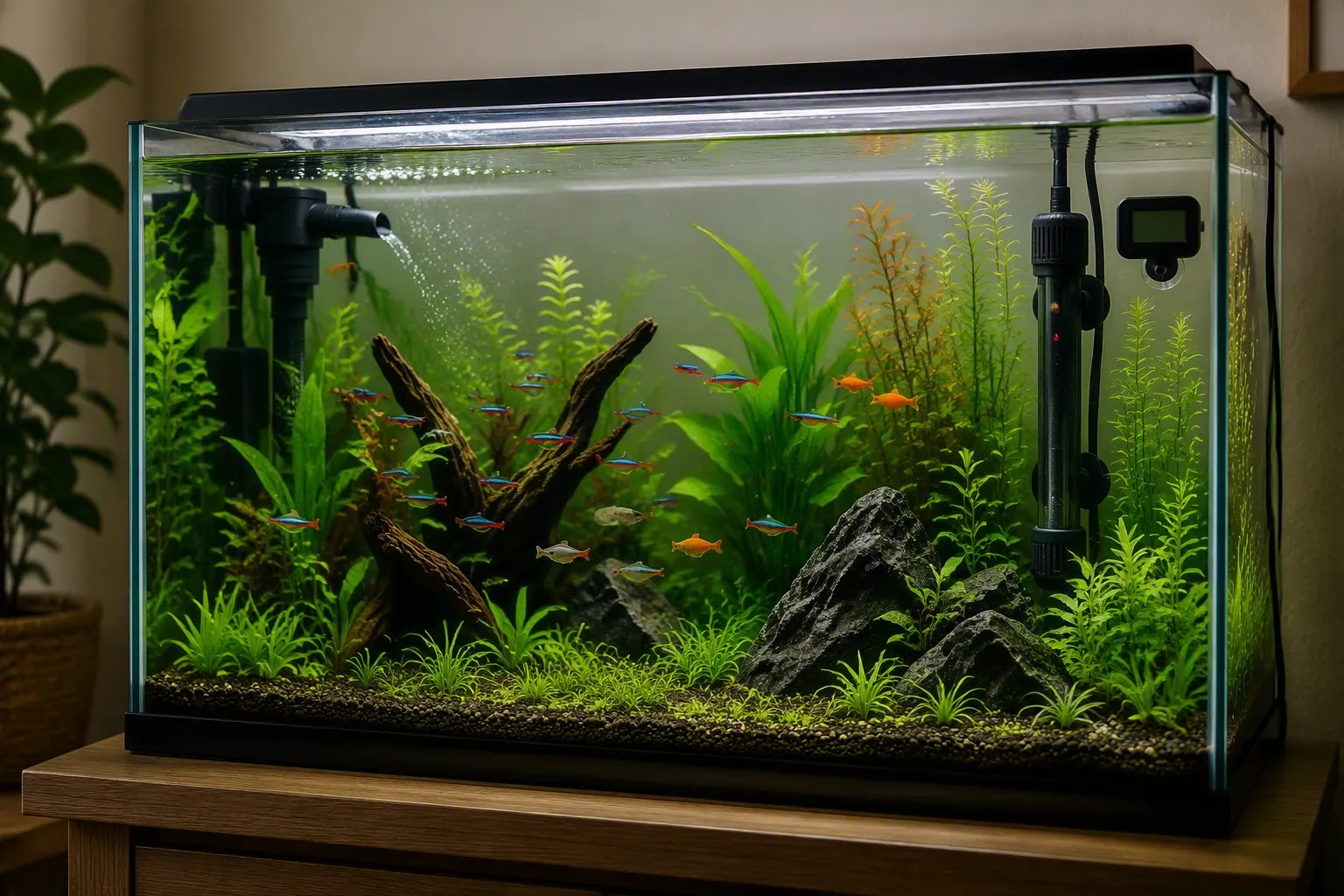
Place a submersible heater where normal filter or pump flow can distribute warmed water through the tank. Aqueon recommends positioning heaters near a filter inlet, outlet, or other area with water circulation.
Then use a separate thermometer away from the heater so you are checking the aquarium rather than only the water immediately beside the heating element.
If you want a deeper explanation of circulation and gas exchange, our aquarium surface agitation guide covers that separately.
One Large Heater or Two Smaller Heaters?
For a small aquarium, one correctly sized heater is usually the simplest setup.
For larger systems, splitting the required heating capacity between two appropriately sized heaters can provide some redundancy. Aqueon’s heater guidance uses paired heaters for some very large aquarium sizes, while Aquarium Co-Op also describes dividing a larger heating requirement between two units.
If one stops heating, the other may slow the temperature drop. If one sticks on, an individual smaller heater has less heating capacity than one oversized unit.
That is risk reduction, not a guarantee. Two heaters still need correct sizing and monitoring.
Safety Features Worth Checking Before You Buy
- Independent temperature verification: Use a separate thermometer even when the heater has a display.
- Dry-run or overheat protection: Useful when documented, but do not assume every electronic heater includes it.
- Protective guard: Worth considering when fish or hardscape may contact the heating element.
- Electrical setup: Use a drip loop, keep connections dry, and follow the manufacturer’s installation instructions.
Before a water change: follow your heater’s instructions before exposing or removing it. Aqueon recommends unplugging its heater and allowing it to cool before removal, then allowing it to acclimate in the aquarium before powering it again after installation.
If a heater ever sticks on and the aquarium is already overheating, do not suddenly add ice or very cold water. Our aquarium heater stuck-on emergency guide covers controlled cooling separately.
Which Aquarium Heater Should You Buy?
Choose the Fluval E Series if you value an actual-temperature display and obvious high/low warnings.
Choose the Aqueon Pro Adjustable if you want the strongest combination of adjustability, shatter-resistant construction, documented safety protection, warranty, and value.
Choose the EHEIM thermocontrol+ e if you operate a larger aquarium and remote monitoring is useful enough to justify the extra complexity and price.
Choose the Finnex HMA if a guarded titanium heating element is the specific feature you want.
Choose the Fluval P25 for a genuine nano aquarium only when its fixed 76–78°F temperature suits your livestock.
The best heater is not necessarily the model with the longest feature list. It is the one with the correct heating capacity, temperature control your livestock needs, safety features you understand, and monitoring you will actually use.
Frequently Asked Questions
What Size Aquarium Heater Do I Need?
Start with the sizing chart for the heater you are considering and account for both aquarium volume and how far the target water temperature sits above the coolest normal room temperature.
Is a Titanium Aquarium Heater Better Than Glass?
Not automatically. Titanium removes the possibility of breaking a glass heating tube, but thermostat design, controller quality, warranty, safety features, and correct sizing still matter.
Should I Buy an Adjustable or Preset Heater?
Adjustable heaters are more versatile for most aquariums. Preset heaters make sense when the factory temperature matches the species you keep and the tank falls comfortably within the heater’s capacity.
Do I Need a Thermometer if the Heater Has a Display?
Yes. A separate thermometer gives you an independent reading and can be positioned away from the heater to check how well heat is being distributed through the aquarium.
Are Two Aquarium Heaters Safer Than One?
Two smaller heaters can provide useful redundancy in some larger aquariums, but they do not eliminate failure risk. Both still require correct sizing and temperature monitoring.
Should I Turn Off the Heater During a Water Change?
Follow the heater manufacturer’s instructions, especially whenever the water level could expose the heating element. For broader maintenance timing, see our aquarium water-change guide.
Editorial standard: These recommendations are based on manufacturer specifications, safety documentation, heater-sizing guidance, construction, monitoring features, warranty information, intended use, and market information reviewed in September 2026. We did not perform controlled long-term temperature testing, so published accuracy figures remain manufacturer claims rather than independent PNZ measurements. Prices, stock, specifications, and warranty terms may change after publication.