
Why Does My Cat Follow Me Into the Bathroom? 5 Likely Reasons
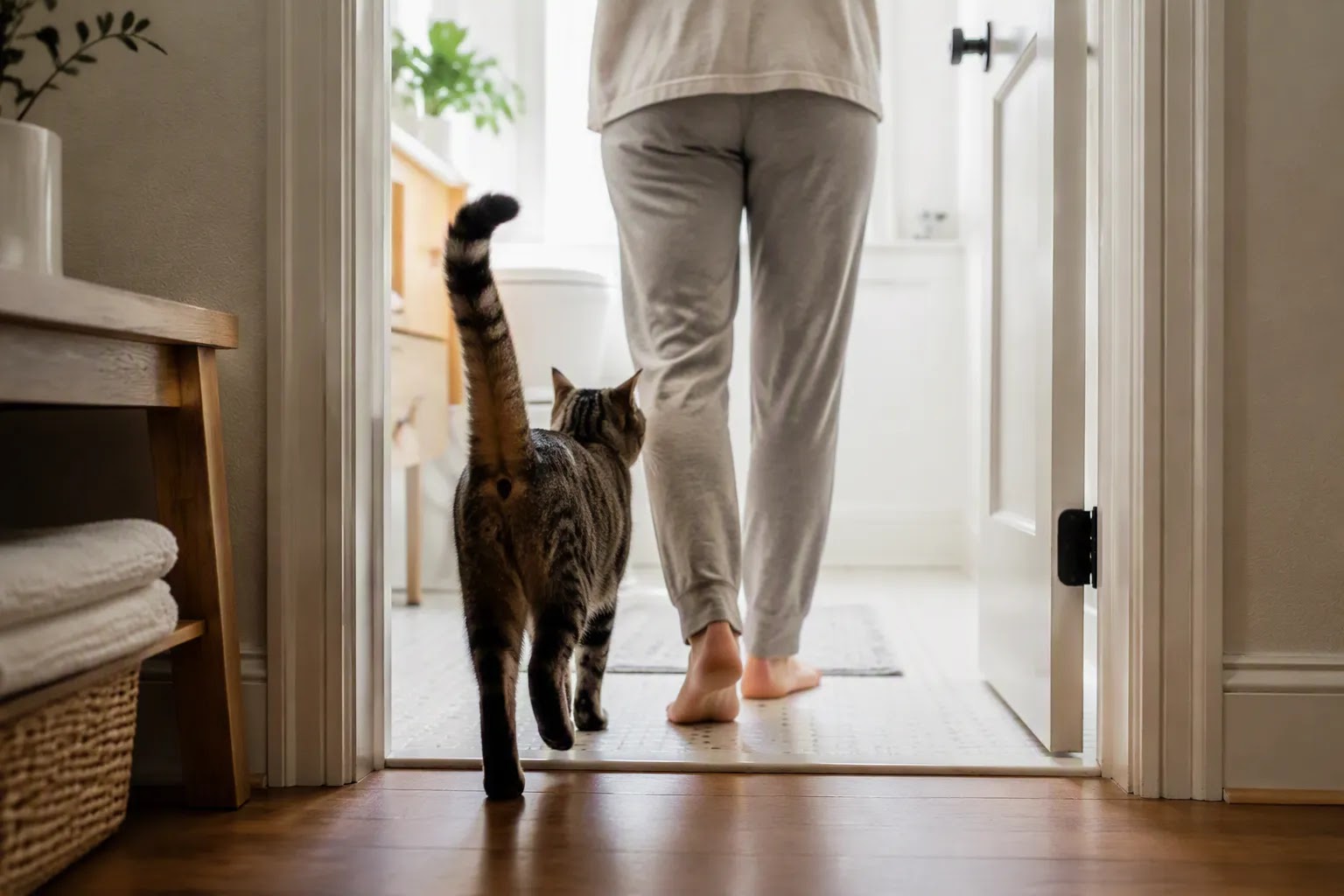
You stand up from the couch and walk toward the bathroom.
Behind you: four soft paws.
You close the door halfway. A small face appears in the gap. Close it completely, and suddenly your cat—who ignored you for most of the afternoon—seems to have urgent business on the other side.
If this happens every day, the behavior can feel oddly specific. Why the bathroom?
Why Does My Cat Follow Me Into the Bathroom?
There probably is not one universal explanation.
Cats differ considerably in how much proximity and interaction they seek from people. Some frequently choose to stay near their owners; others prefer shorter, more selective contact.
The bathroom can bring several appealing things together in one small space.
You often go there at predictable times. You become relatively stationary. The door may suddenly limit access. The room contains unusual sounds and smells. And when your cat follows, there is a good chance you look at them, speak to them, or offer some attention.
For some cats, that combination is enough to make the bathroom trip part of the daily routine.
1. Your Cat Has Learned the Routine
Cats can become remarkably good at noticing sequences that humans barely think about.
You wake up. Walk down the hallway. Turn on the bathroom light. Brush your teeth. Breakfast comes next.
To you, those may feel like separate little tasks.
To your cat, they can become one predictable chain of events.
Feline environmental guidance emphasizes positive, consistent, and predictable interaction with people. When the same event repeatedly comes before something meaningful—food, play, attention, or simply time with you—the earlier event can become part of the pattern.
That may explain why a cat who ignores the bathroom in the middle of the afternoon suddenly becomes your shadow during the morning routine.
The room itself may not be the important part.
What happens before, during, or after the bathroom trip may be.
If your cat also appears every time you open your computer, you may recognize the same kind of learned pattern. Our guide to why cats sit on laptops looks at how attention and routine can make an ordinary household object surprisingly interesting.
2. The Closed Door Changes Something
Many cat owners know the pattern.
An open door can sit unnoticed for hours.
Close it, and suddenly the room matters.
This does not mean your cat has a philosophical objection to human privacy. Closing the door simply changes access to a familiar space—and to you.
If your cat normally moves freely around the home, a closed bathroom door creates something different from the usual environment.
Your cat may wait outside, sniff beneath the door, paw at it, or hurry after you before it closes.
Curiosity is an especially plausible explanation when your cat enters, investigates the sink or tub, looks around briefly, and then leaves without showing much interest in interacting with you.
3. The Bathroom May Be Part of Your Social Routine
There is also a very simple possibility.
Your cat may enjoy being near you.
Domestic cats can form meaningful social relationships with people, but how those relationships look varies from one cat to another. Some cats regularly seek proximity. Others choose particular moments when interaction feels comfortable.
The bathroom can create one of those moments almost accidentally.
You are no longer walking around the house, cooking, vacuuming, or moving from room to room. For a few minutes, you are relatively predictable and available.
A cat who enjoys quiet, low-pressure company may take advantage of that opportunity.
They might rub against your legs, sit on the bath mat, settle nearby, or simply watch without demanding anything.
Sometimes following you into the bathroom is not about the bathroom at all. It is simply an easy opportunity to share space with you.

4. Following You May Have Been Rewarded Before
Picture the routine from your cat’s point of view.
You walk into the bathroom. Your cat follows. You look down and speak to them. Maybe you pet them. Perhaps you turn on the faucet because they enjoy watching the water.
Following you has just produced something interesting.
Behavior that repeatedly leads to a rewarding outcome can become more likely to happen again. Attention itself can be one of those rewards.
This does not mean your cat is deliberately manipulating you.
It can be much simpler:
Follow human. Something enjoyable happens.
After enough repetition, the behavior can become part of the routine even when you never intentionally taught it.
5. The Bathroom Itself Can Be Interesting
For a moment, take yourself out of the equation.
Bathrooms contain plenty of things a curious cat may investigate:
- Running or dripping water
- Cool tile floors
- Warm bath mats or towels
- Unusual echoes and household sounds
- Sinks and counters that provide elevated viewpoints
- Changing scents from water, towels, soap, and daily activity
Cats rely heavily on scent and other sensory information when investigating familiar environments, so even a room they visit every day can continue to offer changing details.
If you want to understand that sensory side more deeply, our guide to how cats use scent to understand their environment explains why familiar rooms can contain far more information for a cat than humans notice.
Is My Cat Following Me to the Bathroom to Protect Me?
This is a popular explanation online, but it goes beyond what the behavior alone can tell us.
Your cat may prefer being near you, notice when you leave the room, and care about maintaining access to you.
That is different from proving that your cat believes you are vulnerable in the bathroom and has come to stand guard.
Routine, curiosity, social proximity, changing access, and learned attention are simpler explanations that fit the behavior without assigning a specific human-like motive.
If your cat happens to sit facing the doorway while you are there, that still does not prove they have appointed themselves head of security.
Sometimes a cat sitting near a door is simply a cat sitting near a door.
What Does Your Cat’s Body Language Tell You?
Bathroom-following can happen in different emotional states, so look at how your cat behaves once they arrive.
A relaxed cat may walk in casually, explore, rub against you, groom, sit down, or leave again without hesitation.
A cat that is tense may crouch, vocalize repeatedly, pace, flatten or rotate the ears backward, lash the tail, or appear unable to settle.
The act of following by itself does not tell you the whole story.
If you are unsure what those smaller signals mean, our cat body-language guide explains how to read posture, ears, eyes, tail movement, and distance-seeking in context.
Why Does My Cat Wait Outside the Bathroom Door?
Some cats want to enter. Others appear satisfied simply knowing where you are.
A cat that lies quietly outside the bathroom may be maintaining proximity without needing direct interaction.
That is very different from a cat becoming highly distressed whenever the door closes.
If your cat waits peacefully and resumes normal activity when you come out, there usually is not much to fix.
You may simply have a very punctual bathroom companion.
What If You Want Some Privacy?
You are allowed to have bathroom boundaries, even if your cat strongly disagrees with the policy.
Consistency is usually more useful than punishment.
If the door sometimes opens after scratching or repeated meowing, persistence may occasionally work from your cat’s perspective. That can make the behavior more likely to continue.
If you want the bathroom to be off-limits:
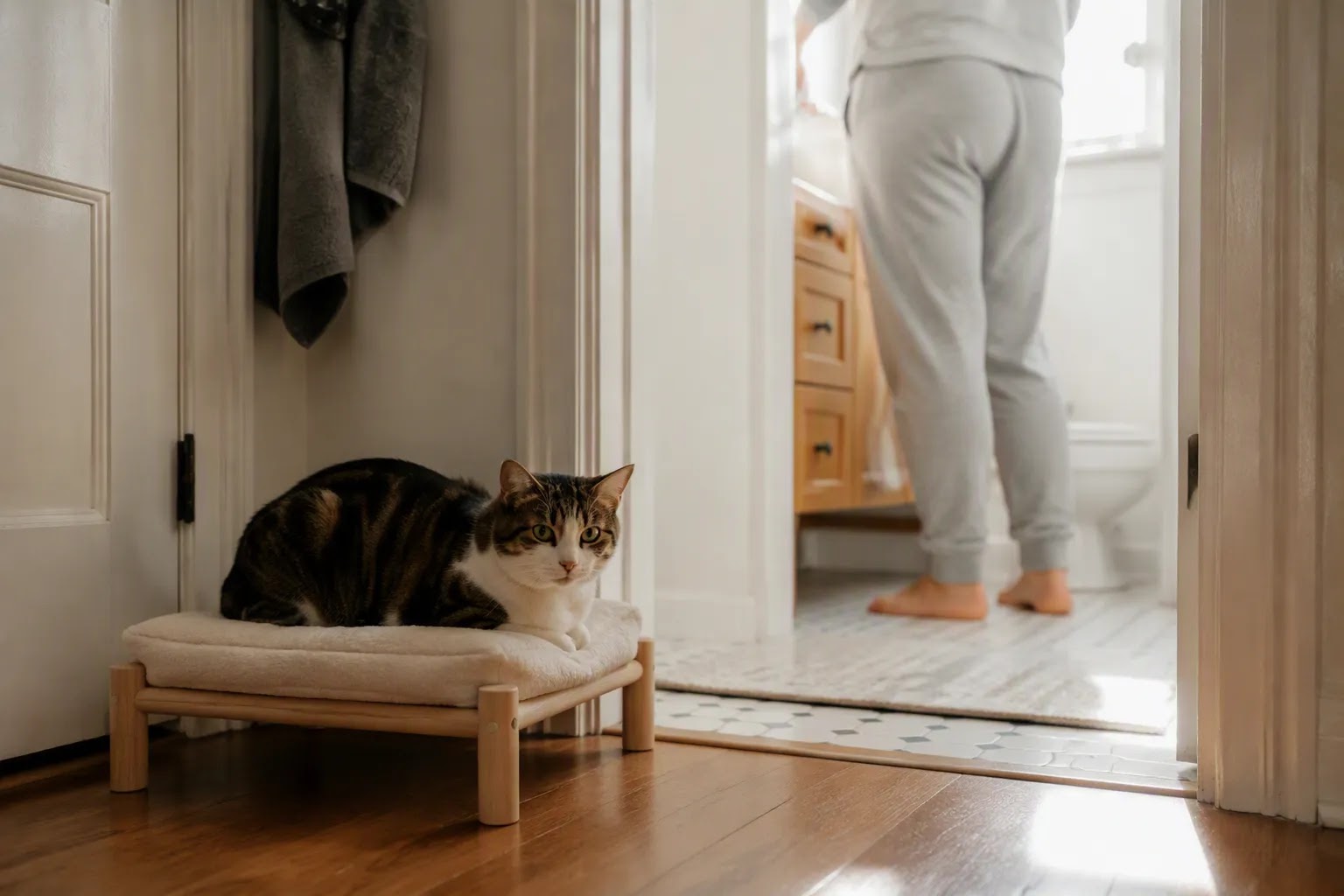
- Provide a comfortable resting place outside the room
- Redirect your cat there before entering when practical
- Reward calm behavior with attention, play, or something else your cat values
- Avoid yelling, spraying water, or frightening your cat away
- Keep the rule reasonably consistent
If your cat mainly wants to remain near you, a comfortable bed or perch close to the doorway may be enough to make the new routine easier.
When a New Bathroom-Following Habit Deserves Attention
If your cat has followed you into the bathroom for years and otherwise behaves normally, the habit itself is usually not concerning.
A sudden broader change is more meaningful.
Talk with your veterinarian if a new increase in following or attention-seeking appears alongside unusual vocalization, confusion, appetite or thirst changes, altered litter-box habits, pain, restlessness, or a major change in your cat’s normal social behavior.
This can be especially important in older cats, where a new behavior change should not automatically be dismissed as personality.
Following you into one particular room is a behavior. A wider change in how your cat acts can be a clue that something else has changed.
Sometimes the Bathroom Is Just Part of Being Together
Tomorrow morning, you may hear that familiar little trot behind you again.
Your cat may follow you through the doorway, inspect the sink as though it changed overnight, rub against your ankle, and settle onto the same bath mat they chose yesterday.
You do not have to decide whether that moment means love, curiosity, routine, or a carefully negotiated combination of all three.
For many cats, the explanation is probably less dramatic: the trip is predictable, you are there, interesting things happen there, and your cat has learned that being included is worthwhile.
Which is why, in some homes, going to the bathroom alone quietly becomes one of those luxuries cat owners vaguely remember having once.