
How to Teach a Dog to Come When Called: Step-by-Step Recall
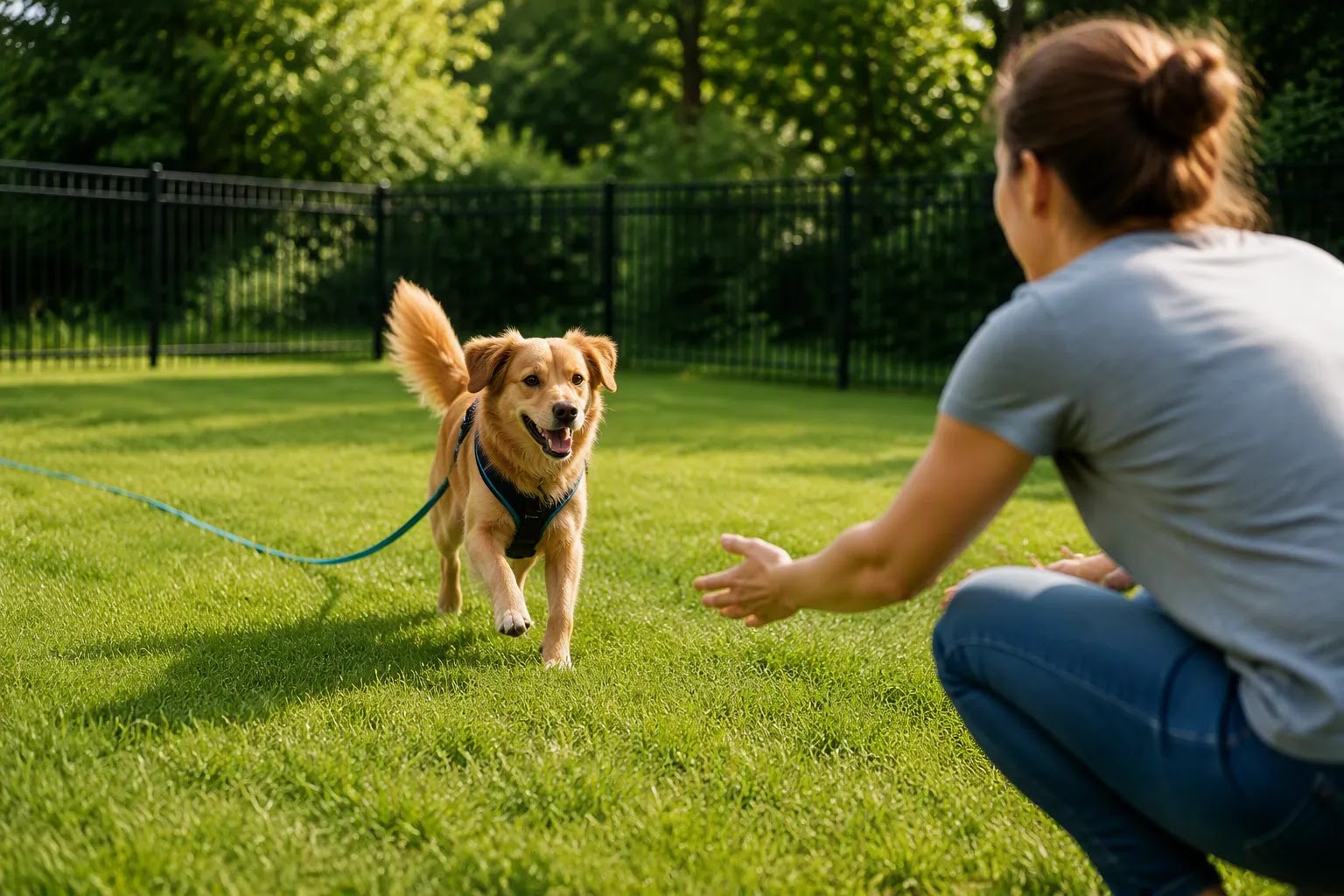
Your dog comes running when you call from the kitchen. Then you try the same thing outside, where there are squirrels, smells, people, and another dog across the park—and suddenly “come” seems to mean nothing.
That does not necessarily mean your dog is stubborn. Recall asks them to stop something interesting, turn away from it, and choose you instead. The skill has to be built gradually enough that returning remains worthwhile even as the environment gets harder.
Quick answer: Start recall training in a quiet place, reward your dog generously for coming all the way to you, and increase distance and distractions gradually. Use the cue once when success is likely rather than repeating it while your dog is absorbed elsewhere. Outdoors, use a long line attached to a secure harness until the response is dependable. Never punish a dog after they return.
What Does a Reliable Recall Actually Mean?
Recall is the behavior of returning to you when given a cue such as “come,” “here,” or a whistle.
It is one of the most useful safety skills a dog can learn, but even excellent recall is not a guarantee.
VCA Animal Hospitals recommends keeping dogs leashed when there is a realistic chance of encountering hazards such as vehicles or large animals, even while recall skills are developing well.
The goal is not to prove that your dog can safely be off leash everywhere. It is to build a response that becomes increasingly fast, enthusiastic, and dependable while continuing to manage high-risk situations sensibly.
Choose a Recall Cue Worth Protecting
Choose one simple cue and use it consistently across the household.
Common options include:
- “Come”
- “Here”
- A distinctive whistle
- Another short word your dog does not hear constantly
The exact word matters less than what it predicts.
You want your dog to learn that hearing the cue and returning to you leads to something worthwhile: excellent food, a favorite toy, play, praise, or another reward that genuinely matters to that dog.
If “come” has already been repeated hundreds of times while your dog ignores it—or regularly predicts scolding, the end of fun, nail trimming, or another disliked event—a fresh cue can sometimes make rebuilding the behavior easier.
Step-by-Step Recall Training Plan
Step 1: Make Moving Toward You Valuable
For the first few repetitions, you do not even need the recall word.
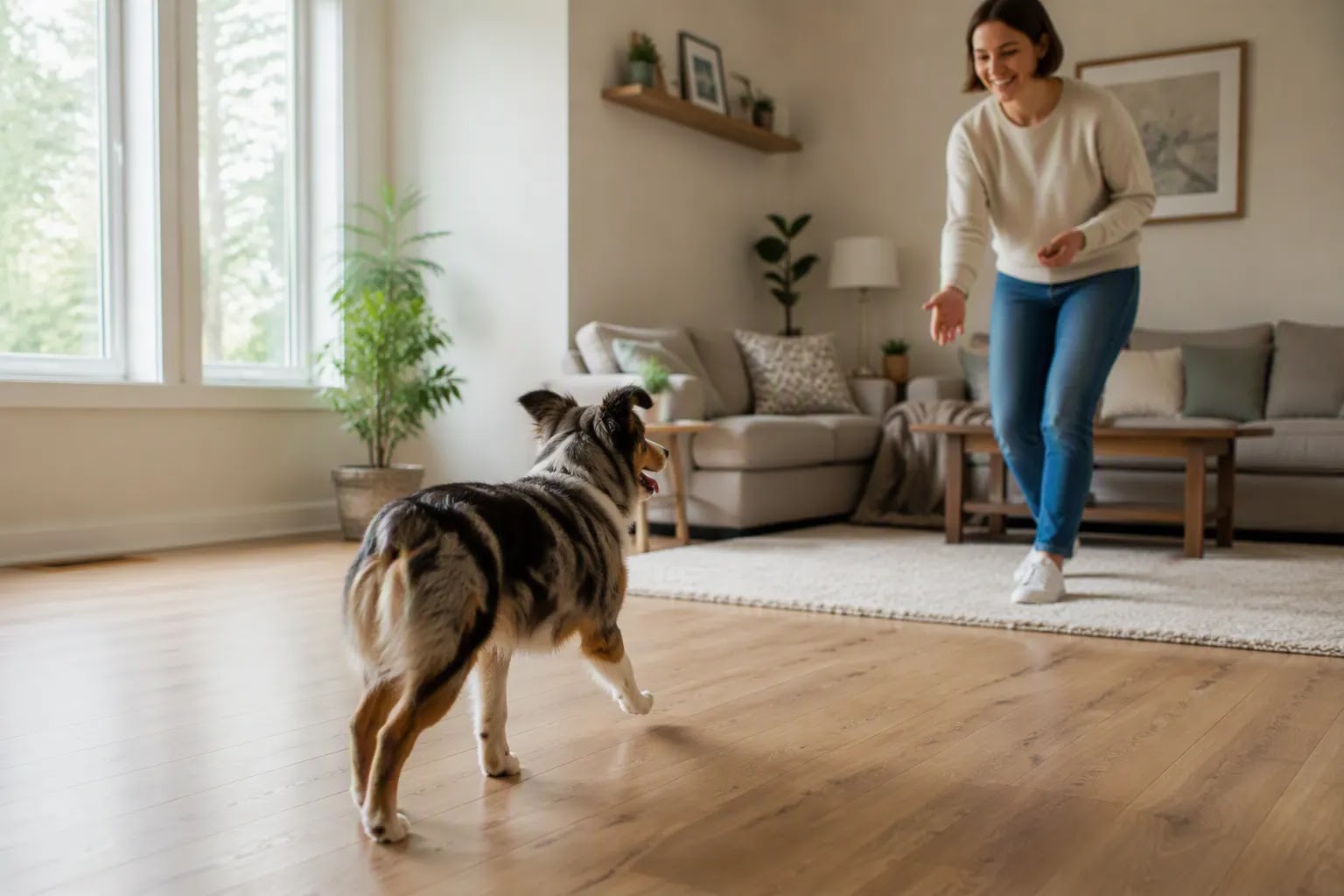
In a quiet room, wait until your dog is a few feet away. Encourage them toward you with friendly body language, a little backward movement, or another sound they naturally notice.
When they reach you, reward them.
The first lesson is simple: moving all the way to you pays off.
Step 2: Add the Cue When Success Is Likely
Once your dog is happily moving toward you, add your chosen cue.
Say it once in a cheerful voice when your dog is close enough and focused enough that you reasonably expect success.
- Choose a moment with few distractions.
- Use your dog’s name if you need their attention.
- Say the recall cue once.
- Move backward a few steps if that encourages them toward you.
- Reward generously when they arrive.
Give your dog a moment to respond rather than immediately repeating the word.
The Dogs Trust recall guide likewise recommends beginning in a low-distraction environment, rewarding every return, using the recall cue sparingly, and increasing difficulty gradually.
Step 3: Reward the Full Arrival
If your dog turns toward you but stops halfway, the recall is not finished yet.
Build value for coming close enough that you could actually secure your dog if necessary.
Deliver rewards near your body instead of throwing them away the instant your dog approaches. Occasionally give several small treats in succession, play briefly, or use another reward your dog values.
You want the finished behavior to mean come all the way back, not “run toward the human and bounce away again.”
Step 4: Add a Comfortable Collar or Harness Hold
A dog may happily run back and then dodge your hand when you try to attach the leash.
In a real escape, getting within a few feet of you is not enough if you still cannot safely secure them.
During easy recalls, gently touch and briefly hold the collar or harness while giving rewards. Build the duration gradually so being secured becomes part of the rewarding recall routine rather than the unpleasant part at the end.
VCA specifically includes a gradual collar-touch exercise in recall training for this reason.
Step 5: Increase Distance Slowly
Once short indoor recalls are easy, increase one challenge at a time.
Call from across the room, then from another room, a hallway, or a securely fenced yard.
If you increase distance, keep distractions easy. If you move to a new environment, shorten the distance again.
Use a Gradual Recall Progression
| Stage | Practice Setup | Progress When |
|---|---|---|
| 1 | Quiet room, short distance | Your dog readily turns and comes over several short sessions |
| 2 | Different rooms or secure yard | More distance remains easy |
| 3 | Secure outdoor space with mild distractions | Your dog can disengage without repeated cues |
| 4 | Outdoor practice on a long line | Your dog responds around controlled real-world distractions |
| 5 | More challenging environments | Responses stay dependable while safety and leash rules are maintained |
There is no advantage in rushing through these stages.
If your dog struggles after you increase distance, change location, or add a distraction, that is useful information. Make the next repetition easier.
Move Recall Training Outdoors Safely
Going directly from your living room to an open park is a major jump.
Outside, your dog may be competing with scent trails, wildlife, people, dogs, food on the ground, movement, and years of reinforcement for exploring.
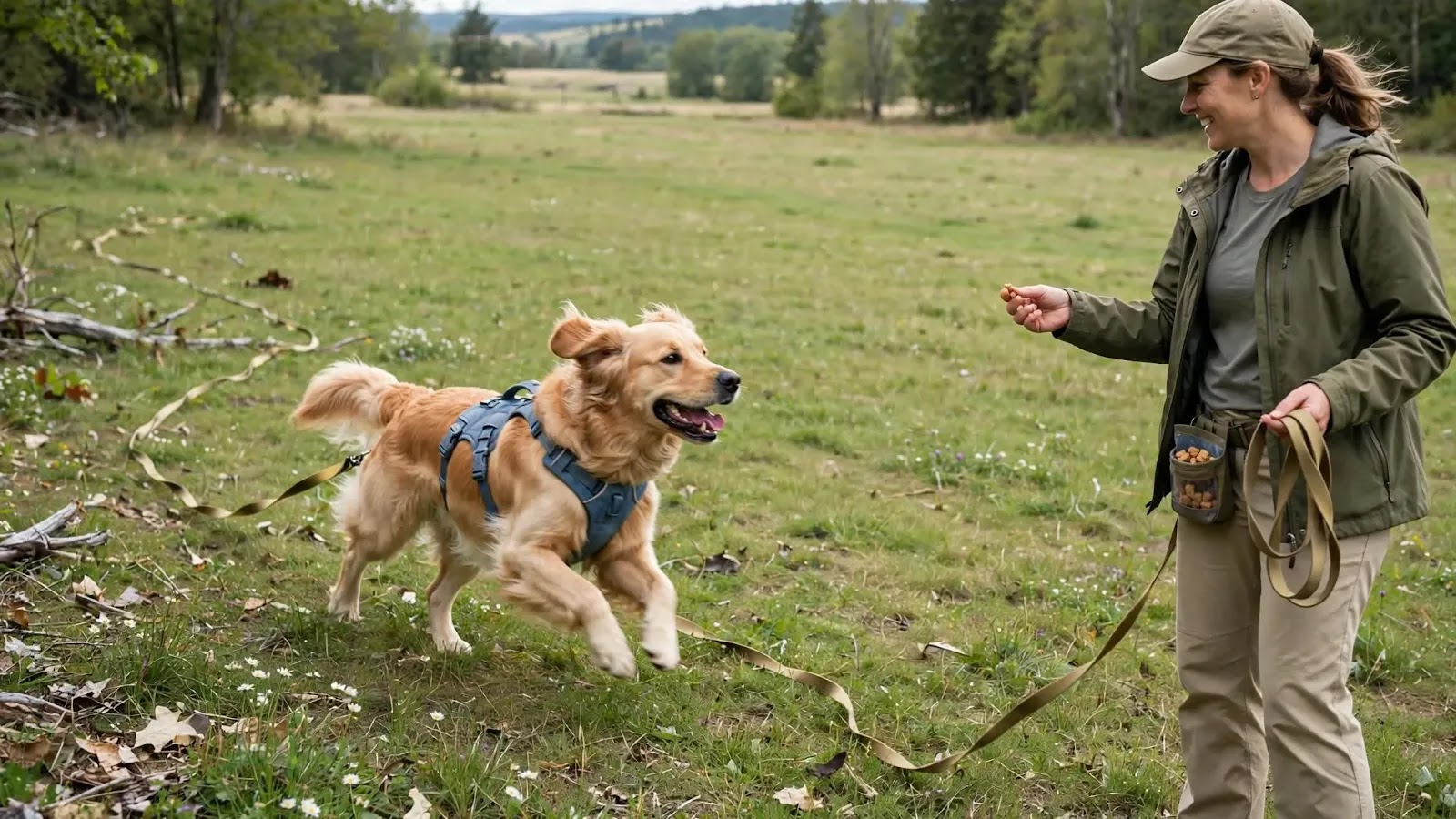
A long line gives your dog room to practice without allowing an unfinished recall to become an escape.
Attach it to a comfortable, secure harness and choose an open practice area where the line is less likely to wrap around obstacles. Keep it organized and do not wrap the line around your hand.
The long line is a safety tool, not a way to jerk your dog back to you.
If your dog ignores the cue, stay calm, prevent them from disappearing, and reduce the difficulty of the next repetition.
Add Distractions One at a Time
A dog who comes instantly across the kitchen has not yet learned to leave a squirrel, another dog, or a fascinating outdoor scent.
Start with mild distractions you can control, such as:
- A toy on the floor
- Another household member nearby
- A quiet backyard scent
- A person walking in the distance
- A familiar dog far enough away that your dog can still respond
Do not repeatedly test recall against the hardest distraction available.
Before you call, ask: “Is my dog likely to succeed at this distance and distraction level?” If the answer is probably not, change the setup before using the cue.
A distraction is probably too difficult when your dog cannot disengage, stops responding to familiar cues, pulls or lunges toward it, becomes increasingly tense or over-aroused, or stops accepting a reward they normally value.
Give the dog more distance or return to an easier environment instead of repeating the cue.
If reading those signals is difficult, our guide to dog and cat body language explains how posture, ears, tail movement, and overall tension fit together.
If you are working with a young puppy, unfamiliar environments also overlap with social development. Our guide to safe puppy socialization covers that separate process.
Do Not Let “Come” Always Mean the Fun Is Over
This is one of the easiest ways to weaken a recall unintentionally.
If every park recall is immediately followed by clipping on the leash and going home, the cue can begin predicting the end of something your dog enjoys.
During safe practice, sometimes call your dog, reward them, briefly hold the collar or harness, and then release them back to exploring.
Coming back does not always have to make the good stuff disappear.
That pattern helps keep the return itself valuable rather than turning recall into a warning that freedom is about to end.
What to Do When Your Dog Ignores the Recall Cue
Do not stand at a distance repeating:
“Come. Come! COME! COME!”
Repeated cues with no response can teach your dog that the first one does not matter.
Instead:
- Stay calm.
- Use the leash, long line, or secure environment to prevent escape.
- Move closer or reduce the distraction.
- Regain your dog’s attention without frightening or jerking them toward you.
- Make the next recall easier.
- Reward the successful return.
Most failed recalls are useful feedback. The distance may have been too great, the distraction too strong, the reward too weak, or the skill insufficiently practiced in that environment.
Do not punish your dog when they eventually return.
From the dog’s perspective, the behavior immediately before your response was coming back to you. Scolding, rough handling, or a leash correction at that moment can make returning less appealing next time.
The American Veterinary Society of Animal Behavior recommends reward-based training methods and advises against aversive approaches such as shock collars, prong or choke corrections, intimidation, and physical punishment.
Common Recall Mistakes to Avoid
- Repeating the cue: If your dog does not respond, change the setup instead of getting louder.
- Progressing too fast: Kitchen success does not automatically transfer to a busy park.
- Calling only to end fun: Practice recall-and-release too.
- Using rewards that cannot compete with the environment: Match the reward to the difficulty.
- Allowing repeated escapes: Use a leash, long line, or secure fenced area while the skill is unfinished.
- Treating recall as a test: Build successful repetitions instead of constantly checking whether your dog can handle an impossible situation.
When Is a Dog Ready to Be Off Leash?
There is no fixed number of training sessions that makes a dog ready.
Before considering off-leash freedom, ask whether:
- The location legally allows it
- The environment is appropriate and sufficiently safe
- Your dog has practiced recall successfully in that type of environment
- Your dog can disengage from realistic distractions there
- You can safely manage encounters with people, dogs, wildlife, and other hazards
Even excellent recall does not make an unfenced area beside traffic safe.
A dog also does not need unrestricted off-leash access to have a fulfilling life. Long lines, secure fields, fenced areas, sniffing, training, and other forms of enrichment can provide meaningful freedom with less risk.
How Long Does Recall Training Take?
Think in weeks and months of gradual practice rather than expecting a finished recall after one weekend.
Some dogs learn the basic cue quickly but need much longer before they can respond around difficult distractions.
Age, previous training, reinforcement history, environment, temperament, and what the individual dog finds rewarding all influence progress.
VCA notes that it can take many weeks or months of practice before a dog is ready to respond reliably in the face of significant distractions.
Short, successful sessions repeated regularly are generally more useful than one exhausting recall session.
When to Get Professional Training Help
Consider working with a qualified reward-based trainer if your dog repeatedly bolts, cannot be managed safely on a long line, has intense chasing behavior, becomes highly fearful outdoors, or makes little progress even after you carefully reduce the difficulty.
Fear, aggression, or a sudden major behavior change may also warrant veterinary evaluation rather than being treated as a simple obedience problem.
Look for a professional who can explain what they are teaching, how your dog will be reinforced, and how their methods protect welfare.
Build a Dog Who Wants to Return
A dependable recall is not created by finding a louder command.
It grows from many successful repetitions in which coming back proves worthwhile.
Start where success is easy. Reward the full return. Teach your dog to stay close enough to be secured. Sometimes let them return to the fun. Add distance and distractions gradually, and use a long line until the skill is ready for more responsibility.
The goal is not a dog who comes because they are afraid of what happens if they do not. It is a dog with a long history of learning that turning away from the world and coming back to you is a very good choice.