Dog Re-Entry After Indoor Pest Control: Floor Residue, Drying & Label Timing
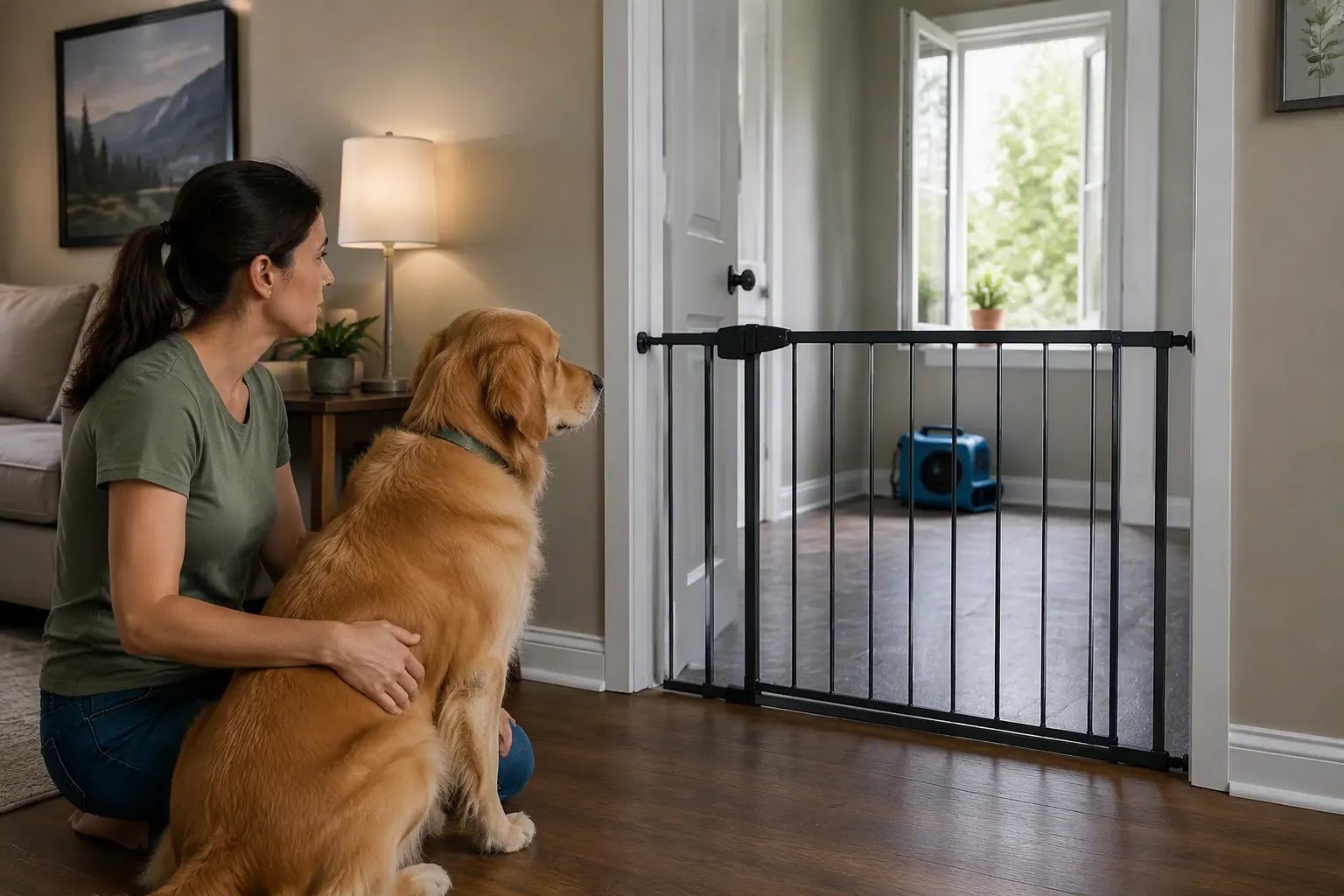
The pest-control technician has packed up, your dog is waiting at the other side of the door, and the obvious question is: “Can I let him back in yet?”
This is where a generic rule such as “wait two hours” can cause trouble. Indoor pesticides differ in formulation, application method, drying behavior, ventilation requirements, and label instructions.
Quick Answer: Follow the pesticide label’s re-entry instructions. For sprayed treatments, keep your dog away for the full required period and until treated surfaces are completely dry, using whichever condition keeps the dog out longer. Complete any required ventilation before normal re-entry. If the applicator gives additional, more conservative precautions, follow those too.
How Long After Pest Control Can a Dog Go Back Inside?
There is no universal waiting time for every indoor pesticide treatment.
A liquid spray, insecticidal dust, bait station, gel bait, and total-release fogger are not managed the same way.
EPA advises keeping pets away from pesticide-treated areas until the product has dried or for as long as the label requires.
For sprayed pesticides, the National Pesticide Information Center recommends keeping pets away for the label-specified period or until the pesticide has dried completely, whichever is longer.
Health Canada likewise advises keeping pets away during treatment, following the label’s re-entry directions, allowing treated areas to dry, and ventilating indoor spaces before animals return.
The rule to remember: The pesticide label is more useful than a generic timer. If someone says “two hours” but the registered product requires four, the four-hour requirement does not disappear.
Know Exactly What Was Applied
Before normal re-entry, ideally know both the product and the treatment locations.
If a professional treated the home, ask for:
- the product name
- the active ingredient or ingredients
- the EPA registration number in the United States, when applicable
- the Pest Control Product registration information in Canada, when applicable
- which rooms and surfaces were treated
- the required re-entry conditions or time
- ventilation instructions
- any areas that must remain inaccessible after re-entry
Many professional treatments target cracks, baseboards, wall voids, or pest harborages rather than coating every floor surface. Knowing where the product actually went helps you manage your dog’s contact appropriately.
If pesticides are stored at home between treatments, our pesticide storage guide for dog homes covers that separately.
Ask before the technician leaves: “At what exact time can my dog walk normally through this room, and are there any application sites he still needs to avoid licking, chewing, or touching?”

What Does “Until Dry” Mean?
For a liquid pesticide spray, the treated surface should no longer be visibly wet or damp from the application.
Do not shorten a label-required re-entry interval simply because one corner of the room already looks dry.
Drying speed can vary with:
- humidity
- temperature
- ventilation
- how heavily the product was applied
- whether the surface is hard, carpeted, fabric, or otherwise porous
Carpet and other absorbent materials may remain damp longer than lightly treated sealed flooring.
Do not rub a treated surface with your bare hand to “test” whether pesticide remains. Wait the required time and follow the label or applicator’s inspection instructions.

Dry Does Not Mean Pesticide-Free
This distinction matters.
Many pesticides are intended to leave a residual deposit after the water or another liquid carrier evaporates. That residue may be part of how the treatment keeps working.
So “dry” does not necessarily mean the pesticide has disappeared.
Instead, drying is often one of the conditions that allows normal re-entry under the registered use directions.
After re-entry, prevent your dog from deliberately licking, chewing, or repeatedly mouthing treated baseboards, cracks, floor edges, or other application sites.
Why Wet Paw Contact Matters
A dog walking across freshly applied liquid pesticide may pick up residue on the paws or coat and later ingest some while licking or grooming.
The actual risk depends on the active ingredient, formulation, concentration, amount, and route of exposure.
That is why keeping a dog away while a treatment is still wet matters even when the animal does not directly eat the pesticide.
Once the full label-required re-entry conditions have been met, ordinary contact with a correctly treated surface is different from walking through a fresh application.
Routine paw washing is not automatically required after every correctly timed re-entry. If your dog actually walked through wet pesticide or has visible product on the paws or coat, remove the dog from the area and obtain product-specific decontamination advice.
Re-Entry Rules Change With the Treatment Type
| Treatment Type | Re-Entry Principle | Dog-Specific Concern |
|---|---|---|
| Liquid spray | Follow the label-required period and allow sprayed surfaces to dry completely. | Wet product can reach paws, coat, and skin and later be licked. |
| Indoor dust | Follow the label and keep pets out until dust has settled as required. | Accessible loose dust should not be available for sniffing, licking, or walking through. |
| Gel or enclosed bait | There may be no drying period. | The bait must remain inaccessible for as long as it is present. |
| Total-release fogger | Everyone and all pets leave for the label-specified period, then ventilate as directed. | Premature re-entry can involve airborne pesticide and deposited residue. |
Dusts Need Different Handling From Sprays
Indoor insecticidal dust should not be treated like a wet floor spray.
Structural pest-control guidance distinguishes between liquid or aerosol applications that must dry and dust treatments that must settle before re-entry.
Many professional dusts are intended for cracks, crevices, wall voids, or other locations animals cannot access.
If you see a substantial loose deposit where your dog can step in it, sniff it, or lick it, keep the dog away and contact the applicator rather than assuming the placement is appropriate.
Baits Must Stay Inaccessible
Ant, cockroach, and rodent baits may remain active for days or longer.
Being allowed back into the room does not make a bait safe for a dog to chew or eat.
Before normal access resumes, check that:
- bait stations cannot be picked up or chewed
- gel bait is not on an exposed dog-accessible surface
- no loose bait pellets are on the floor
- the dog cannot simply push a nose or paw beneath furniture and reach the product
Out of sight is not the same as out of reach. Food-based pest baits can be attractive to dogs, so they need to remain physically inaccessible for as long as they are in use.
Foggers Need Their Own Re-Entry Plan
Total-release foggers, or “bug bombs,” release pesticide-containing aerosol throughout an enclosed area and should not be treated like a small crack-and-crevice application.
EPA requires everyone—including pets—to leave the treated space for the time stated on the product label.
Many fogger labels use a period of roughly two to four hours, but that is not a universal timer.
After the required absence period, ventilate according to the label before normal occupancy resumes.
Do not bring your dog back simply because the timer ended if ventilation is still required.
For treatment-specific preparation, see our guide to bug bombs in homes with dogs.
Ventilation Is Part of Re-Entry
Follow the label or applicator’s directions for opening windows and doors or using fans and ventilation systems.
Do not rely on odor alone.
A strong smell does not tell you precisely how hazardous a pesticide exposure is, and the absence of smell does not prove all re-entry requirements have been satisfied.
Label timing, drying, ventilation, and access restrictions are better safety checks than a sniff test.
Should You Mop Before Your Dog Comes Back?
Not automatically.
If pesticide was intentionally placed along a baseboard, crack, floor edge, or other target surface, immediately scrubbing or mopping it may remove the residual treatment.
Cleaning incorrectly may also spread residue beyond the intended application site.
Do not automatically mop, steam-clean, scrub, or apply another household cleaner to treated surfaces simply because you are concerned about residue.
Follow the pesticide label or ask the applicator which surfaces should remain undisturbed and which require cleaning.
If pesticide accidentally reached a dog bowl, toy, bed, food area, or another surface that was not supposed to be treated, keep your dog away from the item until you have product-specific cleanup instructions.
What About Carpet, Rugs, and Dog Bedding?
Porous materials can remain damp longer than tile or sealed flooring.
Do not return your dog to treated carpet that is still damp when drying is required for re-entry.
If beds, blankets, toys, chews, or bowls were removed before treatment, return them only after the area meets the full re-entry conditions.
If a fabric item was accidentally sprayed, do not assume drying alone means the dog should chew or sleep on it. Ask whether the item should be laundered, cleaned in a specific way, or replaced.
The Dog Re-Entry Checklist
Before opening the gate, check all five:
- The pesticide label’s required re-entry period or conditions have been satisfied.
- Sprayed surfaces that must dry are completely dry.
- Required ventilation is complete.
- Baits, gels, dusts, and other application sites that must stay inaccessible really are out of your dog’s reach.
- Food bowls, water bowls, bedding, toys, and chews are not contaminated.
If all five are satisfied, you have a much stronger basis for re-entry than simply watching a clock.
What If Your Dog Went Back Inside Too Soon?
Remove the dog from the treated area first and prevent additional contact.
Then identify:
- the exact pesticide product
- the active ingredient and formulation if known
- whether the treatment was still wet or airborne
- whether your dog walked through it
- whether visible product is on the paws or coat
- whether the dog licked the floor, paws, bait, or treatment site
- approximately how long the exposure lasted
Read the product label for first-aid information and contact the applicator, your veterinarian, or an animal poison-control service when meaningful exposure may have occurred.
Seek veterinary help promptly if your dog may have swallowed pesticide or develops concerning signs after exposure. Difficulty breathing, seizures, collapse, severe weakness, or markedly reduced responsiveness require immediate emergency veterinary attention.
In the United States, the ASPCA Animal Poison Control Center can be reached 24/7 at 888-426-4435; a consultation fee may apply.
Our pet first-aid kit checklist can help keep emergency information organized, but suspected pesticide poisoning needs product-specific advice.
Do Not Give a Home Antidote
Pesticides belong to many chemical classes, and there is no universal home antidote.
Do not induce vomiting or give milk, oil, activated charcoal, hydrogen peroxide, food, or another home remedy simply because pesticide exposure occurred.
Some treatments are inappropriate—or dangerous—for certain products and exposure routes.
Contact a veterinarian or animal poison-control professional first and have the pesticide packaging or service report available.
Make the Next Treatment Easier
Before a future indoor pest-control visit:
- tell the company that a dog lives in the home
- ask which product will be used
- ask exactly where it will be applied
- get the pet re-entry directions in writing when possible
- remove dog bowls, food, toys, chews, and bedding from treatment areas
- plan where your dog will stay during treatment and drying
- keep the product name or service report afterward
If you are deciding how to control pests around your dog in the first place, see our IPM guide to pest control in dog homes.
The Bottom Line
The safest answer to “Can my dog go back inside yet?” does not come from a universal number of hours.
It comes from the specific pesticide label, the treatment type, required drying, required ventilation, and whether any active product remains accessible to your dog.
For a typical sprayed treatment, that usually means waiting until the label’s re-entry requirements are satisfied and the treatment is fully dry.
Dusts need to settle as directed. Baits need to stay inaccessible. Foggers require their own evacuation and ventilation procedure.
Check those conditions before opening the gate—not just the clock.
Veterinary & Pesticide Safety Disclaimer: This article provides general educational guidance and does not replace the directions on a registered pesticide label, advice from the licensed applicator, or veterinary care. Risk depends on the active ingredient, formulation, concentration, exposure route, amount, and individual dog. Seek product-specific professional guidance after suspected significant exposure.
Sources & Editorial Standards
General pet re-entry recommendations and the requirement to keep pets away until pesticide has dried or for the period required by the label were checked against current U.S. EPA pesticide safety guidance and National Pesticide Information Center guidance on pets and pesticides.
The distinction between liquid or aerosol treatments that must dry and dust treatments that must settle before re-entry was cross-checked against Health Canada’s structural pest-control labeling guidance and its pet pesticide safety guidance.
Fogger evacuation and ventilation recommendations were checked against the current EPA safety precautions for total-release foggers.
Label use, keeping baits inaccessible, and keeping pesticide products away from pet food and water were cross-checked against the EPA’s Read the Label First: Protect Your Pets guidance.
Poison-exposure first steps and the recommendation not to give home antidotes or induce vomiting without professional guidance were checked against current Pet Poison Helpline emergency guidance. The current ASPCA Animal Poison Control number and fee notice were verified against the ASPCA.