Best Aquarium Water Test Kits: Liquid Reagents vs. Strips
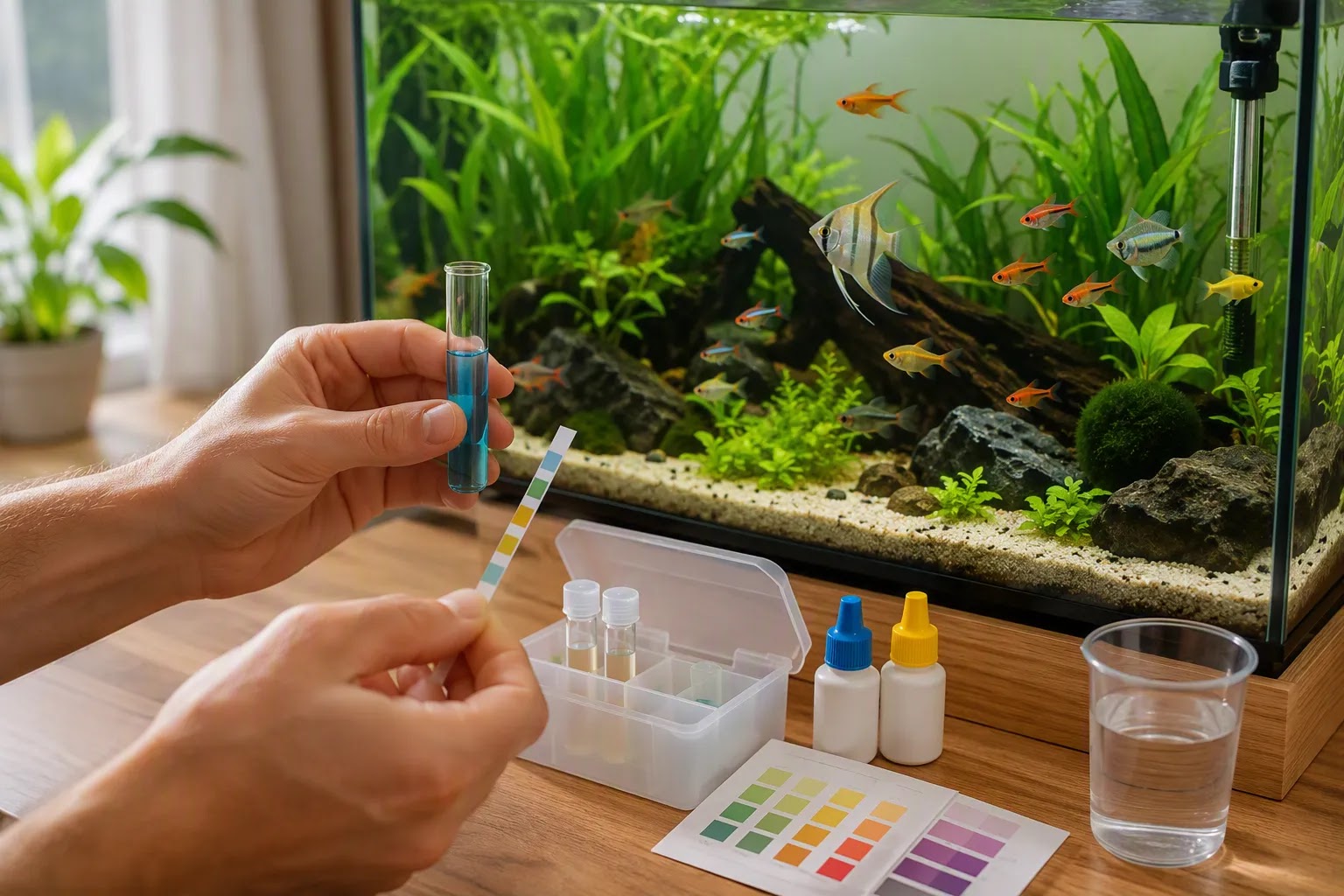
If you have ever stood over an aquarium holding a test tube in one hand, a color chart in the other, and wondered whether that shade was yellow-green or green-yellow, you already know one surprisingly important thing about water testing: you have to be willing to use the test you buy.
That is why the simple “liquid kits are good, strips are bad” argument is not very useful.
Liquid reagent kits are especially practical when cycling a new aquarium or investigating ammonia, nitrite, or another water-quality problem. Test strips are much faster and often add measurements such as GH, KH, or chlorine that some popular freshwater master kits leave out.
For most freshwater aquariums, our best overall choice is the API Freshwater Master Test Kit. It puts ammonia, nitrite, nitrate, pH, and high-range pH testing into one widely available package, which makes it particularly useful during cycling and troubleshooting.
If the extra bottles, tubes, shaking, timing, and cleanup would make you postpone testing, the Tetra EasyStrips Complete Test Strip Kit is the easier beginner option because it combines multi-parameter strips with separate ammonia strips in one package.
Quick buying answer: Choose a liquid master kit if you are cycling a freshwater aquarium, troubleshooting ammonia or nitrite, or want a reusable kit for deliberate testing. Choose strips when speed and convenience will make you test more consistently. For many established freshwater aquariums, keeping a liquid kit for deeper checks and strips for fast routine monitoring is a practical combination.
Best Aquarium Water Test Kits at a Glance
| Test Kit | Best For | Format | Key Parameters | Main Advantage | Main Trade-Off |
|---|---|---|---|---|---|
| API Freshwater Master Test Kit | Best Overall | Liquid reagents | pH, high-range pH, ammonia, nitrite, nitrate | Excellent coverage for cycling and troubleshooting | No GH, KH, or chlorine test |
| Tetra EasyStrips Complete | Best Strips for Beginners | Multi-strips + ammonia strips | Ammonia, chlorine, nitrate, nitrite, GH, KH, pH | Broad coverage with very little setup | Only 25 complete testing sets |
| Aquarium Co-Op Multi-Test + Ammonia Strips | Best for Frequent Testing | Separate strip bottles | Ammonia, nitrate, nitrite, pH, GH, KH, chlorine | High-count options and fast routine checks | Requires two products |
| Fluval Master Test Kit | Best Liquid Alternative | Liquid reagents | pH, ammonia, nitrite, nitrate | Simple core freshwater package | No GH, KH, or chlorine test |
| Seachem MultiTest Marine Basic | Best for Saltwater Basics | Reagent/sensor system | Marine pH, alkalinity, ammonia, nitrite, nitrate | Marine-focused testing with reference samples | Not a complete reef-chemistry kit |
How We Chose These Aquarium Test Kits
This is a research-based buying guide, not a laboratory comparison claiming that we independently tested every kit against calibrated analytical equipment.
We compared current manufacturer specifications, instructions, parameter coverage, number of tests, storage requirements, availability, and the practical role each product fills.
We did not invent “accuracy scores.” A meaningful accuracy ranking would require controlled reference solutions, repeat testing, defined tolerances, and standardized reading conditions.
Instead, we focused on buying questions that matter at home:
- Does the kit test ammonia?
- Does it include nitrite and nitrate?
- Does it provide GH or KH information?
- How much time and cleanup does one testing session require?
- Is the process easy enough to repeat consistently?
- How sensitive is the product to incorrect timing or storage?
- Is it suited to cycling, routine freshwater monitoring, or marine use?
Liquid Reagents vs. Test Strips: Which Should You Buy?
Liquid Kits Make Sense When You Need to Investigate
Liquid testing asks more from the user.
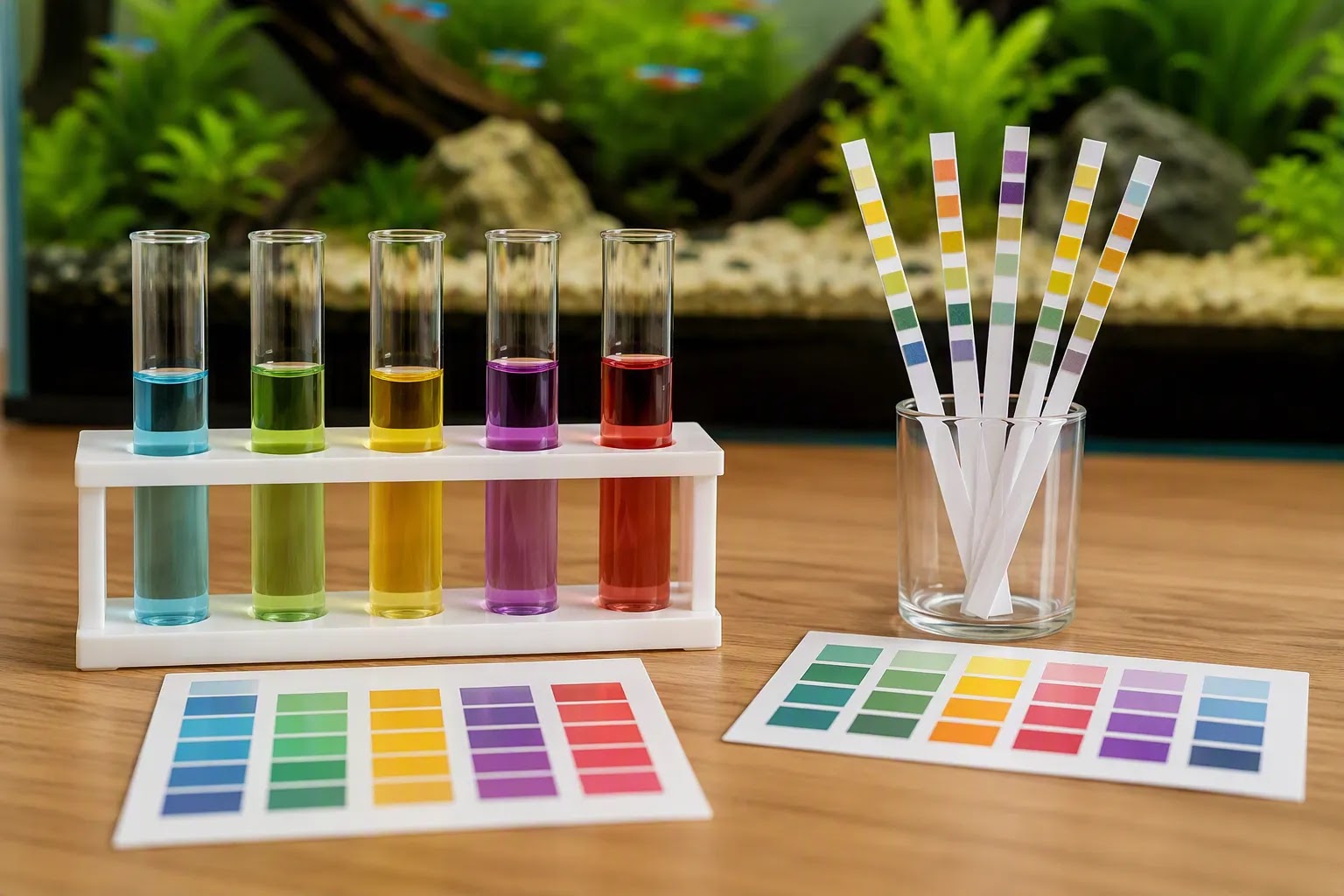
You measure aquarium water into a tube, add the correct reagents, mix or shake them as directed, wait for the specified development time, and compare the result with a color chart.
That extra effort can be worthwhile when you are cycling a tank or troubleshooting water quality because kits such as API’s Freshwater Master combine ammonia, nitrite, and nitrate testing in one package.
The weakness is user error and inconvenience. Miscounting drops, skipping required shaking, using contaminated tubes, reading too early or late, or simply postponing the test can all affect how useful the kit becomes.
Strips Make Sense When Convenience Improves Consistency
Test strips remove much of that friction.
A strip can usually be dipped and read within seconds or about a minute, with no test tubes or reagent bottles to rinse afterward.
They are especially useful for quick monitoring in established aquariums or multi-tank setups.
Multi-parameter strips also commonly include GH, KH, and chlorine, which are absent from the API and four-parameter Fluval master kits compared here.
The important catch is ammonia.
Many popular multi-strips do not test it, so a bottle labeled “5-in-1” or “6-in-1” should never be assumed to cover everything needed for cycling.
Storage matters too. Strip containers need to remain tightly closed and dry because humidity can damage unused test pads.
A better decision rule: choose the format that measures the parameters you need and that you will actually use correctly. A detailed liquid kit left untouched in a cabinet provides less information than a properly stored strip you reliably use.
The 5 Best Aquarium Water Test Kits for 2026
1. API Freshwater Master Test Kit — Best Overall
Best for: New freshwater aquariums, fishless cycling, troubleshooting, and owners who want ammonia, nitrite, nitrate, and pH testing in one reusable kit.
Who should skip it: Owners who strongly dislike liquid testing, people mainly shopping for GH/KH measurements, and saltwater aquarists.
The API Freshwater Master Test Kit remains our strongest single-kit choice because its parameter selection fits the situations where freshwater owners most often need deliberate testing.
It tests pH, high-range pH, ammonia, nitrite, and nitrate. API describes the kit as providing more than 800 tests across its reagents and includes four test tubes plus its color-comparison chart.
That “800 tests” figure does not mean 800 complete rounds of every parameter. Different reagents are consumed at different rates.
The major omission is hardness. GH and KH are not included, and neither is chlorine.
That means owners who regularly monitor mineral hardness may still want a separate hardness test or multi-parameter strip.
- Pros: Ammonia, nitrite, and nitrate together; strong cycling coverage; large number of tests; widely available; strong long-term value.
- Cons: Slower than strips; tubes need rinsing; some procedures require careful shaking and timing; no GH, KH, or chlorine.
- Ease of use: Moderate.
- Safety: Reagents are chemical testing products. Follow the instructions, keep them away from children and pets, and never return tested water containing reagents to the aquarium.
- Value: Excellent when you will use the kit regularly.
Verdict: For a new freshwater aquarium, this is the first kit we would buy because it includes the nitrogen-cycle measurements you do not want to discover are missing halfway through cycling.
Alternative: Fluval’s liquid Master Test Kit is a reasonable alternative if you prefer that system or find it more convenient to buy locally.
View current API Freshwater Master Test Kit specifications
2. Tetra EasyStrips Complete Test Strip Kit — Best Strips for Beginners
Best for: Beginners who want fast, broad testing without separately figuring out which ammonia test to add.
Who should skip it: High-volume testers who will quickly use 25 complete sets or owners who prefer dedicated liquid reagents for troubleshooting.
Tetra’s Complete kit solves one of the biggest weaknesses of ordinary multi-strips: ammonia is included as a separate test.
The package contains 25 six-parameter strips and 25 ammonia strips.
Together they cover:
- Ammonia
- Chlorine
- Nitrate
- Nitrite
- General hardness (GH)
- Carbonate hardness / alkalinity (KH)
- pH
That gives a beginner unusually broad coverage without test tubes or multiple reagent bottles.
The trade-off is quantity. Twenty-five complete rounds can disappear quickly if you are testing every day during a new-tank cycle.
- Pros: Ammonia included, broad parameter coverage, very fast, minimal cleanup, simple beginner setup.
- Cons: Only 25 complete testing rounds, strips need dry storage, cost per full test can rise with frequent use.
- Ease of use: Excellent.
- Safety: Store tightly closed and follow the manufacturer’s handling directions.
- Value: Very good for a beginner or single aquarium; less compelling for heavy daily testing.
Verdict: This is the easiest recommendation here for someone who wants one strip-based package that already accounts for ammonia.
Alternative: Aquarium Co-Op’s high-count strip bottles are more attractive when frequent testing matters more than having everything packaged together.
View Tetra EasyStrips Complete specifications
3. Aquarium Co-Op Multi-Test Strips + Ammonia Test Strips — Best for Frequent Testing
Best for: Multi-tank freshwater keepers, established tanks, and owners who want quick testing often enough that high strip counts matter.
Who should skip it: Anyone who wants ammonia included in the same bottle or Canadian shoppers who need straightforward direct shipping from the manufacturer.
Aquarium Co-Op separates routine multi-parameter testing from ammonia testing.
The Multi-Test Strips measure nitrate, nitrite, pH, GH, KH, and chlorine, with readings developing between approximately 15 and 60 seconds depending on the parameter.
The separate Ammonia Test Strips are read in about 30 seconds.
The Multi-Test product is available in 25- and 200-strip bottles, while the ammonia strips are available in 25- and 100-strip bottles.
That makes the system particularly appealing when you maintain several tanks and want enough strips on hand for frequent checks.
It also lets established-tank owners use the general multi-strip routinely and reach for ammonia testing when a new tank is cycling or something changes.
For Canadian readers, Aquarium Co-Op currently does not ship website orders directly to Canada and instead points shoppers toward its Canadian retail partner, so availability of individual products can be less straightforward than API or Tetra.
- Pros: Very fast, large-count bottles available, GH/KH/chlorine included, separate high-count ammonia option.
- Cons: Two products required for ammonia-inclusive testing, strips depend on dry storage, Canadian purchasing is less direct.
- Ease of use: Excellent.
- Safety: Less reagent handling than a liquid kit, but timing and storage still matter.
- Value: Excellent for frequent or multi-tank testing.
Verdict: The high-count Multi-Test bottle is especially useful for routine freshwater monitoring, but the setup is only complete for ammonia testing once the separate ammonia strips are also available.
Alternative: Tetra EasyStrips Complete packages both types more conveniently for a beginner with one tank.
View Aquarium Co-Op Multi-Test Strips
View Aquarium Co-Op Ammonia Test Strips
4. Fluval Master Test Kit — Best Liquid Alternative
Best for: Freshwater keepers who want a compact liquid kit covering the core biological-filtration measurements.
Who should skip it: Owners who need GH, KH, chlorine, or a broader collection of specialty tests in the same kit.
Fluval’s four-parameter Master Test Kit covers pH, ammonia, nitrite, and nitrate.
The kit is made in Canada and includes the relevant liquid reagents, a pipette, two glass test tubes, and instructions.
Its strength is simplicity: it keeps the focus on the water measurements most commonly used when checking freshwater biological filtration.
The trade-off is coverage. Unlike API, it does not add a separate high-range pH test, and GH/KH are still absent.
That makes Fluval a credible alternative rather than a clear upgrade over API.
- Pros: Core freshwater parameters, liquid-reagent format, compact package, made in Canada.
- Cons: No GH, KH, or chlorine; fewer included test types than some alternatives.
- Ease of use: Moderate.
- Safety: Treat all reagents as chemical testing products and follow the included handling instructions.
- Value: Good when locally available at a competitive price.
Verdict: Fluval makes sense if you prefer its testing system or local availability. It is not a reason to replace an API kit that already meets your needs.
Alternative: API Freshwater Master remains our overall choice because of its broader pH coverage and strong value.
View Fluval Master Test Kit specifications
5. Seachem MultiTest Marine Basic — Best for Saltwater Basics
Best for: Marine fish and brackish-water keepers who want a reusable basic testing system built around marine chemistry.
Who should skip it: Freshwater beginners, reef keepers expecting one box to cover every reef parameter, or anyone prioritizing one-minute dip-strip testing.
Aquarium test-kit comparisons often focus almost entirely on freshwater products and then treat saltwater as an afterthought.
Seachem’s MultiTest Marine Basic is designed around marine testing from the start.
It combines the company’s Marine pH & Alkalinity, Ammonia, and Nitrite & Nitrate systems.
The ammonia component measures both total and free ammonia, while the pH and alkalinity section is designed around marine conditions. The kit also includes reference samples that can be used to check test performance.
Seachem states that each included testing system provides more than 75 tests.
The limitation is in the name: Marine Basic.
A reef aquarium may need additional measurements such as calcium, magnesium, phosphate, or more specialized alkalinity testing depending on the system.
- Pros: Marine-specific pH and alkalinity, ammonia, nitrite, nitrate, reference samples, reusable testing system.
- Cons: More involved than strips, higher learning curve, not a complete advanced reef-chemistry package.
- Ease of use: Moderate compared with dip strips.
- Safety: Components include chemical reagents that require careful handling according to Seachem’s instructions.
- Value: Strong for marine keepers who will use the full basic package.
Verdict: If you keep a saltwater fish system, use a marine-focused testing setup rather than assuming the freshwater winner automatically fits your aquarium.
Alternative: Reef keepers should build their testing setup around the additional chemistry their specific reef requires rather than assuming a basic marine kit covers everything.
View Seachem MultiTest Marine Basic specifications
What Does a New Freshwater Aquarium Need to Test?
This buying guide does not need to reteach the nitrogen cycle, but it does affect what you should buy.
If you are cycling a new freshwater aquarium, you need access to ammonia, nitrite, and nitrate testing.
That is why a multi-strip can look comprehensive while still being incomplete for this specific job.
The API Freshwater Master includes all three measurements. Tetra EasyStrips Complete adds ammonia through its separate ammonia strips. Aquarium Co-Op requires its ammonia strips in addition to the Multi-Test product.
Our guide to confirming whether a fish tank is fully cycled explains how to interpret those readings without repeating the entire cycling process here.
If you are starting from the beginning, use our fishless aquarium cycling guide alongside your test kit.
If the relationship among ammonia, nitrite, and nitrate is still unclear, our simple aquarium nitrogen cycle explanation covers the biology separately.
Do Liquid Aquarium Tests Give More Accurate Results Than Strips?
Not automatically.
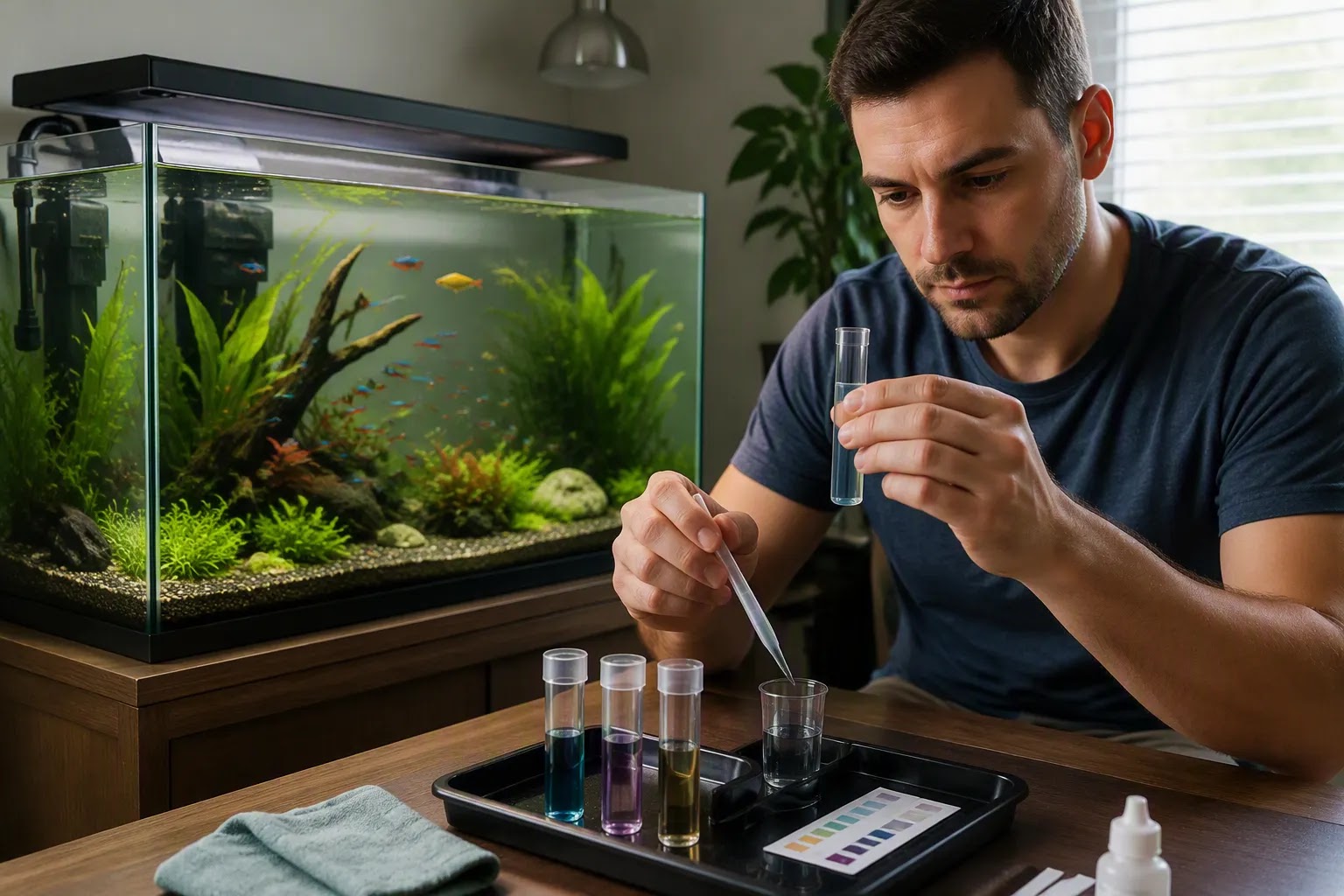
Liquid kits often use dedicated reagents and may provide more detailed color scales, but the result still depends on following the procedure correctly.
Common liquid-test errors include incorrect sample volume, miscounted drops, insufficient shaking, dirty test tubes, incorrect development time, and difficult color interpretation.
Strips have different failure points, including humidity, touching pads with wet fingers, expired stock, poor timing, or reading colors outside the specified window.
Without controlled laboratory comparison, it would be misleading to claim that one product is a specific percentage more accurate than another.
For most home aquarists, appropriate parameter coverage, correct technique, consistent storage, and repeatable use are more useful buying criteria than unsupported precision claims.
If any test produces a result that does not make sense, repeat it carefully before making a drastic aquarium change.
Which Aquarium Water Test Kit Should You Buy?
Choose the API Freshwater Master Test Kit if you are cycling a new freshwater aquarium or want one reusable liquid kit for ammonia, nitrite, nitrate, and pH troubleshooting.
Choose Tetra EasyStrips Complete if you strongly prefer strips and want ammonia included without buying several separate products.
Choose Aquarium Co-Op Multi-Test Strips plus Ammonia Strips if you test multiple freshwater aquariums frequently and value large-count bottles and speed.
Choose the Fluval Master Test Kit if you prefer a straightforward liquid alternative covering pH, ammonia, nitrite, and nitrate.
Choose Seachem MultiTest Marine Basic if you need a marine-focused basic system rather than adapting a freshwater kit.
For many established freshwater owners, there is also nothing wrong with using both formats: a liquid kit for cycling or troubleshooting and a multi-strip for fast routine monitoring of parameters such as nitrate, GH, and KH.
If testing reveals an ammonia spike in a stocked aquarium, the buying decision is over and the priority becomes the fish. Our aquarium ammonia spike emergency guide covers the next steps.
Frequently Asked Questions
Are Aquarium Test Strips Good Enough?
They can be very useful when they measure the parameters you need and are stored, timed, and read correctly. The main buying limitation is often coverage: many multi-parameter strips do not include ammonia.
What Test Kit Is Best for Cycling a New Freshwater Tank?
Our choice is the API Freshwater Master Test Kit because it puts ammonia, nitrite, and nitrate testing in one reusable freshwater package.
Do I Need Both Test Strips and a Liquid Kit?
No. But the combination can be practical. A liquid kit can handle cycling and troubleshooting, while multi-parameter strips make quick measurements such as nitrate, GH, and KH easier.
What Should I Check Before Buying a Multi-Parameter Strip?
Read the actual parameter list rather than relying on labels such as “5-in-1” or “6-in-1.” In particular, verify whether ammonia is included or requires a separate test.
How Long Do Aquarium Test Strips Last?
Follow the expiration date and storage instructions for the specific product. Aquarium Co-Op currently states that its strips expire two years after production, but humidity can damage strips earlier if the bottle is not kept tightly closed and dry.
Editorial standard: This comparison is based on current manufacturer specifications, instructions, test coverage, storage requirements, availability, and practical use cases reviewed in September 2026. We did not perform controlled laboratory accuracy testing and therefore do not invent accuracy rankings. Manufacturer performance claims remain manufacturer claims, and prices, stock, specifications, or availability may change after publication.
:::