How to Read a Pesticide Label When You Have Pets: Re-Entry, Bait & Aquatic Warnings

You pick up an ant spray, flea product, lawn treatment, or rodent bait and turn the package over. Suddenly you are staring at tiny print, unfamiliar ingredients, warnings, registration numbers, and several different sets of directions.
If you have pets, the most important information is rarely the marketing claim on the front.
It is on the label.
A pesticide label tells you where the product may be used, how it must be applied, when pets can return, how bait must be placed, whether aquatic life is at risk, how the product should be stored and discarded, and what to do after an accidental exposure.
Quick answer: Before using a pesticide around pets, find the Directions for Use, Precautionary Statements, domestic-animal warnings, re-entry or drying instructions, bait-placement directions when relevant, Environmental Hazards, Storage and Disposal, and First Aid. Follow the exact label rather than replacing its instructions with a general internet waiting time.
The Label Sections Pet Owners Should Find First
You do not have to memorize every regulatory phrase. Start with the sections that determine how your pet could actually encounter the product.
| Label Section | What to Look For | Why It Matters |
|---|---|---|
| Directions for Use | Approved pests, locations, application methods, amounts, and restrictions | Tells you whether the product can be used where and how you intend to use it |
| Precautionary Statements | Exposure hazards, protective equipment, domestic-animal precautions | Identifies exposures that need to be prevented |
| Re-Entry / Access Instructions | Drying, settling, ventilation, or specified waiting periods | Tells you when pets may return to the treated area |
| Bait Directions | Placement, securing, accessibility, and station restrictions | Helps prevent pets from licking, chewing, moving, or eating bait |
| Environmental Hazards | Warnings about fish, aquatic invertebrates, water, runoff, or drift | Especially important around aquariums, ponds, and aquatic pets |
| Storage and Disposal | How to store product and handle leftovers and empty containers | Helps prevent exposure after treatment is finished |
| First Aid | Immediate exposure instructions and emergency information | Provides important product-specific information after an accident |
The U.S. Environmental Protection Agency’s pet pesticide guidance recommends reading pesticide labels before buying, storing, and using products and following restrictions on pet access.
1. Start With Directions for Use
A bottle may say “indoor insect control” or “kills ants,” but that does not mean you can apply it anywhere ants appear.
The Directions for Use tell you which pests, sites, surfaces, application methods, amounts, and frequencies are actually allowed.
Before applying the product, check:
- Is the pest you want to control listed?
- Is the intended location allowed?
- Is the surface you plan to treat permitted?
- Are you supposed to spray, dust, place bait, dilute a concentrate, or use the product another specific way?
- Does the label restrict use near food, animal feed, water, or particular surfaces?
- Does it specify an amount or maximum application frequency?
EPA-registered labels commonly state that using a pesticide in a manner inconsistent with its labeling violates federal law.
Using a smaller amount does not make an unapproved location or method acceptable.
2. Understand CAUTION, WARNING, and DANGER
The signal word is usually prominent on the front of a U.S. pesticide label.
You may see:
- CAUTION
- WARNING
- DANGER
These words communicate the product’s acute toxicity or irritation hazard category. In general, DANGER represents a more severe acute hazard category than WARNING, while CAUTION represents a lower category.
CAUTION does not mean “safe for pets.” The signal word is not a pet-safety rating. It does not replace directions about animal access, treated surfaces, bait placement, species restrictions, or aquatic hazards.
Then read the Precautionary Statements. Depending on the product, this section may include Hazards to Humans and Domestic Animals, exposure routes, protective equipment, First Aid, and Environmental Hazards.
3. Find the Exact Product Registration Number
The registration number helps identify the specific regulated product rather than relying only on a brand name that may appear on several formulations.
United States
Look for an EPA Registration Number, usually written as “EPA Reg. No.” followed by numbers.
You can use it to identify accepted labeling through EPA’s Pesticide Product and Label System.
Canada
Registered Canadian pesticide products carry a Pest Control Product registration number, often shown as “Reg. No.” or “Registration No.” under the Pest Control Products Act.
Health Canada’s Pest Management Regulatory Agency maintains pesticide-label information for Canadian products.
The number is particularly useful when packaging is damaged, several products have similar names, or an exposure needs to be identified accurately.
Do not assume a U.S. and Canadian product with similar branding has identical directions. Use the label belonging to the exact formulation in your possession.
4. Read the Pet Re-Entry Instructions Literally
There is no universal waiting period for every household pesticide.
Depending on the product, the label may tell you to:
- Keep people and pets out during application
- Wait until sprayed surfaces are dry
- Allow dust to settle
- Ventilate before re-entry
- Remain out for a stated period of time
- Prevent contact with a particular treated surface
Follow the most specific instruction that applies to your product and application.
If the label gives a waiting time, do not shorten it because an online article says “two hours should be enough.” If it requires both drying and ventilation, completing only one step is not the same as following the directions.
Also avoid confusing household re-entry instructions with the regulatory term Restricted-Entry Interval (REI), which has a specific meaning in U.S. agricultural worker-protection rules.
For household use, the practical rule is simpler: find the exact pet-access restriction on your product.
If you need broader dog-specific pesticide planning rather than label interpretation, our pet-safe pest control guide for dogs covers that separately.
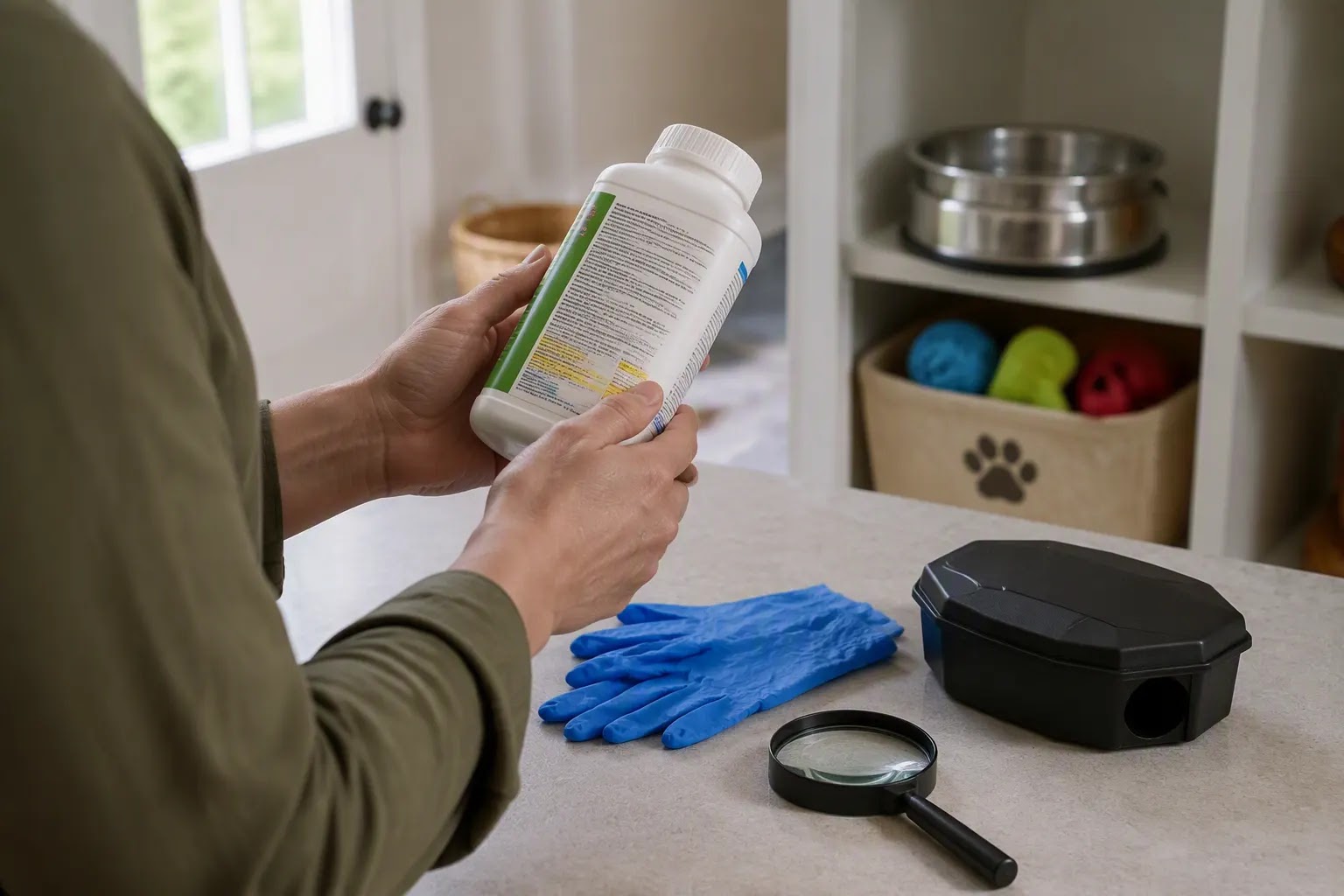
5. Read Bait-Station Directions as Carefully as Spray Directions
Pesticide baits are designed to attract the pest that consumes them, so accessibility matters.
A plastic housing may reduce access, but “bait station” does not automatically mean a pet can safely reach, chew, carry, or play with it.
Read whether the label requires the station to be:
- Used only in specified locations
- Kept inaccessible to pets and children
- Secured so it cannot be moved
- Used only with the bait supplied or approved for that station
- Discarded rather than opened or refilled
Rodent bait stations illustrate why the exact wording matters. Different stations may have different resistance to tampering and different approved locations.
Do not judge safety from how sturdy the plastic looks. Follow the product-specific placement instructions.
6. Check Environmental Hazards Around Aquatic Pets
If you keep fish, shrimp, snails, amphibians, or other aquatic animals, pay particular attention to the Environmental Hazards section.
Depending on the product, warnings may include:
- Toxic to fish
- Toxic to aquatic invertebrates
- Do not apply directly to water
- Drift or runoff may harm aquatic organisms
- Do not contaminate water while cleaning equipment
- Do not contaminate water with washwater or rinsate
These may look like outdoor environmental warnings, but they matter in a home with an aquarium too.
Keep pesticide spray, dust, drips, contaminated hands, cleaning water, and application equipment away from aquarium water.
The exact precautions depend on the product and application method.
For the broader treatment-day process, see our pest control around fish tanks guide.

7. Read Storage, Disposal, and First Aid Before You Need Them
Storage and Disposal
Pet exposure can happen long after treatment ends.
The Storage and Disposal section tells you how the exact pesticide and its container should be handled.
Basic label-safe habits include:
- Keep pesticides in their original labeled containers
- Close containers securely
- Store them where pets cannot reach them
- Keep pesticides away from pet food, animal feed, and drinking water
- Follow product-specific temperature and storage restrictions
- Follow the label for leftover product and container disposal
Do not transfer pesticide into a drink bottle, food jar, or other unlabeled container. Doing so creates an obvious ingestion risk and separates the chemical from information that may be essential during an emergency.
Do not assume that a sink, toilet, drain, yard, or household trash is automatically an acceptable disposal route. Follow the product label and applicable local requirements.
First Aid
Locate the First Aid section before opening the product rather than searching for it after an accident.
It may contain instructions for swallowing, inhalation, eye exposure, or skin contact and may include emergency contact information.
However, first-aid wording on a household pesticide label may be written primarily for human exposure.
Do not automatically apply human poisoning instructions to a dog, cat, bird, fish, or another pet.
If you suspect pet exposure:
- Stop further exposure if you can do so safely.
- Keep the pesticide package and label available.
- Contact your veterinarian or an appropriate animal poison resource.
- Provide the exact product name, active ingredient when available, registration number, and estimated exposure.
- Do not induce vomiting or give a home remedy unless a veterinary professional specifically directs you to.
The National Pesticide Information Center likewise recommends keeping product information available and contacting veterinary help when pesticide exposure is suspected.
Do Not Judge a Pesticide by the Active Ingredient Alone
The active ingredient is useful information, especially after an exposure, but it is not the entire product.
Two pesticides can contain the same active ingredient while differing in concentration, formulation, application method, approved uses, or other ingredients.
That is why advice such as “this ingredient is usually okay once dry” cannot replace instructions for the exact product.
Identify the product, not just the chemical name.
A 60-Second Pesticide Label Check
Before opening the package, make sure you can answer these questions:
- Correct pest? Is the pest you want to control listed?
- Correct location and method? Is the intended room, surface, yard, crack, structure, or other site allowed?
- Pet precautions? What does the label say about domestic animals or pet access?
- Re-entry? Is there a drying, settling, ventilation, or waiting requirement?
- Bait placement? If applicable, where must the bait be placed or secured?
- Aquatic hazards? Does the label warn about fish, aquatic invertebrates, drift, runoff, or water contamination?
- Storage and disposal? How must unused product and the container be handled?
- Emergency information? Can you quickly find the First Aid section and registration number?
If you cannot answer one of those questions, pause before applying the product.
That is much easier than reconstructing the label after a pet has walked through the treatment, chewed a bait station, or pesticide has reached aquarium water.
The Label Is the Product-Specific Safety Plan
The most useful pesticide advice for a pet owner is often not a list of products labeled “safe” or “unsafe.”
It is knowing where to look.
Directions for Use tell you whether the product belongs in that location. Precautionary Statements tell you what exposures to avoid. Re-entry language tells you when pets can return. Bait directions control placement. Environmental Hazards matter around aquatic life. Storage and Disposal help prevent tomorrow’s accident. First Aid provides information when something goes wrong.
Key takeaway: Instead of asking only, “Is this pesticide pet-safe?” ask, “What does this exact product label require for my pet, this location, and this method of use?”
For broader household pest prevention rather than label interpretation, cat owners can also use our pet-safe pest control guide for cats.