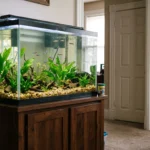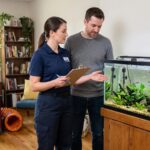
Pest Control Around Fish Tanks: How to Protect Your Aquarium
The pest-control company tells you everyone needs to leave the treated area. The dog can go with you, and the cat can stay somewhere else.
Then you look across the room at a fully stocked aquarium.
A fish tank is different from a pet bed or food bowl. It contains the environment your fish continuously live and breathe in, and that environment may interact with room air through pumps, open sumps, filters, skimmers, and other equipment.
Quick Answer: Tell the pest-control company about your aquarium before treatment day and get the exact product, application method, and aquarium precautions. Depending on the treatment, the tank may remain in an untreated room, need specific protection, or require removal or specialized preparation. Covering the display alone may not protect an open sump or equipment that pulls room air into the water. For foggers, current pesticide-safety guidance specifically advises covering fish tanks and turning off fish-tank pumps during application. Do not turn off every aquarium device for every treatment without a plan for oxygen, filtration, temperature, and safe restart.
Why Aquariums Need Their Own Pest-Control Plan
Fish remain in continuous contact with aquarium water, and their gills create a direct interface with that environment. Preventing pesticide contamination is far safer than trying to determine afterward how much entered the system.
Some insecticides are particularly hazardous to aquatic animals. Pyrethrins, for example, are classified by the National Pesticide Information Center as highly to very highly toxic to fish and very highly toxic to several aquatic invertebrates.
That does not mean every household pesticide creates the same aquarium risk. The product, formulation, concentration, application method, amount, and route of exposure all matter.
“Pet-friendly” does not automatically mean aquarium-safe. Fish, shrimp, snails, and other aquatic animals may require precautions that are very different from those used for dogs and cats.
Follow the Air Path Before Treatment
Protecting the top of the display tank does not automatically isolate the entire aquarium system.
An external air pump can pull room air through its intake and push that air into the water. A protein skimmer actively mixes air and water. Open sumps, refugiums, overflow chambers, and external reservoirs create additional water surfaces exposed to room air.
Follow the Air Path: Trace every place where room air meets your aquarium. Which equipment pulls room air into the water? Which components leave water exposed? Which devices only move aquarium water internally? Those are different functions and may need different precautions.
At the same time, circulation, aeration, heating, and biological filtration are part of the aquarium’s life-support system. Turning everything off for too long can create a second emergency through low oxygen, temperature change, or disrupted filtration.
The safe rule is not “turn everything off.” It is “know the treatment, know the equipment, and make a treatment-specific plan.”
Get the Exact Pest-Control Information Before Treatment Day
“We’re spraying for bugs” is not enough information.
A bait placement, crack-and-crevice application, residual spray, aerosol, dust, fogger, and structural fumigation create very different exposure scenarios.
Ask for:
- the exact product name
- active ingredient
- application method
- rooms or areas being treated
- aquarium-specific precautions on the label
- required pet exclusion and re-entry conditions
- ventilation instructions
- any equipment-shutdown instructions
In the United States, ask for the EPA registration number when applicable. In Canada, registered pesticide products carry a Pest Control Product number.
If you’re unsure where this information appears, see our guide to how to read a pesticide label when you have pets.
The registered pesticide label and treatment-specific instructions take priority over a generic aquarium checklist.
Tell the Pest-Control Company About the Aquarium Early
Do not wait until the technician arrives to mention a large freshwater, planted, reef, or other aquarium.
Tell the company when scheduling the treatment. This gives them time to determine whether:
- the aquarium room can remain untreated
- a more targeted method can be used
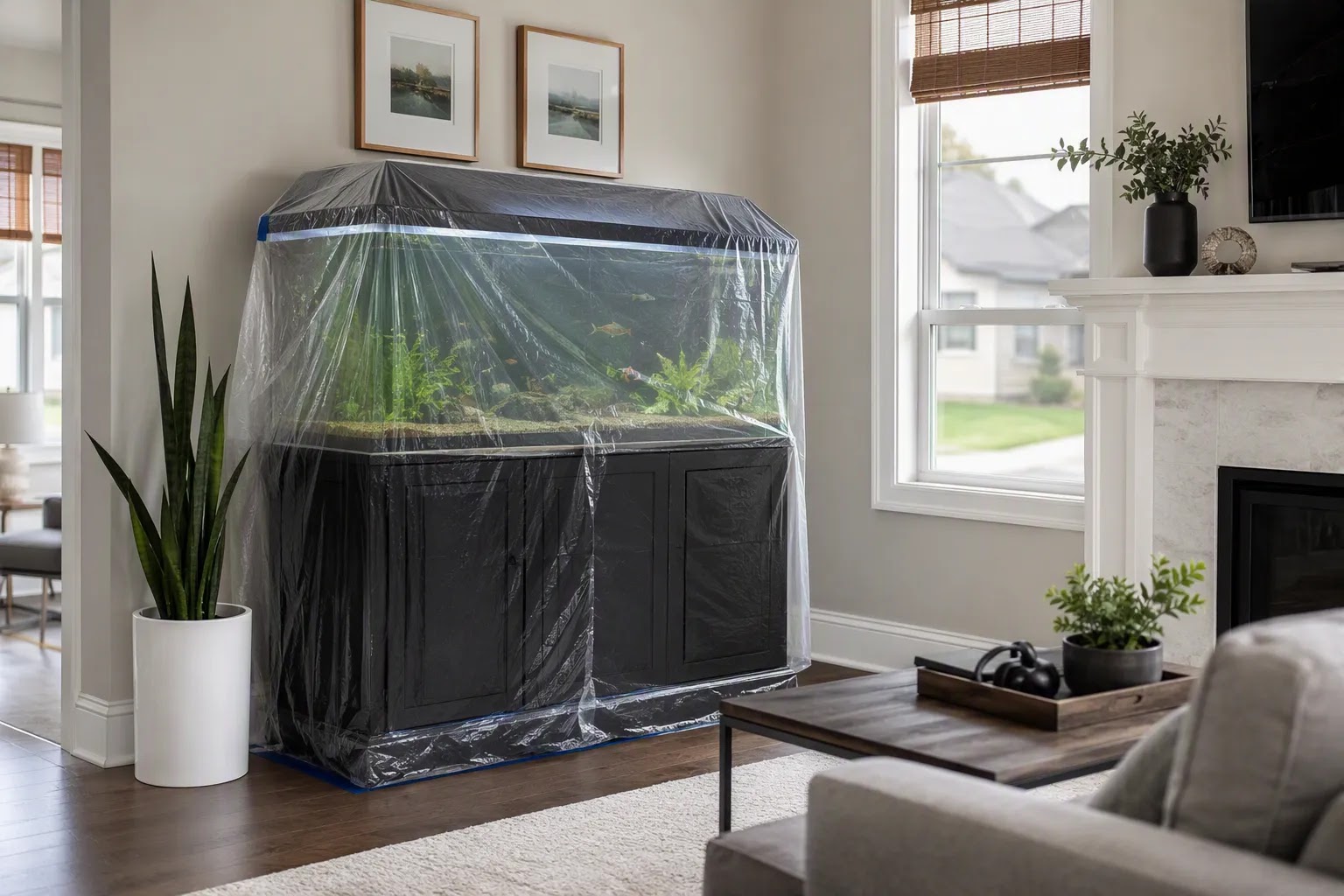
- the tank must be covered or otherwise isolated
- fish or the entire aquarium must be relocated
- air pumps, skimmers, or other equipment need special handling
A short conversation beforehand is much safer than improvising beside a full aquarium minutes before application begins.
Does the Aquarium Need to Be Moved?
Not always.
A large filled aquarium is extremely heavy and moving a mature system can create its own risks. Whether removal is necessary depends on the pesticide, treatment method, location, label, and aquarium design.
| Treatment | Planning Priority |
|---|---|
| Targeted treatment outside the aquarium room | The tank may be able to remain in place if the room is genuinely excluded from treatment and the applicator confirms the system will not be exposed. |
| Spray, aerosol, or dust in the aquarium room | Follow the exact label and applicator instructions for tank protection, equipment, and whether removal is necessary. |
| Fogger or bug bomb | Current NPIC and Health Canada guidance says to cover fish tanks and turn off fish-tank pumps during application. Plan oxygen, equipment shutdown, and restart before using the fogger. |
| Structural fumigation | Treat this as a separate procedure. Follow the fumigant label and the licensed fumigator’s written preparation plan; fish, tanks, water, filters, and aeration may require removal or specialized gas isolation. |
How to Prepare the Aquarium Before Pest Control
1. Keep the Aquarium Stable
If routine maintenance is due, completing normal maintenance beforehand can leave the aquarium in a known condition.
But avoid combining pest-control day with an unnecessary deep clean, complete filter-media replacement, major aquascape change, or another major biological disruption.
You already have one unusual event coming. Don’t deliberately create another.
2. Protect Aquarium Supplies Too
Contamination does not have to enter the water during application itself.
A net, maintenance bucket, food container, sponge, test tool, or replacement filter media exposed to pesticide residue can bring that material back to the aquarium later.
Remove or protect fish food, nets, medications, conditioners, test kits, feeding tools, buckets, scrapers, tubing, and spare filter media according to the treatment plan.
For long-term storage precautions, see Pesticide Storage Near Aquariums.
3. Protect the Entire Connected Water System
If the aquarium remains in place, do not protect only the visible display.
An open sump underneath a covered aquarium still exposes connected water. The same principle applies to refugiums, overflow chambers, reservoirs, and other water-containing components.
Use the covering or isolation method required for the specific treatment. A loose towel or blanket should not be assumed to block every aerosol, vapor, dust, or fog.
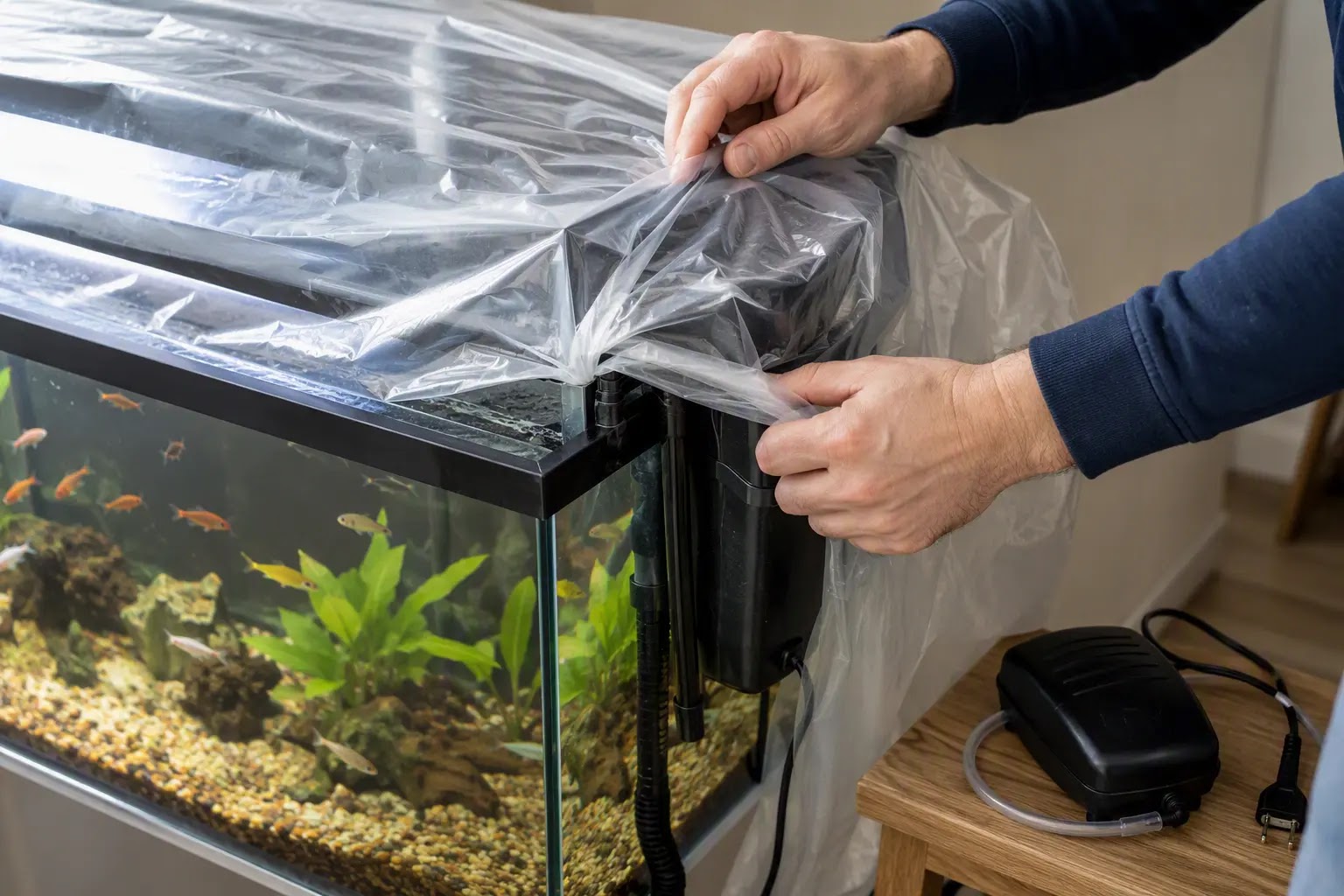
4. Separate Air-Handling Equipment From Water-Circulation Equipment
An external air pump drawing room air is not doing the same job as a submerged pump moving water inside the aquarium.
A protein skimmer also interacts with room air differently from a return pump, while an air-driven sponge filter depends on incoming air for both filtration and water movement.
Foggers need special handling. Current NPIC and Health Canada guidance specifically advises turning off fish-tank pumps during fogger application so airborne pesticide is not drawn into the aquarium. Follow the exact fogger label and plan how the aquarium will remain safe during the shutdown.
Do not extend that instruction to every pesticide treatment automatically. With other treatments, shutting down circulation or filtration unnecessarily could reduce oxygenation or impair the biological filter.
5. Plan for Oxygen, Temperature, and Filtration
Covering an aquarium or stopping selected equipment can alter gas exchange and temperature.
How quickly this matters depends on tank volume, stocking, temperature, surface movement, which equipment is offline, animal and plant respiration, and shutdown duration.
There is no universal number of hours that every aquarium can safely remain covered or without normal equipment.
For any prolonged treatment, decide beforehand how oxygenation, temperature, and biological filtration will be protected without drawing contaminated room air into the system.
6. Make the Aquarium Impossible to Miss
Communication mistakes are easy when several people are preparing a home.
Simple backup: Put a large visible note beside the aquarium saying AQUARIUM — SPECIAL TREATMENT PRECAUTIONS. It does not replace talking with the applicator, but it can stop someone unfamiliar with the plan from treating beside the tank.
What About Structural Fumigation?
Do not apply ordinary indoor-spray or fogger advice to structural fumigation.
Fumigant labels can include detailed requirements for removing animals and managing aquariums, water, biological filters, and aeration. Some registered labels describe removing the fish or aquarium, or isolating tank water and biological filtration from the fumigated space with gas-resistant materials while supplying uncontaminated outside air when aeration is required.
If your home will be structurally fumigated, obtain the licensed fumigator’s written preparation instructions well in advance and follow the exact fumigant label.
After Pest Control: Restart the Aquarium Deliberately
Do not uncover the tank simply because you have returned home.
First confirm that the product-specific re-entry requirements have been met and that any required ventilation is complete.
Then:
- Confirm all treatment restrictions have ended.
- Complete required ventilation.
- Remove covers carefully so residue on their exterior does not fall into the water.
- Restart every aquarium device that was intentionally switched off.
- Check flow, aeration, filtration, heaters, return pumps, and skimmers.
- Observe the fish and other aquatic animals.
Physically confirm that the aquarium sounds, flows, heats, and circulates the way it normally does before considering the procedure finished.
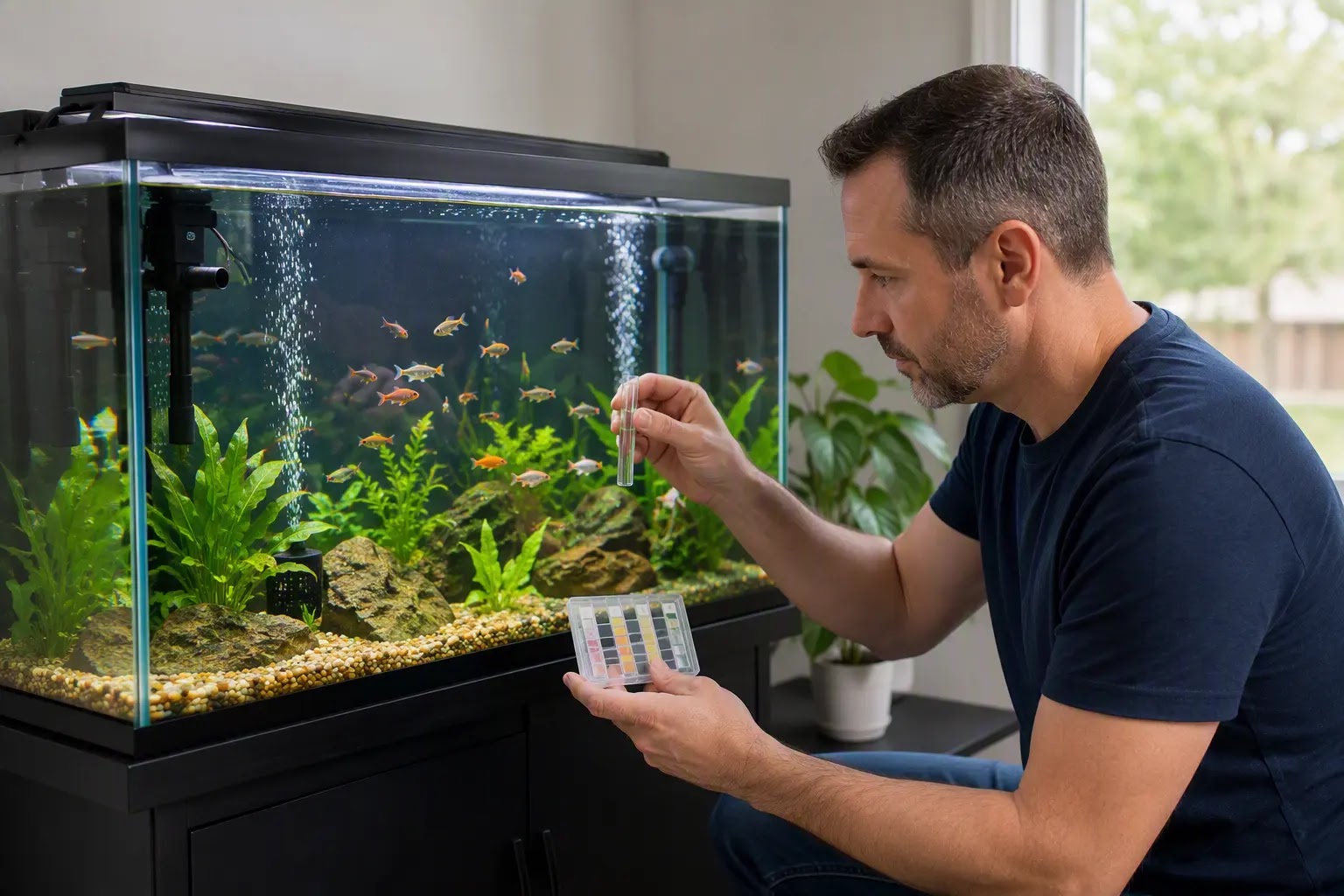
If aeration or filtration was interrupted for a meaningful period, checking temperature, ammonia, nitrite, and other relevant water parameters can help identify a life-support problem.
If ammonia is detectable, see our aquarium ammonia-spike emergency guide.
What If Pesticide May Have Reached the Water?
Abnormal behavior after pest control does not automatically prove pesticide poisoning. Low oxygen, excessive heat, a pump that was never restarted, interrupted biological filtration, ammonia, or nitrite can produce overlapping signs.
But suspected contamination should be taken seriously, especially when several animals become abnormal at the same time soon after treatment.
Concerning signs include persistent gasping, unusually rapid or labored gill movement, loss of balance, disoriented swimming, profound lethargy, sudden distress affecting multiple animals, or unexpected deaths after a suspected exposure.
If fish are gasping, our fish-gasping emergency guide can help you check oxygen, temperature, ammonia, nitrite, and other immediate causes.
Keep the pesticide container, label, registration number when applicable, and the pest-control company’s treatment information available.
For suspected pesticide entry into the water, use our dedicated Pesticide in Fish Tank: Emergency Steps guide and seek product-specific advice from an aquatic veterinarian, pesticide-information service, or other qualified aquatic-health professional.
Do not assume that a water change, activated carbon, medication, oxidizer, or aquarium “detoxifier” is the correct response to every pesticide. The useful intervention depends on the compound, formulation, amount, exposure route, and aquarium system.
The Bottom Line
An aquarium makes pest-control preparation more complicated than moving a food bowl or taking a dog out of the house, but most of that complexity can be handled before treatment day.
Find out exactly what will be used. Tell the applicator about the aquarium early. Protect the entire connected water system, not just the display tank. Follow the air path, manage equipment according to the specific treatment, and verify every life-support device afterward.
The goal isn’t to choose between pesticide exposure and an unsafe equipment shutdown. Good preparation is what helps you avoid both.
Aquatic Health & Pesticide Safety Disclaimer: This article is for general educational purposes and cannot determine whether a specific pesticide treatment is safe for an individual aquarium. Risk depends on the product, formulation, concentration, application method, aquarium design, livestock, equipment, treatment duration, and exposure route. Always follow the registered pesticide label and treatment-specific instructions from the licensed applicator. If pesticide contamination is suspected or fish or other aquatic animals develop severe or rapidly worsening signs, seek product-specific guidance from an aquatic veterinarian, pesticide-information service, or other qualified aquatic-health professional.
Sources & Editorial Standards
Aquarium-specific pesticide precautions were checked against the National Pesticide Information Center’s current Pesticide Use Around Pets guidance, including its recommendations to cover or remove fish tanks and to turn off fish-tank pumps during fogger applications.
Canadian aquarium, fogger, pet-exclusion, re-entry, and ventilation recommendations were reviewed against Health Canada’s guidance for keeping pets safe when using pesticides.
General pesticide-label precautions were checked against the U.S. Environmental Protection Agency’s pet pesticide safety guidance. Aquatic toxicity information for pyrethrins was reviewed against the NPIC Pyrethrins General Fact Sheet.
The importance of oxygen, water flow, and biological filtration was cross-checked against the Merck Veterinary Manual guidance on aquatic life-support systems and University of Florida IFAS guidance on ammonia and biofiltration.
Because pesticide treatments and aquarium systems vary substantially, this guide intentionally does not prescribe one universal covering method, equipment-shutdown period, ventilation period, water-change amount, or chemical decontamination procedure.