
Pesticide Storage in Dog Homes: Preventing Chewed Containers, Spills & Garage Exposure
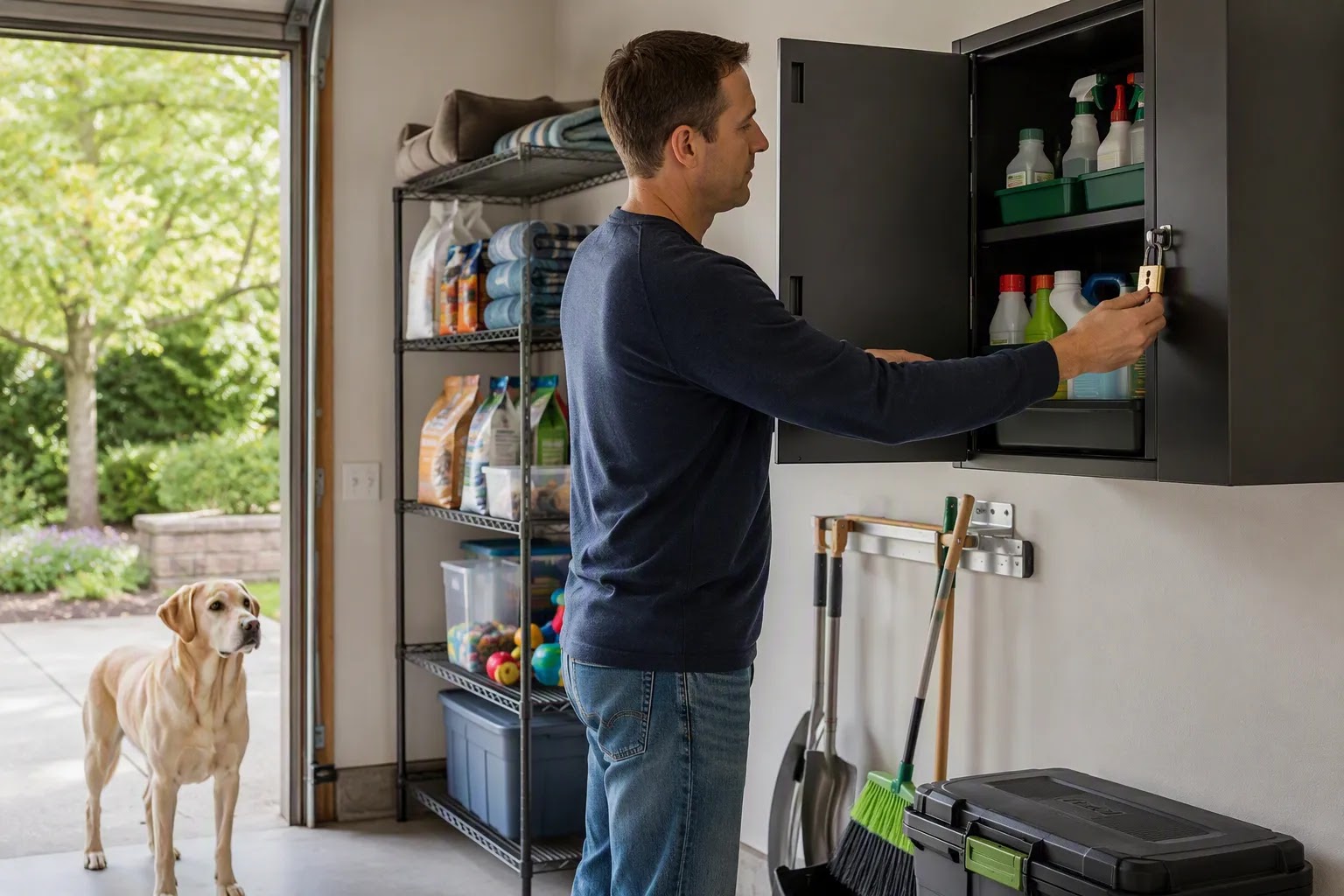
You finish treating a few weeds, set the bottle on the garage floor “for just a minute,” and head inside to wash your hands.
When you return, your dog is standing beside it—with the container between his paws.
That is exactly the kind of accident safe pesticide storage is designed to prevent. Dogs investigate with their noses and mouths, and a bottle that seems securely closed to you may still be chewable, knockable, or reachable from a low shelf.
Quick Answer: Keep pesticides in their original labeled containers, tightly closed and physically inaccessible to your dog—preferably inside a secure locked or latched storage area that also meets the product label’s temperature, ventilation, and fire-safety requirements. Keep pesticides separate from dog food, treats, medications, bowls, toys, and other pet supplies.
The Biggest Storage Risk Is Access
Dog owners often think carefully about keeping a pet away while pesticide is being applied, then relax once treatment is finished.
But an unused pesticide sitting in storage creates a different kind of risk.
A dog may:
- chew through a plastic bottle or bag
- knock a container from a shelf
- lick residue from a leaking package
- walk through a spill and later lick the paws
- reach insect, rodent, slug, or snail bait stored in an open package
- investigate contaminated measuring or application equipment
EPA recommends storing pesticides where pets and children cannot reach them, preferably inside a locked cabinet in an appropriate storage location.
Do not rely on height alone. Large dogs can reach surprising places, containers can fall, and puppies may discover access routes that seemed impossible a week earlier.
Keep Pesticides in Their Original Containers
Never transfer pesticide into a soda bottle, water jug, food container, or ordinary household spray bottle just because the original package is inconvenient.
The original container keeps several important things together:
- the product identity
- active ingredients and concentration
- storage instructions
- application directions
- disposal information
- first-aid and emergency information
- the closure designed for that product
If your dog ever reaches a pesticide, knowing exactly what product was involved can make veterinary and poison-control advice much more useful.
If the wording on the package is confusing, see our guide to reading a pesticide label when you have pets.
Inspect the Container Before Putting It Away
Look for:
- a loose or crooked cap
- residue around a nozzle or opening
- cracks or punctures
- damaged bags or boxes
- bulging or distorted packaging
- corrosion
- a faded or unreadable label
Do not place a leaking or badly damaged container back on the shelf and hope to deal with it later.
Follow the product label and contact the manufacturer or your local household hazardous-waste program for product-specific handling or disposal instructions when needed.
Is a Garage Safe for Pesticide Storage?
Sometimes—but “garage” is not a safety category.
The exact storage location still needs to meet the requirements for the product you own.
Watch Temperature and Humidity
Temperature extremes can alter some pesticide products and damage their containers.
A detached garage during a Canadian winter and a closed garage during a hot U.S. summer create very different conditions.
Read the storage section on the label. If it says to protect the product from freezing, excessive heat, or moisture, follow that instruction rather than assuming the garage is suitable year-round.
Keep Flammable Products Away From Ignition Sources
Some pesticide formulations are flammable.
Do not store them beside furnaces, vehicles, grills, lawn equipment, or other ignition sources when the label or product characteristics make that unsafe.
Keep Leaks Away From Water and Drains
Do not choose a shelf where a leaking pesticide could easily reach a floor drain, driveway runoff, well, groundwater, pond, or other water source.
Assume Your Dog Will Eventually Enter
If your dog passes through the garage on the way outside, follows you while you work, waits there before walks, or can enter when a door is left open, the pesticide-storage area needs its own physical barrier.

The Garage Test: Does this exact location meet the pesticide label’s storage requirements, stay secure through every season, keep flammable products away from ignition sources, contain a possible leak, and remain inaccessible to your dog even when someone forgets the garage door is open?
Build a Dog-Proof Storage Zone
1. Use a Lock or Secure Latch
Put pesticides inside a cabinet or dedicated enclosure your dog cannot open, knock over, or chew through.
Do not treat a child-resistant cap as a substitute for secure storage. The entire pesticide container should still be inaccessible.
2. Close and Store Products Immediately
Return caps, lids, and trigger locks to their proper positions as soon as you finish using the product.
Avoid leaving pesticides on the garage floor, driveway, patio, lawn, or edge of a workbench while you finish another task.
The “I’ll Put It Away in a Minute” Rule: Close the pesticide and return it to secure storage before your dog gets access to the area again—not after you coil the hose, answer a message, or finish another job.
3. Add Secondary Containment When Appropriate
The pesticide should remain in its original container.
For suitable household products, placing tightly closed bottles upright inside a stable, leak-resistant tray or larger compatible container can provide another barrier if one develops a leak.
Secondary containment is not repackaging. Do not pour pesticides together or move them into unlabeled bottles.
4. Separate Pesticides From Dog Supplies
Keep pesticide storage separate from:
- dog food and treats
- food-storage bins
- water and feeding bowls
- medications and supplements
- toys and chews
- grooming supplies
- pet first-aid equipment
This reduces both direct access and cross-contamination if a bottle leaks.
5. Secure Pesticide Equipment Too
Sprayers, spreaders, measuring devices, gloves, funnels, buckets, and other application equipment can carry residue.
Keep them inaccessible to your dog and follow the product and equipment manufacturer’s cleanup and storage directions.
Never turn a pesticide measuring cup, scoop, funnel, bucket, or spray bottle into pet-care equipment later.
6. Avoid Unnecessary Stockpiles
More pesticide means more containers to inspect, secure, and eventually dispose of.
Buy the quantity you reasonably expect to use according to the label rather than building a large household stockpile.
Prepare for Leaks Before They Happen
Check the storage area periodically.
Look for:
- wet or sticky shelves
- powder beneath packages
- new unexplained odors
- corrosion
- cracked plastic
- damaged labels
- containers that have fallen onto their sides
If you find unexplained residue, keep your dog away while you identify the product and obtain appropriate cleanup instructions.
Do not let the dog sniff, walk through, or investigate the spill.
Keep Basic Spill Supplies Available
Depending on the products you store, useful basic supplies may include:
- non-absorbent gloves
- garbage bags
- paper towels or other appropriate absorbent material
- sawdust or kitty litter when suitable for a small liquid spill
The actual protective equipment and cleanup method still come from the pesticide label.
If a small spill occurs:
- Remove your dog and block access.
- Read the pesticide label.
- Stop the leak only if you can do so safely.
- Contain the spill with appropriate absorbent material when directed.
- Avoid excessive water that could spread contamination.
- Keep contaminated cleanup materials inaccessible to animals.
- Dispose of waste according to the label and local requirements.
Do not improvise a chemical cleaner. Bleach, ammonia, acids, bases, solvents, or other household cleaners are not universal pesticide neutralizers. Some pesticides can react with particular cleanup chemicals, so use product-specific instructions.
Never pour unused pesticide or contaminated liquid down a sink, toilet, sewer, floor drain, or street drain unless the registered label specifically provides an approved disposal method.
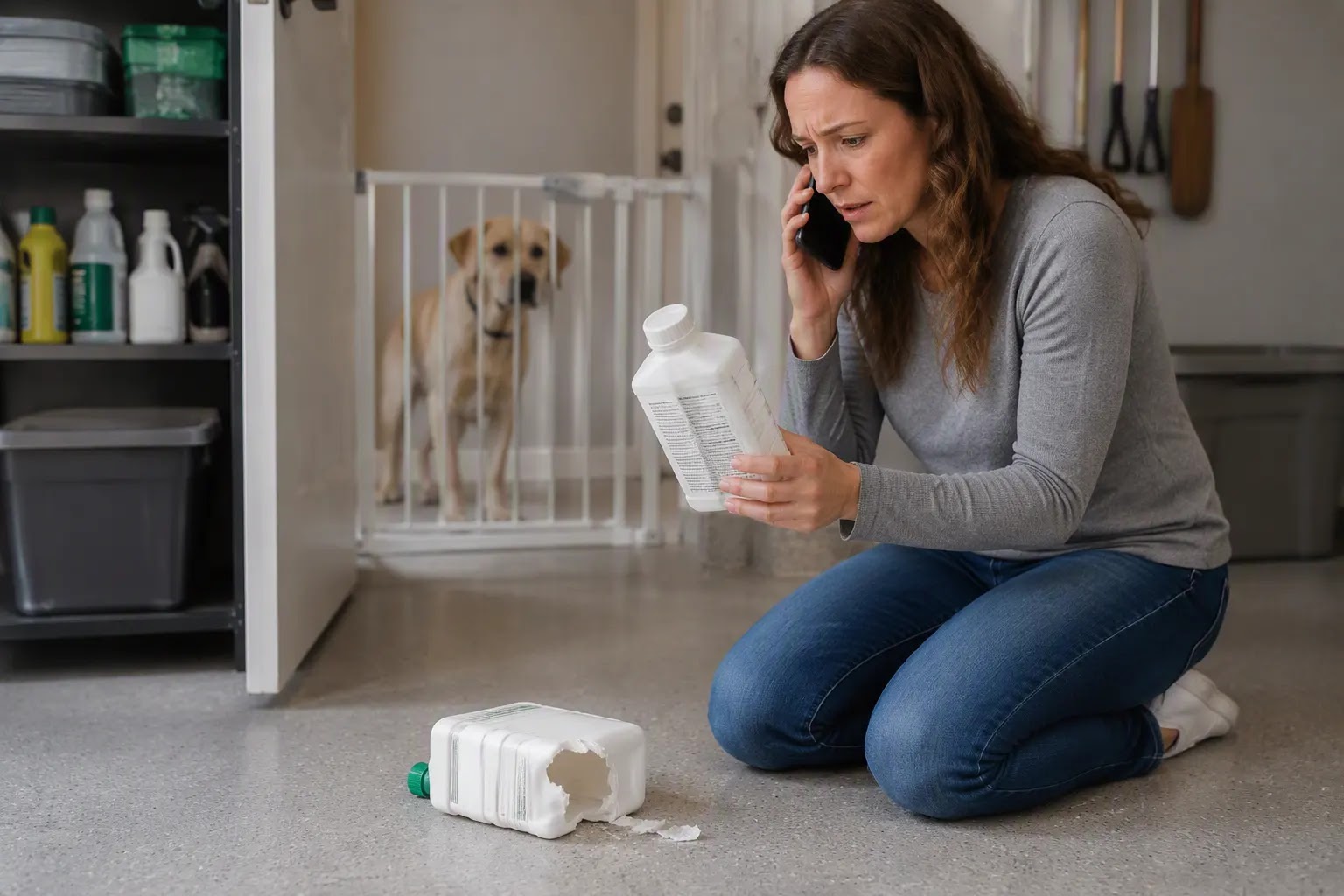
What If Your Dog Chews a Pesticide Container?
Separate your dog from the product and prevent further access.
Then identify the exact container.
Useful information includes:
- product name
- active ingredient and concentration if listed
- your dog’s approximate weight
- when the incident occurred
- whether the package was punctured
- whether any product appears to be missing
- whether liquid, powder, gel, or bait reached the mouth, coat, or paws
- any abnormal signs you have noticed
If the package is punctured or leaking, product is missing, your dog may have swallowed or contacted pesticide, or you cannot confidently rule out exposure, contact your veterinarian or an animal poison-control service promptly. Keep the original container and label available.
Do Not Automatically Induce Vomiting
Pesticides vary widely, and vomiting can be inappropriate or dangerous for some products and exposure situations.
Do not give hydrogen peroxide to induce vomiting unless a veterinarian or animal poison-control professional specifically tells you to do so for that dog and that exposure.
Do not automatically give milk, cooking oil, food, activated charcoal, or another home remedy either.
If your dog is having seizures, struggling to breathe, collapsing, or becoming unresponsive after possible exposure, seek emergency veterinary care immediately.
If Pesticide Is on the Paws or Coat
Prevent licking as safely as practical and obtain product-specific decontamination advice.
Do not apply bleach, solvents, disinfectants, or other household chemicals to your dog’s skin.
If the product involved is rodenticide, see our dog ate rat poison emergency guide while contacting a veterinarian or poison-control service.
Storage Is Only One Part of Pesticide Safety
This guide focuses on where products live between uses, how containers and equipment are secured, and what to do about leaks or accidental access.
During actual treatment, different precautions apply.
For reducing pesticide exposure before choosing a product, see our IPM pest-control guide for dog homes.
If your home has already been treated and you are deciding when your dog can safely return, use our dog re-entry after indoor pest control guide.
The Five-Minute Storage Audit
Open your current pesticide-storage area and ask:
- Can my dog open or physically enter this space?
- Are all pesticides still in their original labeled containers?
- Are caps and lids completely closed?
- Is anything cracked, leaking, corroded, or deteriorating?
- Could a leak reach dog food, treats, bowls, medications, or toys?
- Does the location meet each product’s temperature requirements?
- Are flammable products separated from ignition sources?
- Could a spill reach a drain or outdoor water source?
- Is application equipment inaccessible too?
- Are you storing old or unnecessary products that should be properly disposed of?
- Could you immediately identify every product if your dog reached one?
If one answer is “I’m not sure,” that is the item worth fixing now.
The Bottom Line
A safe pesticide cabinet is not simply a high shelf with closed bottles.
It is a storage system that still protects your dog when someone gets distracted, a container leaks, the garage door stays open, or a curious puppy discovers a new route through the room.
Keep pesticides in their original containers, follow each label’s storage requirements, use a real physical barrier, separate them from dog supplies, prepare for leaks, and keep application equipment secure too.
The safest storage system is the one your dog cannot defeat on the day you forget to be perfectly careful.
Sources & Editorial Standards
Pesticide storage, locked-cabinet guidance, original-container requirements, separation from food and animal feed, ignition-source precautions, environmental protection, and avoiding unnecessary stockpiles were checked against the current U.S. EPA pesticide-storage guidance.
Container integrity, temperature considerations, designated storage locations, locks or latches, secondary containment, and keeping pesticide inventory small were cross-checked against the National Pesticide Information Center’s current pesticide-storage guidance.
Small-spill preparation, absorbent materials, protective gloves, and the warning against spreading pesticide with excessive water were checked against NPIC Safe Use Practices for Pesticides. Product-specific cleanup precautions were also checked against NPIC guidance on pesticide cleanup.
Disposal guidance—including not pouring pesticides into household or street drains and never reusing empty pesticide containers—was checked against the current U.S. EPA pesticide disposal guidance and Health Canada pesticide safety guidance.
Pet-specific label, storage, food-and-water separation, bait, and spill precautions were checked against the EPA’s Read the Label First: Protect Your Pets guidance.
Emergency poison-response recommendations—including removing the pet from the source and not giving home antidotes or inducing vomiting before obtaining product-specific professional guidance—were cross-checked against current Pet Poison Helpline guidance.
Veterinary Disclaimer: This article provides general educational information and cannot diagnose or treat an individual pesticide exposure. Toxicity varies by active ingredient, formulation, concentration, amount, and route of exposure. If your dog may have swallowed pesticide, contacted a leaking product, or develops concerning signs after exposure, contact a veterinarian or animal poison-control service promptly and keep the original product label available.