Puppy Sleep Schedule by Age: Naps, Overtired Signs & Rhythm
At 7 p.m., your puppy suddenly seems to forget every calm behavior they showed all day. They race across the room, grab your sleeves, bark, and somehow look more energetic the longer they have been awake.
The first instinct is often: They need more exercise.
Sometimes the opposite is true. Young puppies need a remarkable amount of sleep, and an overtired puppy may look restless or impulsive rather than obviously sleepy.
A useful puppy sleep schedule is therefore not about forcing an exact bedtime or counting every minute. It is about creating a predictable rhythm of waking, potty breaks, meals, short activity periods, quiet time, and plenty of opportunities to sleep.
Quick Answer: Many very young puppies sleep around 18–20 hours in a 24-hour period, divided between nighttime sleep and frequent daytime naps. Individual needs vary. As puppies mature, they generally stay comfortably awake for longer stretches and need fewer daytime naps. Use your puppy’s behavior, health, activity, and ability to settle—not a rigid internet timetable—to adjust the routine.
How Much Sleep Do Puppies Need?
There is no veterinary rule saying every puppy of the same age must sleep exactly the same number of hours.
Age matters, but so do breed, temperament, activity, health, household routine, and what happened that day.
At around two months old, VCA notes that a puppy’s active periods may occupy only about four to six hours of the entire day. Other puppy guidance commonly describes roughly 18–20 hours of total daily sleep as normal for many young puppies.
That is a useful reference point—not a target you need to enforce with a stopwatch.
A better question is:
Does your puppy wake alert, eat and interact normally, enjoy age-appropriate activity, and then settle for regular rest?
Puppy Sleep Schedule by Age
Use this chart as a pattern guide rather than a prescription.
| Age | What Sleep Often Looks Like | Useful Routine |
|---|---|---|
| 8–12 weeks | Very high sleep needs are normal. Many young puppies sleep around 18–20 hours total and take frequent naps. | Keep awake periods relatively short and offer quiet rest after eating, play, training, and exploration. |
| 3–4 months | Still a high-sleep stage, although some puppies stay comfortably awake for longer stretches. | Continue protecting several daytime rest periods instead of expecting the puppy to stay active all morning or afternoon. |
| 4–6 months | Sleep often begins to consolidate and some naps naturally disappear. | Keep quiet periods available, especially after stimulating activity or when behavior begins deteriorating. |
| 6–12 months | The pattern becomes more adult-like, but daytime naps remain completely normal. | Allow more flexibility while maintaining a predictable nighttime routine and reliable opportunities to rest. |
The biggest change is usually not a sudden jump from one exact sleep total to another.
Awake periods gradually become longer, and many puppies become better at settling between activities.

What Should an 8- to 12-Week-Old Puppy’s Day Look Like?
This is often when new owners are most surprised by how frequently a puppy sleeps.
A young puppy may wake enthusiastically, potty, eat, explore, play or learn for a while—and then need another nap surprisingly soon.
Some puppies at this age may nap every hour or so, with individual naps lasting anywhere from roughly 30 minutes to two hours.
Instead of scheduling every minute, use a repeating rhythm:
- Wake up and go out to potty.
- Eat, explore, interact, play, or do a brief training session.
- Offer another potty opportunity when appropriate.
- Transition into quiet rest.
- Repeat when the puppy wakes.
Your puppy does not need entertainment during every waking minute.
Sleep and house training also naturally overlap. Puppies commonly need to eliminate soon after waking, so a nap ending is often your cue for the next potty trip.
Our puppy potty-training guide covers that routine in more detail.
How Does Sleep Change From 3 to 6 Months?
A three- or four-month-old puppy may begin staying awake longer without immediately becoming dysregulated.
But daytime naps have not suddenly become optional.
This age can fool owners because the puppy looks bigger, plays harder, and seems able to keep up with household activity—until late-afternoon chaos appears.
Avoid assigning an arbitrary rule such as “a four-month-old should take exactly two naps.” Instead, watch what happens during the puppy’s awake periods.
If they wake refreshed, function well while awake, and settle naturally later, the rhythm is probably reasonable.
If long waking stretches repeatedly end in frantic, grabby behavior and difficulty settling, offer an earlier quiet period and see whether the pattern improves.
What About 6- to 12-Month-Old Puppies?
Adolescent puppies can look almost grown while still needing plenty of rest.
They often tolerate longer waking periods, and you may no longer need to organize every individual nap. Daytime sleep, however, is still normal—even adult dogs spend a substantial portion of each day asleep.
At this stage, think less about counting naps and more about the overall rhythm:
appropriate activity → downtime → sleep → another period of normal activity.
What Does an Overtired Puppy Look Like?
Overtiredness is easy to miss because it does not always look like slow blinking and yawning.
Some puppies appear increasingly chaotic instead.
You may notice:
- more mouthing or grabbing than usual
- frantic running or evening zoomies
- increased barking or whining
- difficulty settling after a long awake period
- worse focus during familiar activities
- rapidly switching between activities
- increased impulsivity or frustration
These signs do not prove your puppy is overtired. Mouthing, zoomies, barking, or restlessness can also happen because the puppy needs to potty, has unused energy, is overstimulated, is hungry, is uncomfortable, or is experiencing another behavioral or medical issue.
The timing provides useful context. If your puppy has been awake through visitors, play, training, household activity, or a stimulating outing and then begins unraveling, offering quiet rest may be more useful than starting another exciting activity.
If mouthing is a persistent problem even when your puppy is well rested, see our puppy biting and nipping guide.

Puppies Don’t Always Put Themselves to Bed
A tired puppy does not necessarily make the sensible decision to leave a busy room and take a nap.
Some keep following people, reacting to noises, grabbing toys, and investigating movement long after they would benefit from rest.
You do not need to force sleep. Instead, make sleep easier.
Reduce stimulation and offer a safe, comfortable, quiet location where interesting activity is no longer constantly competing for the puppy’s attention.
If your puppy is still learning to relax after excitement, our guide to teaching a puppy to settle after play can help.
If the sleep space is a crate, build positive crate comfort separately rather than using confinement as punishment for wild behavior. See our calm puppy crate-training guide.
How to Build a Healthy Puppy Sleep Rhythm
Alternate Activity With Quiet Time
After eating, exploring, training, social interaction, or appropriate exercise, allow the day to move toward calm rather than immediately starting another stimulating activity.
If you’re unsure whether the real issue is too little rest or too little appropriate activity, see how much exercise a puppy needs by age.
Protect the Nap Environment
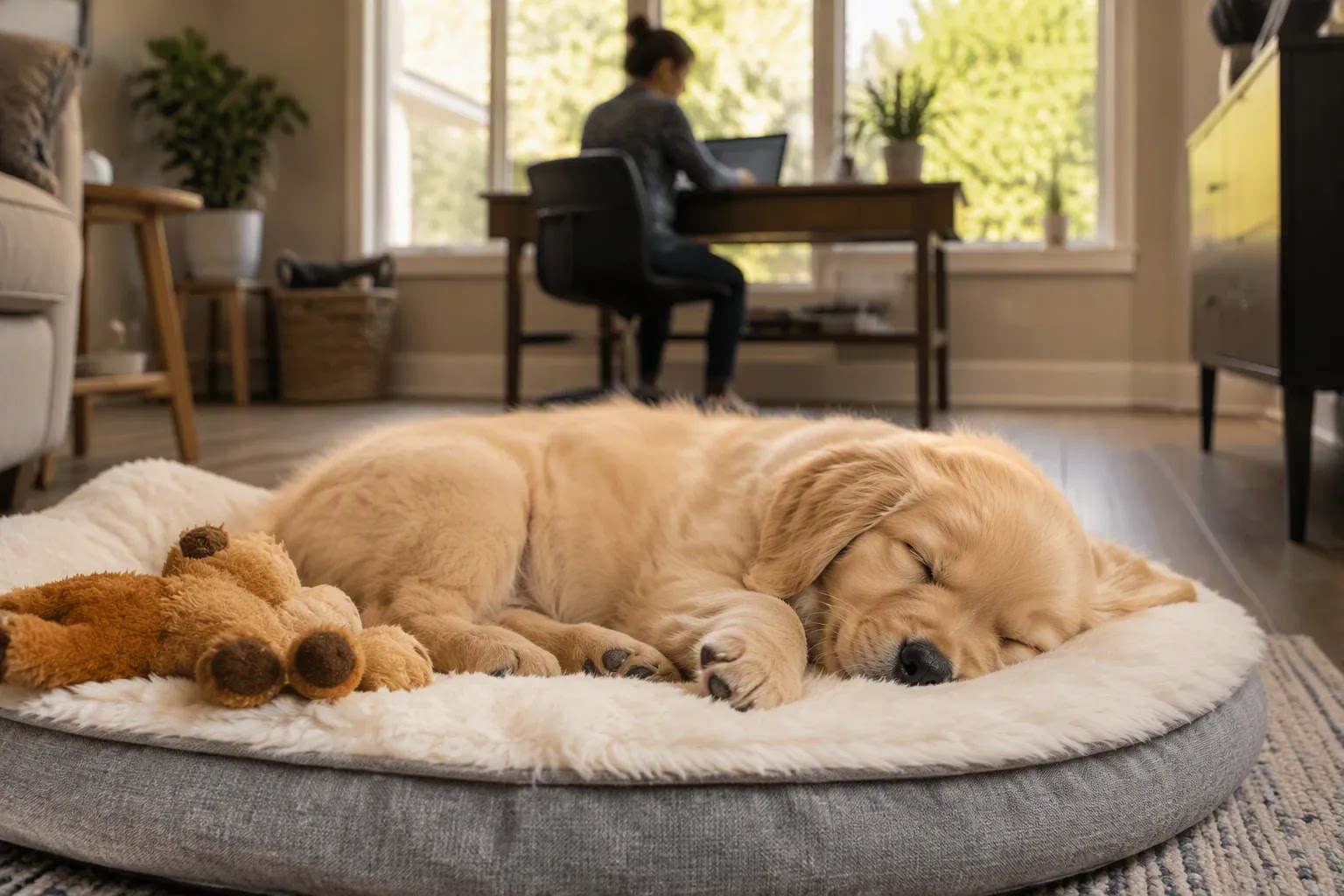
A puppy sleeping in the middle of a busy family room may wake every time someone walks past.
A quieter space with less traffic can make uninterrupted rest easier. Children should also learn to leave a sleeping puppy alone.
Wind the Evening Down
If your puppy regularly becomes frantic in the evening, notice what happens during the hour or two beforehand.
Moving gradually toward calmer interaction may work better than intense play immediately before asking the puppy to sleep.
Don’t Keep a Puppy Awake All Day to Improve Night Sleep
Young puppies normally need daytime sleep.
Deliberately preventing naps can leave you with an exhausted puppy who is harder—not easier—to settle at night.
Make Potty Part of the Sleep Routine
Young puppies commonly need to eliminate after waking from a nap. Very young puppies may also need overnight potty trips while bladder control develops.
A nighttime potty break is therefore not evidence that your puppy has learned a “bad sleep habit.”
Should You Wake a Sleeping Puppy?
Usually, a healthy sleeping puppy does not need to be awakened simply because an internet schedule says the nap should be over.
A schedule should create opportunities for sleep—not continually interrupt natural rest.
There are exceptions. Feeding plans, medication, medical conditions, veterinary instructions, travel, or practical household needs may occasionally require waking the puppy.
Otherwise, letting a healthy puppy finish a peaceful nap is generally reasonable.
The schedule serves the puppy. The puppy does not need to serve the schedule.
When Is Extra Sleep Actually Concerning?
Normal puppy sleep and lethargy are not the same thing.
A healthy sleepy puppy generally wakes and becomes alert, eats normally, interacts, and shows interest in age-appropriate activities during waking periods.
Contact your veterinarian if there is a meaningful change from your puppy’s usual pattern, especially when unusual sleepiness occurs with:
- difficulty waking or unusual weakness
- loss of interest in play or interaction
- poor appetite
- vomiting or diarrhea
- changes in urination or bowel habits
- obvious pain or discomfort
- new nighttime restlessness
- significant snoring, gasping, or abnormal breathing during sleep
Heavy snoring or nighttime gasping deserves particular attention in flat-faced breeds because airway problems can interfere with normal sleep.
Watch the change, not just the number: A puppy sleeping 17 hours instead of 18 is usually less informative than a normally active puppy who suddenly sleeps much more, eats poorly, and no longer wants to interact.
The Bottom Line
The healthiest puppy routine is not the busiest one.
Very young puppies may spend most of a 24-hour day sleeping and still wake ready to explore everything in sight. As they mature, awake periods become longer and naps gradually become less frequent.
You do not need to manage that transition with a stopwatch.
Offer frequent rest opportunities when your puppy is young, use potty breaks naturally around waking, watch whether late-day chaos follows long periods without rest, and make the routine more flexible as your puppy shows they can comfortably handle longer waking periods.
Give your puppy enough calm space to sleep—but let the puppy, not an internet chart, tell you when the routine is ready to change.
Sources & Editorial Standards
Young-puppy sleep needs, age-related sleep changes, and signs that excessive sleepiness may warrant veterinary attention were checked against current VCA Animal Hospitals puppy sleep guidance.
The commonly cited 18–20-hour range for young puppies, daytime naps lasting roughly 30 minutes to two hours, quiet nap environments, and activity-to-rest routines were cross-checked against current American Kennel Club puppy sleep guidance. These figures are presented as typical ranges rather than mandatory targets.
Potty timing after naps, meals, play, and during the night for very young puppies was checked against the Merck Veterinary Manual puppy-care guidance.
Overtired behavior and increased mouthing were cross-checked against current AKC puppy mouthing guidance. Because hyperactivity, barking, biting, and restlessness have multiple possible causes, this article does not treat any single behavior as proof that a puppy needs sleep.