How to Potty Train a Puppy: Step-by-Step House Training Guide
Your puppy wakes from a nap.
You look away for what feels like ten seconds.
Then you see the puddle.
Potty training can make new puppy owners feel as if they need perfect timing and a mathematical bladder formula.
You don’t.
What matters most is simpler: frequent opportunities, close supervision, predictable routines, immediate rewards, and fewer chances to practice eliminating in the wrong place.
Quick Answer: Take your puppy to the chosen potty area frequently, especially after waking, eating, active play, drinking, and leaving a crate or confinement area. Stay with them and reward immediately after they finish in the correct place. Supervise closely indoors and clean accidents thoroughly. Use your puppy’s actual pattern—not a rigid age-to-hours formula—to decide when the next trip is needed.
When Should Puppy Potty Training Start?
Start as soon as your puppy comes home.
Young puppies are still developing physical control, but they can begin learning where and on what surface elimination should happen.
Merck Veterinary Manual notes that voluntary inhibition of urination and defecation begins developing at roughly 8.5 weeks of age.
That does not mean an 8- or 9-week-old puppy suddenly has adult bladder control.
Very young puppies still need frequent bathroom opportunities.
Don’t turn age into a countdown clock. Rules such as “one month of age equals one hour” are rough memory aids, not biological laws. Sleep, play, food, water, size, health, excitement, and individual development can all change how soon a puppy needs to go.
The Transition Rule: The Simplest Potty Schedule
The easiest schedule to remember is based on what your puppy just did—not only what time it is.
The Transition Rule: When your puppy changes activities, think potty.
- Woke up → potty
- Finished eating → potty
- Had a substantial drink → watch closely and offer a trip
- Finished active play → potty
- Came out of the crate → potty
- Starts intense sniffing or circling → go now
- Getting ready for bed → final potty trip
Some very young puppies may also need additional trips between these transitions.
If accidents begin after you lengthen the interval, shorten it again.
Your puppy’s successful pattern matters more than forcing them to match a chart.
Step 1: Use a Consistent Potty Area
Take your puppy to an appropriate elimination area consistently.
A familiar exit, location, and surface can make the pattern easier to learn.
Go with your puppy rather than simply opening the door.
Young puppies become distracted easily, and you need to know whether they actually eliminated so you can reward it.
Step 2: Learn Your Puppy’s Signals
Don’t wait until the squat begins.
Possible pre-potty signals include:
- Suddenly stopping play
- Intense floor sniffing
- Circling
- Restlessness
- Walking away from the activity
- Moving toward a familiar exit
- Whining or becoming unsettled
Your puppy may develop an individual signal that never appears on a standard list.
Supervision is how you learn it.
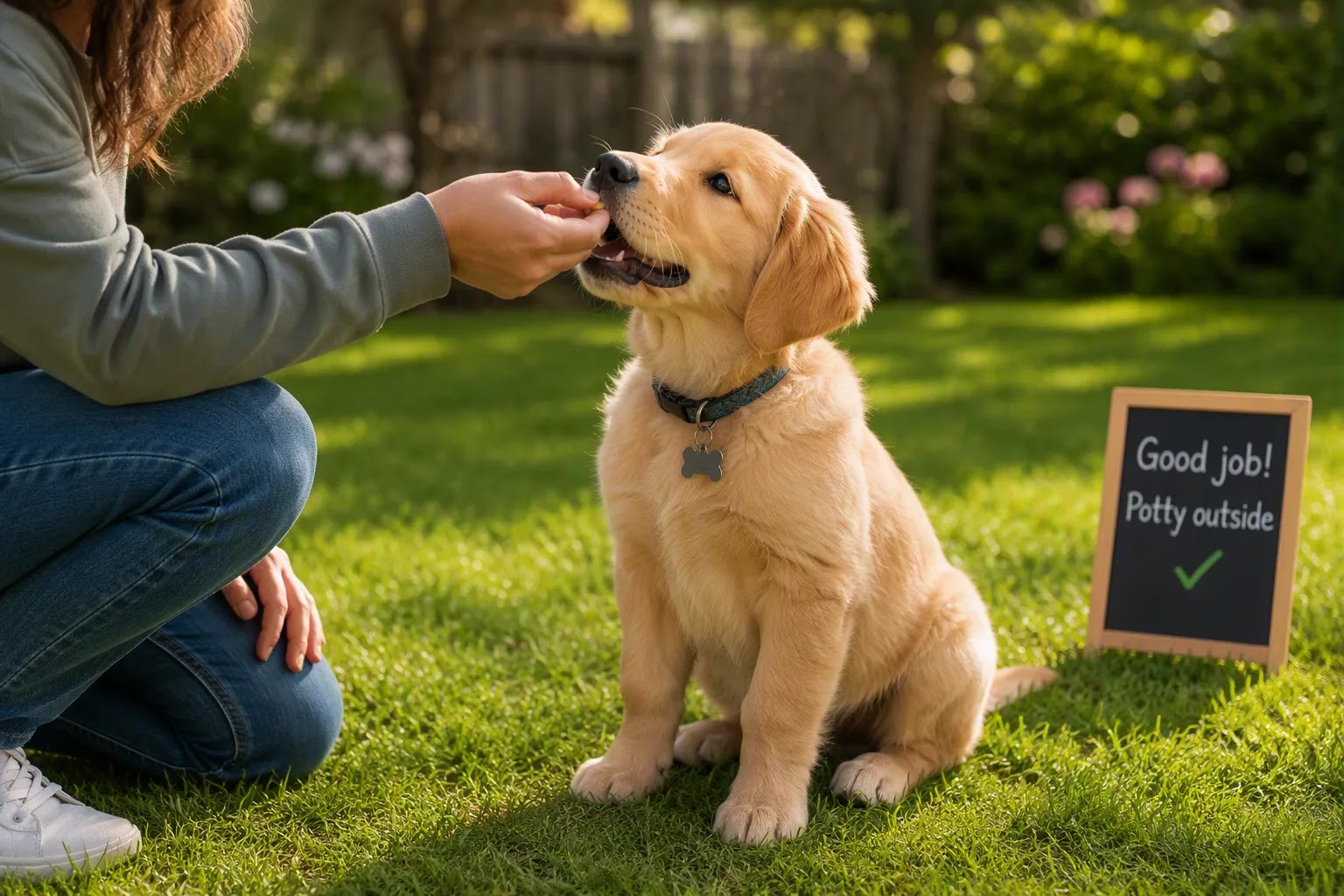
Step 3: Reward Immediately After Success
Stay outside with your puppy.
As soon as they finish urinating or defecating in the correct location, reward them.
A small treat, praise, or another valued reward can work.
The important part is timing.
Reward the potty—not the walk back inside. Keep rewards with you and deliver them immediately after your puppy finishes, while you’re still at the potty area.
Step 4: Potty First, Then Fun
For some puppies, the backyard is much more exciting than the bathroom.
A useful sequence is:
Potty → reward → then sniff, walk, or play.
This keeps the trip clear without teaching the puppy that successful elimination instantly ends outdoor fun.
Once you recognize that your puppy is about to eliminate, you can also quietly introduce a cue such as “Go potty.”
Say it near the behavior rather than repeating it continuously while nothing happens.
Step 5: Supervise Indoors
Prevention is a major part of housetraining.
When your puppy is loose indoors, know where they are.
Management may include:
- Keeping the puppy in the same room
- Using baby gates
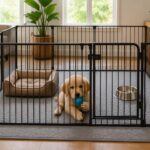
- Using an exercise pen
- Using a supervised lightweight house leash when appropriate
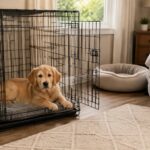
- Using a positively trained crate for suitable short periods
Potty training often succeeds before the squat. The best moment is frequently noticing that the puppy just woke up or finished playing and getting outside before an accident begins.
Step 6: Use the Crate as Management, Not Bladder Training
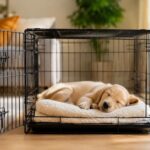
A crate can help with housetraining because many puppies prefer not to eliminate where they rest when they are physically able to wait.
But a crate cannot increase bladder capacity.
It should be large enough for your puppy to stand, turn around, lie down comfortably, and rest naturally.
Introduce it gradually and positively with food, treats, toys, and comfortable rest rather than simply locking a new puppy inside.
For a complete plan, see How to Crate Train a Puppy: 6 Calm, Humane Steps.
A crate doesn’t extend a puppy’s physical limits. If your puppy needs to eliminate, making the crate smaller or waiting longer does not remove that need. Excessive confinement can force crate soiling and make housetraining harder.
What If Your Puppy Has an Accident?
Think of an accident as information.
It may mean:
- The interval was too long
- A transition was missed
- The puppy had too much freedom
- A signal went unnoticed
- The current routine needs adjusting
If You Catch It Happening
Interrupt calmly without frightening your puppy and take them to the correct area if practical.
If they finish there, reward them.
If You Find It Later
Simply clean it.
Delayed yelling, rubbing a puppy’s nose in the accident, or dragging them back to the spot will not teach the intended lesson.
Punishment can instead teach some puppies that eliminating in front of you is unsafe, encouraging them to hide before going.
Clean Accidents Thoroughly
Use a pet-safe cleaner designed to remove urine and fecal odor from the affected material. Enzymatic pet cleaners are commonly useful for this purpose when appropriate for the surface.
Follow the product instructions and treat the full contaminated area, especially on carpet or other absorbent materials.
The goal isn’t only to make the room smell clean to you. It’s to reduce the odor information your puppy can still detect.
Do Young Puppies Need Potty Breaks at Night?
Many do.
Sleeping puppies may sometimes wait longer than they can during active daytime play, but very young puppies should not automatically be expected to stay dry all night.
If accidents occur predictably overnight, offer a quiet trip before the usual accident time.
Keep it boring:
Outside. Potty. Reward. Back to bed.
As your puppy matures and remains dry, nighttime trips can gradually decrease.
Are Puppy Pads Bad for Potty Training?
No.
A pad simply teaches that a particular indoor location and surface are acceptable for elimination.
That can be useful when outdoor access is difficult or a very young puppy cannot reasonably wait.
If your eventual goal is outdoor-only toileting, you’ll later need to deliberately transfer that preference outside.
So pads do not inevitably “confuse” puppies—they simply teach a different location than outdoor-only housetraining.
Potty Training Before Vaccinations Are Complete
Puppies need housetraining and safe early experiences before the entire vaccination series is finished.
At the same time, diseases such as canine parvovirus can persist in the environment, and exposure risk is not equal everywhere.
A clean private area used only by healthy, appropriately vaccinated household dogs is very different from a heavily used apartment relief area or dog park.
Ask your veterinarian about local disease risk. Avoid high-traffic areas used by dogs of unknown vaccination or health status while your puppy is inadequately protected, but don’t assume that complete isolation is the only safe option.
For the broader balance between disease prevention and early learning, see How to Socialize a Puppy Safely Before Vaccines Are Complete.
Food and Water Still Matter
Predictable meals can make bowel movements easier to anticipate.
Build a potty opportunity into the routine after meals rather than waiting for an accident signal.
For meal frequency and portions, see our Puppy Feeding Guide.
Do not routinely restrict daytime water simply to reduce accidents.
If your puppy suddenly begins drinking or urinating much more than usual, treat that as useful medical information rather than solving it by removing access to water.
How Long Does Potty Training Take?
There is no universal deadline.
A puppy may understand the preferred location fairly quickly while still lacking the physical maturity and reliability needed to remain accident-free in every situation.
Progress depends on age, previous living conditions, schedule, supervision, health, environment, and the individual puppy.
Increase freedom after repeated success—not because a certain number of days has passed.
If accidents return after opening more rooms or increasing unsupervised time, reduce freedom temporarily and rebuild the successful pattern.
When Accidents May Be Medical
Not every house-training setback is a training problem.
Contact your veterinarian if your puppy develops:
- A sudden major increase in urination
- Very frequent small urinations
- Straining or pain while urinating
- Blood in the urine
- Markedly increased thirst
- Persistent diarrhea
- Urine leaking during sleep or rest
- Repeated crate accidents despite appropriate frequent breaks
- A sudden return of house soiling after previously reliable training
Medical conditions can increase urine volume or urgency, make elimination painful, or reduce normal control.
Seek urgent veterinary care if your puppy repeatedly strains to urinate but produces little or no urine, becomes severely painful, markedly weak or unresponsive, repeatedly vomits, or shows another serious illness sign.
A Simple Daily Potty Routine
- Wake up: go directly to the potty area.
- Success: reward immediately while still outside.
- Meals: feed predictably, then offer another potty trip.
- Daytime: supervise and provide frequent opportunities.
- After naps, active play, and crate time: go outside again.
- Before bed: offer one calm final trip.
- Overnight: meet the physical needs of a young puppy when necessary.
If accidents keep happening at roughly the same time, move the next planned trip earlier.
For the first few days, noting meals, naps, potty trips, and accidents can help reveal a pattern. Once you know the rhythm, you don’t need to keep tracking forever.
Sources & Editorial Standards
- Merck Veterinary Manual — Housetraining and Elimination Behavior in Dogs
- Merck Veterinary Manual — House Soiling and Medical Causes
- American Veterinary Society of Animal Behavior — Housetraining Tips
- AAHA — Bringing Home a New Puppy
- AVSAB — Puppy Socialization Position Statement
- VCA Animal Hospitals — Urinary Warning Signs
Editorial note: Puppy bladder and bowel control varies substantially among individuals. This guide therefore uses activity transitions, supervision, and the puppy’s actual accident pattern rather than treating an age-based bladder formula as a fixed biological limit. Sudden regression or abnormal urination should be evaluated as a possible health problem rather than assumed to be failed training.
The Bottom Line
Your puppy doesn’t need a perfect bladder-capacity formula.
They need you to make the correct behavior easy to repeat.
Think in transitions. Go outside frequently. Stay with them. Reward immediately. Supervise indoors. Clean accidents and adjust the routine.
The fastest route to reliable housetraining isn’t asking a young puppy to hold it longer. It’s giving them fewer chances to get it wrong and many more chances to get it right.